
1,600-Year-Old Mystery To Replicate Roman Famous Lycurgus Cup – Solved
Eddie Gonzales Jr. – MessageToEagle.com – A University of Sheffield technician has successfully reproduced the remarkable color-changing effect in a famous Roman masterpiece for the first time in 1,600 years.
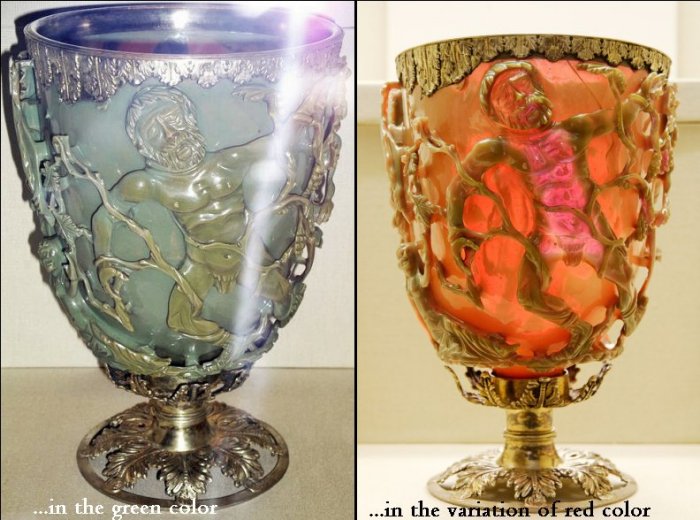
Lycurgus cup, variations of color. Image credit: British Museum
The Lycurgus Cup artifact dates back to the 4th century AD and is housed in the British Museum. It is constructed of ‘dichroic’ glass that shifts from jade green in reflected light to ruby red in transmitted light. This means that depending on where the light source is positioned, observers can see the cup displayed in two distinctive, contrasting colors.
It is one of only 40 surviving glass cage cups from the period and one of the most complete, but it is the only one exhibiting this superb visual effect. Its colors, artistry, and almost perfect condition have intrigued and confounded historians and glassmakers alike for centuries. Its exceptional colors and narrative, depicting a mythical Thracian king ensnared in vines because of his misdeeds, led to the artifact being recognized as one of the seven glass wonders of the world by an international panel of artists and conservators in 2022.
While no one knows exactly how its famous color-changing effect was created, experts believe the Romans achieved it by adding tiny amounts of gold and silver, which, under the right conditions, formed layered nanoparticles thousands of times smaller than a grain of sand. Because these nanoparticles are smaller than the wavelengths of light, they absorb light strongly and display vibrant colors depending on their size and shape.
Many have tried to reproduce this dichroic effect with varying success, but establishing a consistent, repeatable recipe has long proved elusive. After Project Manager Christina Metcalfe challenged them to replicate it for the University’s LightFest in 2025, experts from the University of Sheffield successfully reproduced the effect observed in the famous artifact, finally solving the age-old mystery.
“I’ve studied and worked with glass for over 25 years, so I used the knowledge and experience I’ve gained, coupled with a modern scientific understanding of what I was trying to achieve,” Dr Lisa Hollands, a technician from the University of Sheffield’s School of Chemical, Materials and Biological Engineering, said in the press release.
“To start with, I worked with a leading Roman glass expert, Professor Caroline Jackson, to research what was already known about glass of the time and developed a base glass using modern materials to mimic what the Romans might have used. Then came the harder part: getting small amounts of gold and silver into the glass in the right form.
“Although if the Romans could have seen me experimenting, they’d probably laugh and ask: ‘Why does she not know how to make this?'”
After many painstaking experiments with different furnace types, starting materials and oxygen levels – and even the inclusion of sugar – Dr Hollands finally hit upon a glass recipe that appeared opaque green in reflected light and red when a light was shone through it.
“The next step was to commission a piece worthy of paying homage to its illustrious predecessor,” said Molecular Photonic Breadboards Project Manager Christina Metcalfe.
“We approached Elliot Walker, one of the UK’s finest glass artists and winner of season two of Netflix’s Blown Away, who accepted the challenge and was commissioned to create a contemporary sculpture using Dr Hollands’ recipe.”
“It is a very rare thing to have the opportunity to work with glass developed from ancient mixtures and recipes, and it is always a very exciting one,” Elliot said.
“You can really get an idea of how the glass makers of the past would have adapted to this sort of glass; it’s like shaking their hands. I wanted to keep the sculpture quite classical in form and to carry through the original story of Lycurgus shown on the cup, but we needed a blown element within this to really show the dichroic glass.”
“The piece is a blend of the Lycurgus story and the Farnese Atlas sculpture, with the globe replaced by a cup.”
“We set out to create something tangible to help the public understand what is possible when these tiny nanoparticles are embedded in something. What Lisa and Elliot have achieved has surpassed all our expectations. The incredible historic narrative really captures people’s imaginations, and I like to think we’ve created something that people will marvel at for years to come,” Christina Metcalfe added.
While this specific glass will mainly have decorative applications, the scientific understanding gained will feed into new photonic materials and advanced glasses for radioactive waste management.
Written by Eddie Gonzales Jr., MessageToEagle.com Staff Writer
Related Posts
-
 Researchers Design Extreme Heat Exchanger Using Metal 3D Printing
-
 Mobile Phone Device Can Measure Food Spoilage
-
 World’s Fastest Camera Can Freeze Time And Show Light In Slow Motion
-
 Fairy Flying Robot Flies By The Power Of Wind And Light
-
 A Tensor Language Prototype For High-Performance Computers
-
 Autonomous Vehicles Learning To Drive By Mimicking Others
-
 Ions In The Machine: How Simple Liquids Like Water Can Perform Complex Calculations
-
 Using Your Smartwatch To Reduce Stress
-
 New Living Building Materials May Reduce Greenhouse Gas Emissions
-
 Researchers Developed A Soft, Stretchable And Self-Powered Thermometer

