
Fascinating Study: Deep Secrets Of Flying Snakes Revealed
MessageToEagle.com – Some snakes can fly, according to scientists who may have solved the mystery of how flying snakes stay aloft.
There are five species of paradise tree snakes Chrysopelea paradise. They have intriguing body shape and can be found in the Southeast Asian rainforest.
They have the ability to glide as much as 30m from a tall tree and their ‘slithering’ in an S-shape through the air as they descend is particularly impressive.
‘They look like they are swimming’, but what keeps the reptiles aloft? ‘They turn their whole body into one aerodynamic surface’, explains Professor Jake Socha, from Virginia Tech in the US, who carried out the study.
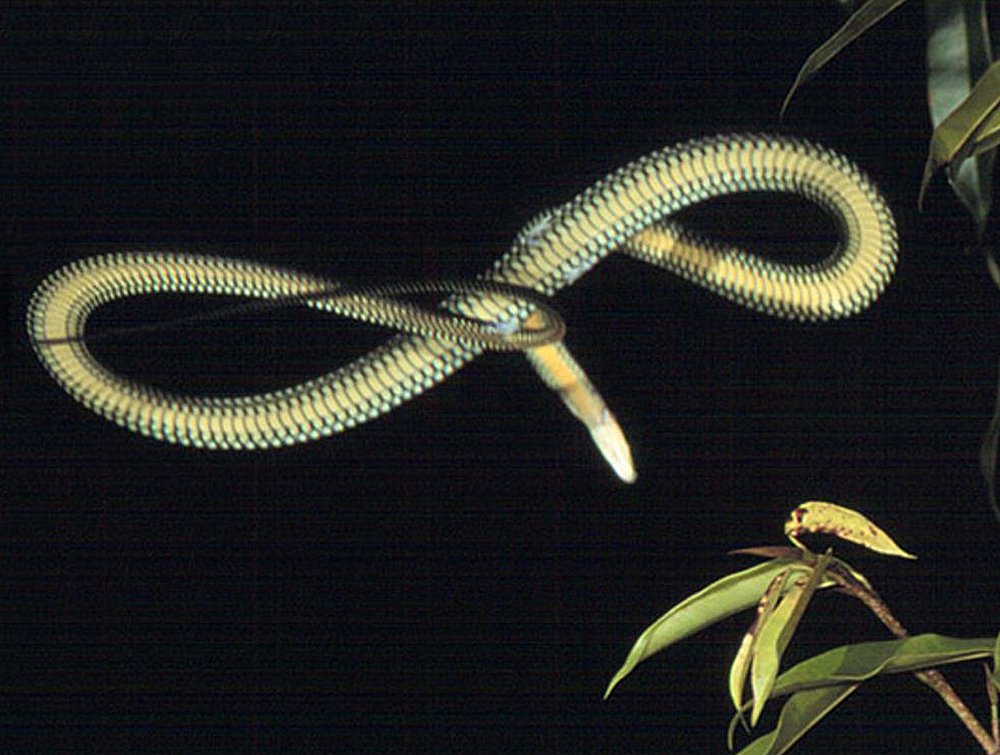
Socha and his colleagues Daniel Holden, Nicholas Cardwell and Pavlos Vlachos, discovered that the snake’s body works like an aerofoil to generate lift forces to keep them airborne.
The snakes flex their ribs as they launch to stretch and flatten the body to change their profile from a circle into an arched semi-circle, according to Socha.
‘It looks like someone’s version of a UFO’, laughs Socha, adding that as aerofoils go it’s an unconventional shape.
Trying to understand the aerodynamic forces generated by the snake’s body, the team created a plastic copy of the snake’s cross-section and placed it in a tank of flowing water.
Although water is much more dense than air, the experiment recreated the effect of air flowing over a snake’s body.
At most angles, the unusual body shape generated sufficient lift to keep the creature aloft.
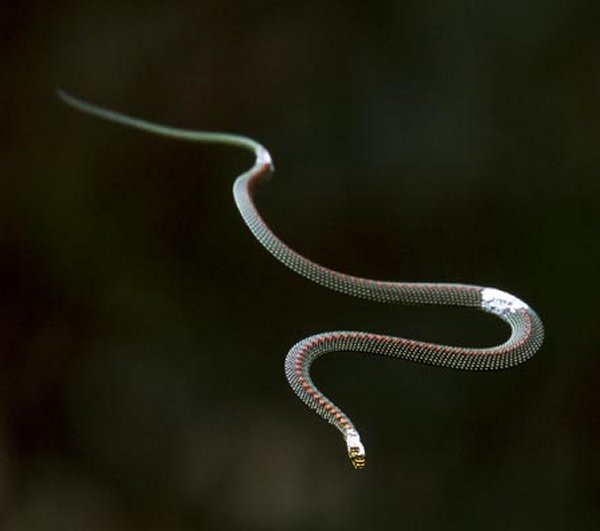
However, there is much more to the snake’s impressive glide than just its unusual body shape, Socha adds.
‘If you make a rough estimate of the lift to drag ratio for the real animal, it appears to do better than what we got from this study.”
“So even though this shape produced more lift than we were expecting, it doesn’t get us the glide performance that snakes can attain, giving us a hint that there is something in what the animal is doing aerodynamically that is not captured by the cross-sectional shape alone’ – which is the next part of the problem that Socha and his team hope to crack.
Journal Reference:
Holden, D., Socha, J. J., Cardwell, N. and Vlachos, P. P.(2014). Aerodynamics of the flying snake Chrysopelea paradisi: how a bluff body cross- sectional shape contributes to gliding performance. J. Exp. Biol.217, 382-394 doi:10.1242/jeb.100339
MessageToEagle.com
Related Posts
-
 Amazing Nature – Hidden Map Inside Plants Discovered
-
 Prehistoric Timeline In Africa Pushed Back By More Than 10 Million Years
-
 Over A Million Years Old Microbial DNA Revealed In Woolly Mammoth Teeth
-
 Migratory Birds Can Be Taught To Adjust To Climate Change – Don’t Let Them Starve
-
 Sauro-Throat: Study Finds First Evidence Indicating Sinosaur Respiratory Infection
-
 ‘Veggie’ Dinosaurs Differed In How They Ate Their Food
-
 Dinosaurs Took Over Amid Ice, Not Warmth – A New Study
-
 ‘One Of The Botanical Wonders Of The World’: Giant Waterlily Grown At Kew Gardens Named New To Science
-
 Controversial Four-Legged ‘Snake’ Is A Different Ancient Animal – Scientists Discovered
-
 First ‘Warm-Blooded’ Dinosaurs Evolved 180 Million Years Ago

