
The Iceni’s Queen Boudicca Who Revolted Against Roman Rule
A. Sutherland – MessageToEagle.com – The Iceni people were British Celts who occupied the area of modern Norfolk, Cambridgeshire and north-west Suffolk. The tribe represented a significant power in eastern Britain during Claudius’ conquest of Britain in 43 AD.
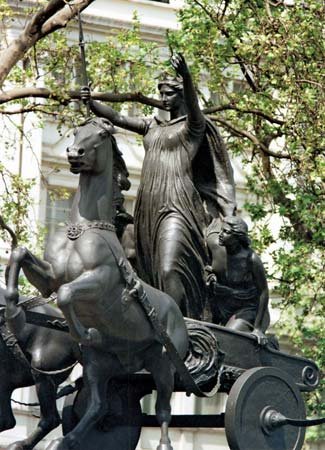
Photos.com/Jupiterimages
In 47 AD the Iceni rose in revolt after the Romans tried to enforce a law forbidding the carrying of weapons and increase Roman influence on the tribe’s affairs; their protest was put down and Prasagustas established as a client king.
Prasutagas decided that it would be wise to make his will assigning half of his personal property to the Roman emperor and so it remained.
However, when he died in 61 Ad, the situation has changed.
The king’s will was ignored, and the kingdom was annexed.
Boudica, Prasutagas’s widow and queen of the Iceni tribe, was publicly flogged, her daughters raped, and the estates of the most prominent Iceni men were confiscated.
In 61 AD, Boudicca raised the Iceni and the neighboring Trinivantes tribe in revolt against Roman rule.
She decided to destroy the invaders and she chose Londinium as a key target for her uprising. On her way to Londinium (modern London) Boudica and her army destroyed Camulodunum (modern Colchester), at that time a settlement for discharged Roman soldiers and site of a temple to the former Emperor Claudius.
Boudicca’s treatment of her enemies was brutal and she must have given the Romans a terrific scare. One legion was so terrified that they refused to move against her.
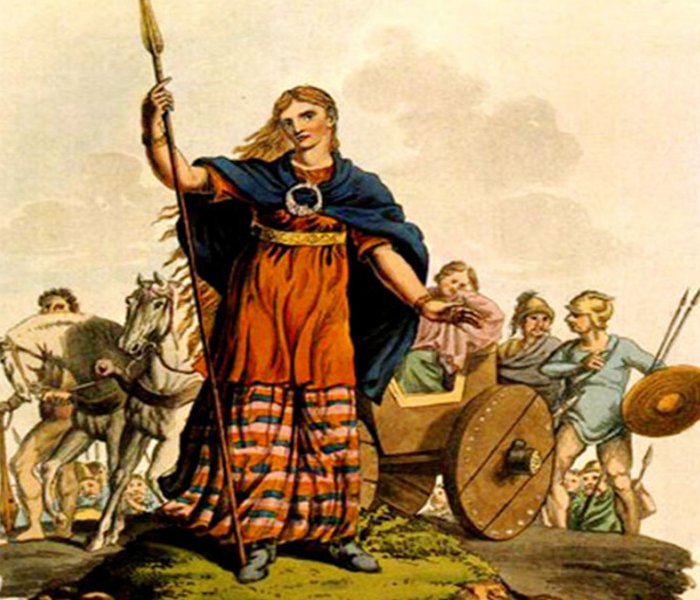
At first, the authorities were unable to prevent the advance of the Boudican revolt. Upon hearing of the revolt, Governor Gaius Suetonius Paulinus hurried from the island of Anglesey off the northwest coast of Wales to Londinium to save the city.
However, due to the lack of sufficient forces, he could not. He instead, decided to sacrifice the single city of Londinium to save the entire province and gave the signal to abandon the city as soon as possible. The inhabitants were allowed to accompany him.
 Only women, or old, or attached to the place stayed in the city.
When the Iceni reached Londinium, they pillaged and burned down the city, killing all inhabitants who had remained.
An estimated 70,000–80,000 Romans and British were killed in the three cities by those led by Boudica.
Suetonius, meanwhile, regrouped his soldiers and, despite being heavily outnumbered, defeated the Britons at the Battle of Watling Street.
The Roman historian Tacitus (56 AD – 117 AD) wrote about what Suetonius told his men before the fight:
“Ignore the racket made by these savages. There are more women than men in their ranks. They are not soldiers – they’re not even properly equipped.
We’ve beaten them before and when they see our weapons and feel our spirit, they’ll crack. Stick together. Throw the javelins, then push forward: knock them down with your shields and finish them off with your swords. Forget about plunder. Just win and you’ll have everything.”
It was only with some difficulty that the Romans managed to quell the Iceni uprising. Londinium, the thriving port growing on the banks of the River Thames was left in ruins.
At first, Boudicca’s fate was unknown, but it was later presumed that she took her own life, by taking poison, rather than fall into the hands of her enemies.
The Romans established a new capital in the Iceni lands at Caistor-by-Norwich. No record of the Iceni exists after this point, though legends suggest that large numbers fled west into Wales and eventually settled in Ireland.
By the Middle Ages, Boudica was forgotten. She was not mentioned in Venerable Bede’s work, the ‘Historia Brittonum’, the ‘Mabinogion’ or Geoffrey of Monmouth’s ‘History of the Kings of Britain’.
There is a tendency to think of Boudicca as a great patriotic leader of the British, perhaps the first national heroine.
There are also many others who do not consider her as a, particularly appealing character.
Written by – A. Sutherland – MessageToEagle.com Senior Staff Writer
Copyright © MessageToeagle.com All rights reserved. This material may not be published, broadcast, rewritten or redistributed in whole or part without the express written permission of MessageToeagle.com
Related Posts
-
 Oldest Greek Oracle At Dodona And Zeus Sacred Oak Tree
-
 Pre-Columbian Societies Declined 2,000 Years Ago Due To Sea Level Fall
-
 Mysterious Ancient Underwater Structure Beneath MacDonald Lake Reveals Traces Of A Lost Civilization In Ontario
-
 2,000-Year-Old Statue Of Priest’s Head Excavated In Laodicea On The Lycus
-
 Cave Hidden Under Pembroke Castle in Wales Could Hold Secrets Dating Back 10,000 Years
-
 Saqqara Necropolis: Biggest Archaeological Discovery In 2020 – Photos Revealed
-
 Mystery Of How Ancient Maya Accurately Predicted Solar Eclipses Solved
-
 New Unique Ancient Underwater Finds In The Ports Of Caesarea And Acre
-
 Does The Aachen Cathedral Offer Evidence Our Calendar Is ‘Missing’ 297 Years?
-
 Denisovans Or Homo Sapiens: Who Were The First To Settle Permanently On The Tibetan Plateau?

