
“Pillars Of Creation” Are Gone
MessageToEagle.com – Every time you look at the beautiful and famous image of the Pillars of Creation taken by Hubble back in 1995, you are actually admiring something that no longer exists.
In fact, the Pillars of Creation were already long gone by the time the image was captured!
Pillars of Creation refers to a photograph taken by the Hubble Telescope of elephant trunks of interstellar gas and dust in the Eagle Nebula
According to astronomers, the pillars which measure up to 4 light years in length were destroyed about 6,000 years ago by the shock wave from a supernova.
Since this is how long it takes to light to travel across such vast distances, we can currently see the shock waves approaching the pillars but we won’t actually see their destruction for another thousand years or so!
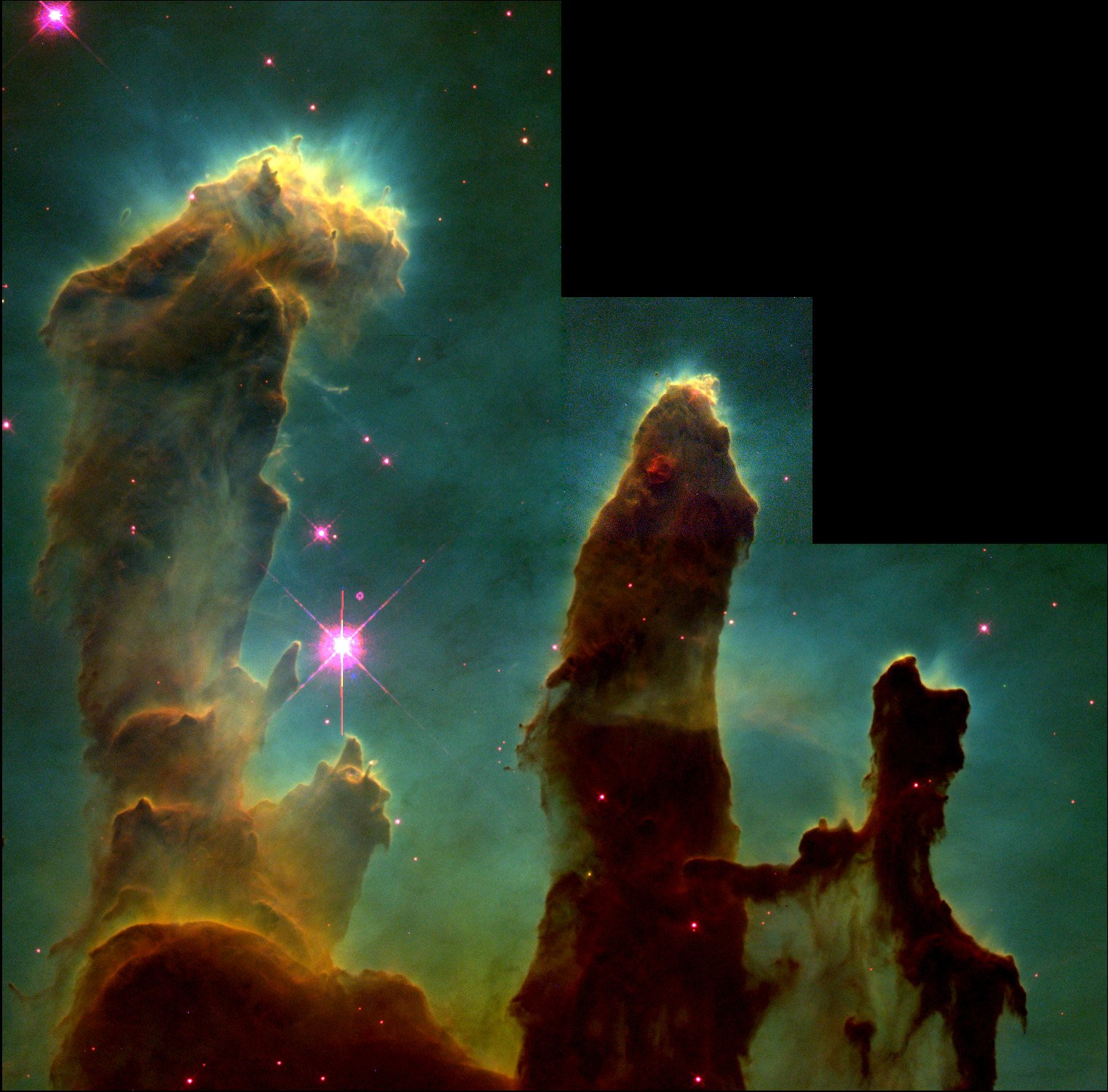
Credits: NASA/ESA/STScI, Hester & Scowen (Arizona State University)
For us, the shockwave has not reached the Pillars of Creation yet. For our senses, they are still there. In one thousand years, there will be a spectacular event in cosmos.
See also:
Get Lost In This Jaw-Dropping View Of The Eagle Nebula
Collisions Of Galaxies: Spectacular And Fascinating Celestial Fireworks
Ancient Text Reveals Sighting Of SN 1006 – Brightest Supernova Ever Observed
The shockwave will arrive to the Pillars of Creation and, just like they were created, they will be destroyed once again, obliterated by the force of a dead star.
Will we then remember that this show actually already happened a very long time ago?
Perhaps, not. Perhaps we will simply just admire the destruction of the Pillar of Creation, just as we today keep admiring Hubble’s beautiful photograph of something that does not longer exists.
The Universe can be just as mind-boggling as the vast distances which prevent us from seeing objects in real-time.
MessageToEagle.com
Related Posts
-
 God Didn’t Create The Universe – Physicists Report New Shocking Discovery
-
 First-Ever Image Of A Sun-Like Star Accompanied By Two Exoplanets – Captured
-
 Nearest Exoplanets Could Host Life
-
 NASA’s Swift, Fermi Missions Detect Exceptional Cosmic Blast
-
 “Celestial Superhighway” To Travel Through The Solar System – Discovered
-
 Aging Stellar Goliath VY Canis Majoris Caught In Act Of Slimming Down
-
 Hubble Space Telescope Fixed After Month Of No Science
-
 Radio Signals From Distant Stars Suggest Hidden Planets
-
 Scientists Fling Model Stars At A Virtual Black Hole To See Who Survives
-
 Measuring The Universe With Star-Shattering Explosions

