
The Kuiper Cliff Mystery – Why Does The Kuiper Belt Suddenly End?
Kevin Montana – MessageToEagle.com – Located in an area of the outer solar system, just beyond the orbit of Neptune the Kuiper Belt contains hundreds of thousands of icy bodies.
This is a rather unexplored region of space and the Kuiper Belt provides an intriguing cosmic mystery. For some unknown reason, it abruptly ends roughly about 50 astronomical units from the Sun.
This is puzzling because theoretical models predict an increase in number of icy bodies. Instead, the rocks stop. The drop off is so dramatic, that the feature of nothingness that exists outside the Kuiper Belt has been nicknamed the Kuiper Cliff.
In 1950, astronomer Gerard Kuiper predicted the existence of the Kuiper Belt. Proof of his discovery came 18 years later.
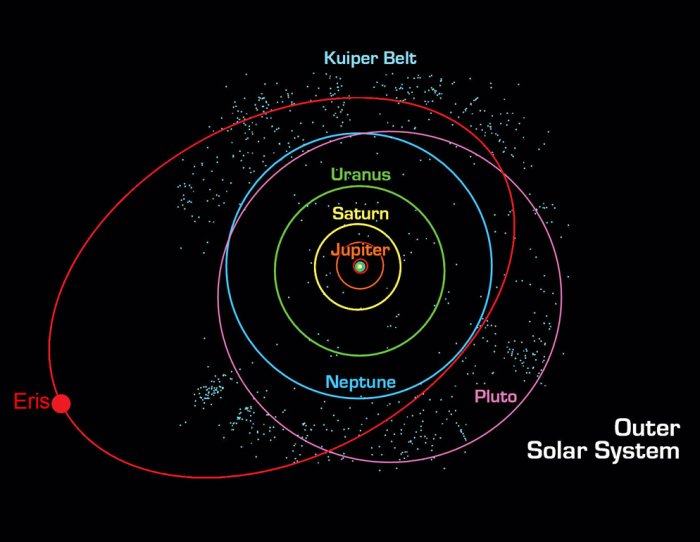
The Kuiper Belt (named after Kuiper) extends from about 30 to 55 AU and is probably populated with hundreds of thousands of icy bodies larger than 100 km (62 miles) across and an estimated trillion or more comets. Pluto and three other dwarf planets reside in the Kuiper Belt. Since the discovery of the Kuiper Belt we have learned a lot about Kuiper Belt Objects, but there are still questions we cannot answer, not yet at least.
Why Does The Kuiper Belt Suddenly End?
The most controversial theory suggests that a lurking planetary body the size of Earth or Mars has swept up the objects gravitationally, creating the Kuiper Cliff.
See also:
Planet X: Four Candidates For Planet X Located And Examined
Was Mysterious Planet 9 Stolen By Our Sun 4.5 Billion Years Ago?
Mystery Of Planet V – Was There Once A 5th Planet Between Mars And The Asteroid Belt?
Supporters of this theory state this is evidence of the mythical Planet X or Planet 9 that astronomers are still trying to find. Some years ago, astronomers ran several simulations, and discovered that a small planet, around half the size of the Earth could have formed inside Neptune’s orbit. It could have been tossed into a bigger orbit by Neptune, and then knocked around the orbits of the ice balls, distorting their orbits and creating the Kuiper Cliff.
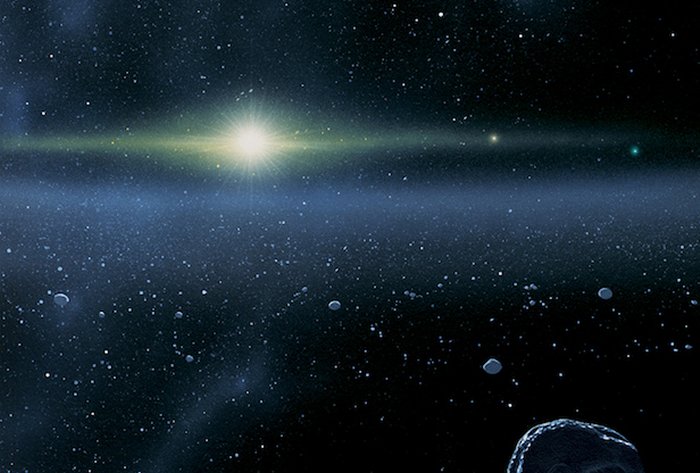
Scientists are trying to solve the Kuiper Cliff mystery.
The birth of this hypothetical planet could have occurred during a time when there was plenty of material in the early solar system.
Another theory, perhaps less exciting but nevertheless plausible, is that the Kuiper Belt does not end abruptly at all. There could still be objects in the region, but they are so small that we cannot observe them.
The cause of the Kuiper Cliff remains unknown.
Written by Kevin Montana – MessageToEagle.com Staff Writer
Copyright © MessageToEagle.com. All rights reserved. This material may not be published, broadcast, rewritten or redistributed in whole or part without the express written permission of MessageToEagle.com
Expand for referencesRelated Posts
-
 Seasons On A Planet Outside Our Solar System – New Insights
-
 Ring-Like Formations Around Titan’s Lakes Explored By Cassini
-
 Cycle Of Spectacular Disturbances At Jupiter’s Equator – Identified
-
 Slowest Ever Pulsar Star Located In Constellation Cassiopeia Discovered By LOFAR
-
 Universe Is Nearly 14 Billion Years Old – Astronomers Suggest
-
 Astronomers Use Giant Galaxy Cluster As X-Ray Magnifying Lens
-
 Enceladus: Inner Complexity Of Saturn Moon Fascinates
-
 How Planets May Be Seeded With The Chemicals Necessary For Life
-
 Moon Rocks Sent There From Earth By Ancient Asteroid – New Study Suggests
-
 Earth’s Atmosphere Stretches Almost Twice The Distance To the Moon And Beyond

