
Astronomers Listen For Signs Of Intelligent Life From Unusual `Oumuamua Asteroid
MessageToEagle.com – Astronomers used the Murchison Widefield Array (MWA) telescope to listen to a mysterious cigar-shaped object that entered our Solar System late last year.
The unusual object—known as ‘Oumuamua—came from another solar system, prompting speculation it could be an alien spacecraft. While they did not find any signs of intelligent life, the research helped expand the search for extra-terrestrial intelligence (SETI) from distant stars to objects closer to home.
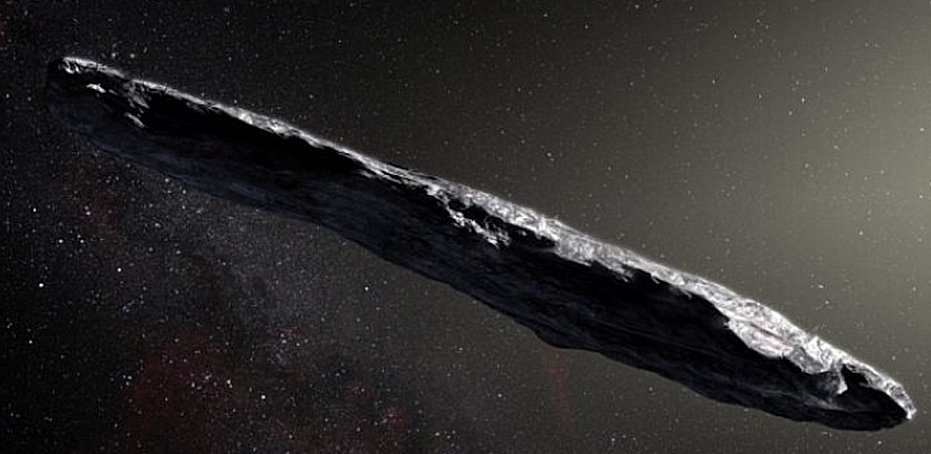
‘Oumuamua was first discovered by the Pan-STARRS project at the University of Hawaii in October and astronomers thought it was a comet or an asteroid from within the Solar System. But after studying its orbit and discovering its long, cylindrical shape, they realized ‘Oumuamua was neither and had come from interstellar space. Its name loosely means “a messenger that reaches out from the distant past” in Hawaiian, and is the first known interstellar object to pass through our Solar System.
Telescopes around the world trained their gaze on the mysterious visitor in an effort to learn as much as possible before it headed back out of the Solar System, becoming too faint to observe in detail.
See also:
Cucumber-Shaped Asteroid ‘Oumuamua’ Had A Violent Past – Researchers Say
‘Oumuamua With Highest Eccentricity Ever Observed, Originates From Binary Star System
“We didn’t set out to observe this object with the MWA but because we can see such a large fraction of the sky at once, when something like this happens, we’re able to go back through the data and analyse it after the fact,” said Professor Steven Tingay who works for the International Centre for Radio Astronomy Research at Curtin University.
“If advanced civilizations do exist elsewhere in our galaxy, we can speculate that they might develop the capability to launch spacecraft over interstellar distances and that these spacecraft may use radio waves to communicate.”
“Whilst the possibility of this is extremely low, possibly even zero, as scientists it’s important that we avoid complacency and examine observations and evidence without bias.”
“We found nothing, but as the first object of its class to be discovered, `Oumuamua has given us an interesting opportunity to expand the search for extra-terrestrial intelligence from traditional targets such as stars and galaxies to objects that are much closer to Earth, Professor Tingay said.
“This also allows for searches for transmitters that are many orders of magnitude less powerful than those that would be detectable from a planet orbiting even the most nearby stars.”
Combining observations from a host of telescopes, scientists have determined that `Oumuamua is most likely a cometary fragment that has lost much of its surface water because it was bombarded by cosmic rays on its long journey through interstellar space.
There could be more than 46 million similar interstellar objects crossing the Solar System every year but they are too far away to study with current technologies, only telescopes such as the Square Kilometre Array (SKA) will enable scientists to observe and better understand these far away interstellar objects.
MessageToEagle.com
Related Posts
-
 Moon Rocks Sent There From Earth By Ancient Asteroid – New Study Suggests
-
 Cosmic Danger – A Supernova Within 50 Light Years Would Kill Life On Earth
-
 Surprise Kilonova Upends Established Understanding Of Long Gamma-Ray Bursts
-
 A ‘Break’ In One Of The Milky Way’s Spiral Arms – Spotted
-
 Stars Memorize Rebirth Of The Milky Way
-
 Tycho Supernova: Death Of A Star – Tycho’s New Star Was Not New At All
-
 New Exoplanet Found In ‘Habitable Zone’ Of Taurus Constellation
-
 Supermassive Black Hole Caught Hiding In A Ring Of Cosmic Dust
-
 Tiny Galaxy With Big Star Power – Discovered
-
 Tiny Galaxy With Big Heart Observed By Hubble Space Telescope

