
Astronomers Use Giant Galaxy Cluster As X-Ray Magnifying Lens
Eddie Gonzales Jr. – MessageToEagle.com – Astronomers have used a massive cluster of galaxies as an X-ray magnifying glass to peer back in time, to nearly 9.4 billion years ago. In the process, they spotted a tiny dwarf galaxy in its very first, high-energy stages of star formation.
While galaxy clusters have been used to magnify objects at optical wavelengths, this is the first time scientists have leveraged these massive gravitational giants to zoom in on extreme, distant, X-ray-emitting phenomena.
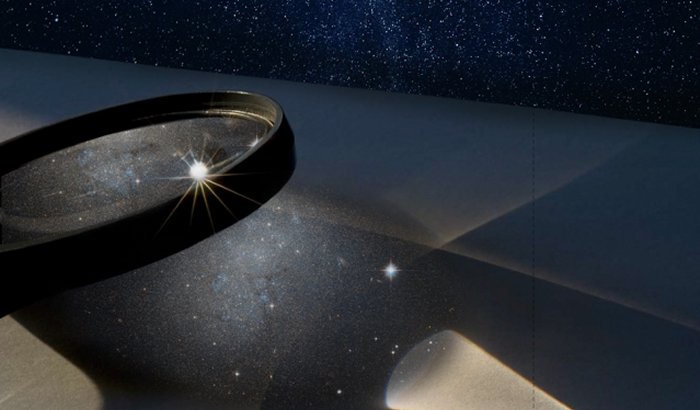 Researchers have for the first time used a massive cluster of galaxies as a huge magnifying lens to detect a small, star-forming dwarf galaxy. Image credit: MIT
Astronomers detected a blue speck of an infant galaxy, about 1/10,000 the size of our Milky Way, in the midst of churning out its first stars—supermassive, cosmically short-lived objects that emit high-energy X-rays, which the researchers detected in the form of a bright blue arc.
“It’s this little blue smudge, meaning it’s a very small galaxy that contains a lot of super-hot, very massive young stars that formed recently,” Matthew Bayliss, a research scientist in MIT’s Kavli Institute for Astrophysics and Space Research, said in a press release.
“This galaxy is similar to the very first galaxies that formed in the universe … the kind of which no one has ever seen in X-ray in the distant universe before.”
Bayliss says the detection of this single, distant galaxy is proof that scientists can use galaxy clusters as natural X-ray magnifiers, to pick out extreme, highly energetic phenomena in the universe’s early history.
Scientists have used galaxy clusters as cosmic magnifying glasses, with a technique known as gravitational lensing. The idea is that if scientists can approximate the mass of a galaxy cluster, they can estimate its gravitational effects on any surrounding light, as well as the angle at which a cluster may deflect that light.
The light emitted by that object would travel straight toward the cluster, then bend around the cluster. It would continue traveling toward the observer, though at slightly different angles, appearing to the observer as mirrored images of the same object, which in the end can be combined as a single, “magnified” image.
In this research (published in the journal Nature Astronomy), astronomers found a way to subtract the X-ray emissions of the galaxy cluster and then they identified two similar patterns of X-ray emissions around the cluster. Those two emissions, gravitationally bent by the cluster, can be traced back to a single, tiny dwarf galaxy from 9.4 billion years ago, when the universe itself was only about 4.4 billion years old.
The combination of Chandra and the Phoenix cluster’s natural lensing power enabled the team to see the tiny galaxy hiding behind the cluster, magnified about 60 times. At this resolution, they were able to zoom in to discern two distinct clumps within the galaxy, one producing many more X-rays than the other.
“Every galaxy had to start out in this phase, but we don’t see a lot of these kinds of galaxies in our own neighborhood,” said Bayliss. “Now we can go back in time, look in the distant universe, find galaxies in this early phase of their life and start to study how star formation is different there.”
Written by Eddie Gonzales Jr. – MessageToEagle.com Staff
Related Posts
-
 Why Do We See The Man In The Moon?
-
 Unexpected Effect Of Black Holes Beyond Their Own Galaxies
-
 Comet ATLAS May Have Been A Blast From The Past
-
 New Horizons’ Evocative Farewell Glance at Ultima Thule
-
 Largest Cosmic Explosion Ever Witnessed Revealed By Astronomers
-
 Astronomers Probe The ‘Cosmic Web’ Of The Universe
-
 Earth’s Magnetic Shield Vibrates Like A Drum When Hit By Impulses
-
 Distant Galaxy eMACSJ1341-QG-1 Found Thanks To Huge Magnification
-
 First-Ever Detection Of Gas In A Circumplanetary Disk
-
 Scientists Help Probe Dark Energy By Testing Gravity

