MessageToEagle.com

Menu
  • Home
  • All Science
  • Astronomy
  • Physics
  • Earth
     
  • Technology
  • Ancient World

Life On Mars Search Could Be Misled By False Fossils, Study Says

MessageToEagle.com | November 22, 2021 | Astronomy | No Comments

Eddie Gonzales Jr. – MessageToEagle.com – Mars explorers searching for signs of ancient life could be fooled by fossil-like specimens created by chemical processes, research suggests.
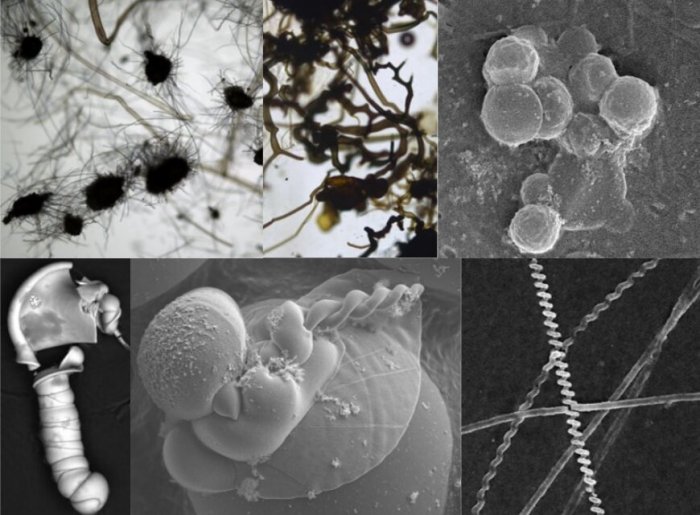
Rocks on Mars may contain numerous types of non-biological deposits that look similar to the kinds of fossils likely to be found if the planet ever supported life, a study says.

Composite image showing some of the types of fossil-like specimens created by chemical reactions that could be found on Mars. Credit: Sean McMahon, Julie Cosmidis and Joti Rouillard

Composite image showing some of the types of fossil-like specimens created by chemical reactions that could be found on Mars. Credit: Sean McMahon, Julie Cosmidis and Joti Rouillard

Telling these false fossils apart from what could be evidence of ancient life on the surface of Mars—which was temporarily habitable four billion years ago—is key to the success of current and future missions, researchers say.

Astrobiologists from the Universities of Edinburgh and Oxford reviewed evidence of all known processes that could have created lifelike deposits in rocks on Mars.

They identified dozens of processes—with many more likely still undiscovered—that can produce structures that mimic those of microscopic, simple lifeforms that may once have existed on Mars.

Among the lifelike specimens, these processes can create are deposits that look like bacterial cells and carbon-based molecules that closely resemble the building blocks of all known life.

Because signs of life can be so closely mimicked by non-living processes, the origins of any fossil-like specimens found on Mars are likely to be very ambiguous, the team says.

They call for greater interdisciplinary research to shed more light on how lifelike deposits could form on Mars, and thereby aid the search for evidence of ancient life there and elsewhere in the solar system.

The research is published in the Journal of the Geological Society.

Dr. Sean McMahon, Chancellor’s Fellow in Astrobiology at the University of Edinburgh’s School of Physic and Astronomy, said: “At some stage a Mars rover will almost certainly find something that looks a lot like a fossil, so being able to confidently distinguish these from structures and substances made by chemical reactions is vital.

For every type of fossil out there, there is at least one non-biological process that creates very similar things, so there is a real need to improve our understanding of how these form.”

Julie Cosmidis, Associate Professor of Geobiology at the University of Oxford, said: “We have been fooled by life-mimicking processes in the past. On many occasions, objects that looked like fossil microbes were described in ancient rocks on Earth and even in meteorites from Mars, but after deeper examination they turned out to have non-biological origins.

This article is a cautionary tale in which we call for further research on life-mimicking processes in the context of Mars, so that we avoid falling into the same traps over and over again.”

Study published in Journal of the Geological Society, 2021; jgs2021-050 DOI: 10.1144/jgs2021-050

Written by Eddie Gonzales Jr. MessageToEagle.com Staff

Related Posts

  • The image is an illustration made by Amanda Smith of the 193cm telescope at the Observatoire de Haute-Provence which was used for this research. This was the telescope that discovered the first exoplanet, 51 Pegasi b, which led to the Nobel Prize in Physics in 2019. In the sky the Kepler-16 circumbinary planet system is represented, along with a depiction of the field of view of NASA's Kepler spacecraft. Credit: Amanda Smith ‘Tatooine-Like’ Exoplanet Spotted By Ground-Based Telescope
    No Comments | Feb 25, 2022
  • An SwRI-led team studied the craters and geology on Pluto and Charon and found there were fewer small craters than expected. This implies that the Kuiper Belt contains relatively small numbers of objects less than 1 mile in diameter. Imaged by New Horizon's LORRI camera, the smooth, geologically stable 'Vulcan Planitia' on Charon illustrates these findings. Credit: NASA/JHUAPL/LORRI/SwRI Charon Shows Small Kuiper Belt Objects Surprisingly Rare
    No Comments | Mar 4, 2019
  • The oldest supermassive black hole storm that blew 13.1 billion years ago Earliest Gigantic Black Hole Storm Discovered By ALMA
    No Comments | Jun 13, 2021
  • Swift’s X-Ray Telescope captured the afterglow of GRB 221009A about an hour after it was first detected. The bright rings form as a result of X-rays scattered from otherwise unobservable dust layers within our galaxy that lie in the direction of the burst. Credits: Credit: NASA/Swift/A. Beardmore (University of Leicester) NASA’s Swift, Fermi Missions Detect Exceptional Cosmic Blast
    No Comments | Oct 17, 2022
  • The galaxy UGC 5101 contains an active nucleus (AGN), a compact core that emits copious radiation and possible stimulates star formation. In this Hubble image, the tidal tail at the left suggests that the galaxy is actually a merging pair of galaxies. Astronomers studying how AGN influence their host galaxy's development have concluded that both grow together. NASA, ESA, the Hubble Heritage Team; STScI/AURA)-ESA/Hubble Collaboration and A. Evans University of Virginia, Charlottesville/NRAO/Stony Brook University 323 Galaxies Examined: AGN And Star Formation – It Appears Both Grow Together
    No Comments | Oct 17, 2018
  • Hubble Inspects Two Galaxies Connected By A Luminous Bridge Hubble Inspects Two Galaxies Connected By A Luminous Bridge
    No Comments | Nov 9, 2022
  • Credit: Villanova University Icy Barnard b Super-Earth Planet May Harbor Primitive Life If Geothermal Activity Exists
    No Comments | Jan 18, 2019
  • This artist’s rendering shows the asteroid (above) and the planet Mercury (below). Credit: CTIO/NOIRLab/NSF/AURA/J. da Silva Fastest Orbiting Asteroid – Discovered
    No Comments | Aug 25, 2021
  • Artist representation of a black hole. The bottom half of the image depicts the black hole which, according to general relativity, traps everything including light. Effects based on loop quantum gravity, a theory that extends Einstein’s general relativity using quantum mechanics, overcome this tremendous pull and liberate everything (top half of image), thus providing a concrete avenue for recovery of information previously thought to be lost in the black hole singularity. IMAGE: A. CORICHI AND J. P. RUIZ Beyond The Black Hole Singularity
    No Comments | Dec 31, 2018
  • A new study led by University of Maryland astronomers documented six sleepy, low-ionization nuclear emission-line region galaxies (LINERs; left) suddenly transforming into blazing quasars (right), home to the brightest of all active galactic nuclei. The researchers suggest they have discovered an entirely new type of black hole activity at the centers of these six LINER galaxies. Credit: (Left; infrared & visible light imagery): ESA/Hubble, NASA and S. Smartt (Queen's University Belfast); (Right; artist's concept): NASA/JPL-Caltech Six Galaxies Undergoing Sudden, Dramatic Transitions – New Observations
    No Comments | Sep 19, 2019

Follow Us

On This Day In History: William Laud Archbishop Of Canterbury Beheaded – On Jan 10, 1645

On This Day In History: William Laud Archbishop Of Canterbury Beheaded – On Jan 10, 1645

Latest From Message To Eagle

  • A Clever Quantum Trick That Allows For Making A Nanoscale Mirror That Can Be Turned On And Off At Will
  • CfA Scientists Detect ‘Wake’ Of Betelgeuse’s Elusive Companion Star
  • Cloud-9: A New Celestial Object Found By Hubble
  • Naturally Occurring “Space Weather Station” And Habitability Of Planets Orbiting M Dwarf Stars – Study
  • Melting Ice Sheets: Ancient Antarctica Reveals A ’One–Two Punch’ Behind Ice Sheet Collapse
  • Red Giant Star R Doradus: Stardust Study Resets How Life’s Atoms Spread
  • Researchers Study Ice Sheet Dynamics In East Antarctica – Look At The East AntarcticIce Sheet’s History
  • Rare Book Of Nicolaus Copernicus Discovered At Lund University, Sweden

Library of Ancient & Unexplained Mysteries

Library of Ancient & Unexplained Mysteries

Latest Archaeology News

Latest Archaeology News

Recommended books:

A Clever Quantum Trick That Allows For Making A Nanoscale Mirror That Can Be Turned On And Off At Will

A Clever Quantum Trick That Allows For Making A Nanoscale Mirror That Can Be Turned On And Off At Will

CfA Scientists Detect 'Wake' Of Betelgeuse’s Elusive Companion Star

CfA Scientists Detect ‘Wake’ Of Betelgeuse’s Elusive Companion Star

Cloud-9: A New Celestial Object Found By Hubble

Cloud-9: A New Celestial Object Found By Hubble

Naturally Occurring "Space Weather Station" And Habitability Of Planets Orbiting M Dwarf Stars - Study

Naturally Occurring “Space Weather Station” And Habitability Of Planets Orbiting M Dwarf Stars – Study

Melting Ice Sheets: Ancient Antarctica Reveals A ’One–Two Punch’ Behind Ice Sheet Collapse

Melting Ice Sheets: Ancient Antarctica Reveals A ’One–Two Punch’ Behind Ice Sheet Collapse

Stardust Study Resets How Life’s Atoms Spread

Red Giant Star R Doradus: Stardust Study Resets How Life’s Atoms Spread

© 2026 MessageToEagle.com.
  • Privacy And Cookies Policy