
Fossil From Spain Shows What The Skin And Color Patterns Of Crocodiles Looked Like 125 Million Years Ago
Eddie Gonzales Jr. – MessageToEagle.com – The soft tissues preserved in Montsecosuchus depereti, a Lower Cretaceous crocodylomorph from the Pedrera de Meià site in the province of Lleida (Catalonia, Spain), are described in detail for the first time in a new study.
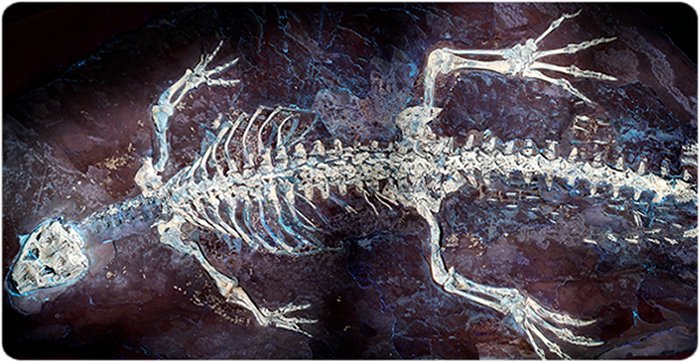
Image credit: Institut Català de Paleontologia Miquel Crusafont.
The analysis, based on ultraviolet light, provides new keys to the coloration in these animals, as well as regarding the evolution of the respiratory system. The research has been led by the Institut Català de Paleontologia Miquel Crusafont.
Approximately 125 million years ago, a small crocodile died in the waters of a karstic lake near the coast of what is now the Catalan Pre-Pyrenees. Its body was preserved in exceptional conditions among the fine sediments of that lacustrine basin, which over time would become the lithographic limestones of the Pedrera de Meià, within the UNESCO Orígens Global Geopark.
The specimen, about 50 centimeters long, cataloged as MGB-512 and kept at the Museum of Natural Sciences of Barcelona, was discovered more than a century ago and partially studied in the 90s, but now a research team has managed to extract unprecedented information: the morphology and distribution of its soft tissues.
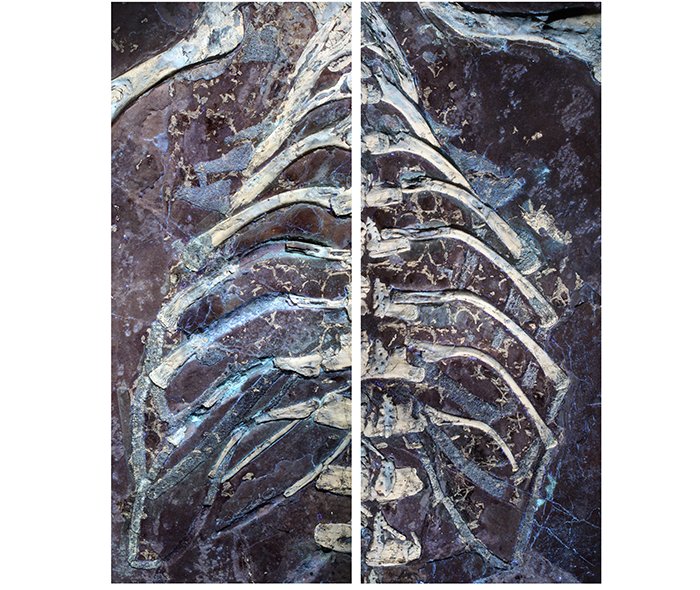
Detail of the rib cage of the specimen where exceptionally preserved soft tissues have been identified. The highlighted structures (in bluish tones) correspond to remains of cartilage associated with the ventral ribs (adapted from Castillo-Visa, O. et al).
During the work to create a database of the fossils from the lithographic limestones of Montsec deposited in various Catalan and European museums, paleontologists Oscar Castillo and Jesús Serrano realized that the holotype of Montsecosuchus depereti showed structures that could correspond to soft tissues of this animal when exposed to ultraviolet light. Under this light, key to this study, the fossilized tissues stand out differently from the rock that surrounds them.
This makes it possible to see structures that go unnoticed under normal light.
“UV light allows us to see details that would otherwise remain completely hidden in the rock,” explains Oscar Castillo-Visa, first author of the work.
Thanks to this method, the research team has been able to document various types of soft tissues, including epidermal scales. Although the species has been known since the beginning of the 20th century, this new study has allowed describing for the first time what the skin of this primitive crocodile was like, showing a great variability in the shapes and sizes of the scales along the body or the absence of the high caudal fin typical of current crocodiles.
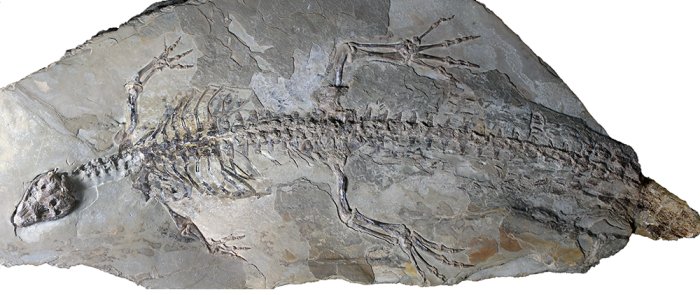
The original fossil skeleton of Montsecosuchus photographed with conventional light (adapted from Castillo-Visa, O. et al).
The study also points to the possible presence of sensory organs in the skin, in some scale inclusions, especially on the neck, limbs, and lateral margins of the trunk and tail. In today’s crocodiles, these organs function as receptors for touch and variations in water pressure, and can also respond to thermal and chemical stimuli. The fact that in Montsecosuchus they appear exclusively in small and peripheral scales could indicate that these structures initially evolved in localized areas before spreading across the entire body surface in later lineages.
Ultraviolet light has also revealed cartilaginous structures in the thorax, indicating that Montsecosuchus already had an efficient respiratory system, similar in some aspects to that of modern crocodiles. All this suggests that, even at an early stage of the group’s evolution, some crocodylomorphs already had a very sophisticated thoracic anatomy.
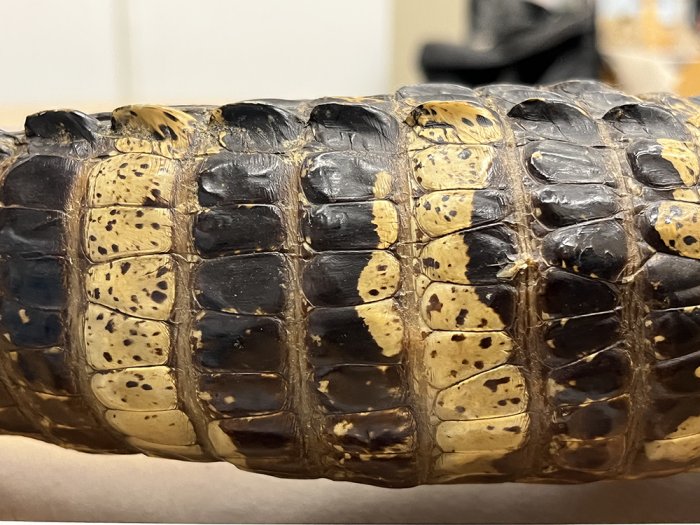
Detail of the tail of a specimen of Alligator mississippiensis from the collections of the Museum of Natural Sciences of Barcelona showing different coloration bands (Photo: Óscar Castillo)
“These traits indicate that, despite being a primitive animal, it was already very well adapted to a semi-aquatic lifestyle,” concludes Castillo-Visa.
But the most surprising find is the evidence of a coloration pattern preserved on the tail. In some scales of the caudal area, UV light makes visible light and dark bands arranged transversely, a pattern that researchers interpret as the original coloration of the animal. These bands could have had a disruptive camouflage function, helping to visually break up the body’s silhouette. If this interpretation is confirmed, Montsecosuchus would become the oldest member of the crocodylomorphs with preserved coloration.
“At the moment we cannot say for sure what color the crocodile’s tail was, but it would be expected that it was not so different from current species, which also show different coloration patterns,” explains Albert G. Sellés, co-author of the article.
The results of the study provide key information about the early evolution of the skin, respiration, and external biology of crocodylomorphs, and demonstrate the importance of the Catalan fossil record for understanding the evolutionary history of vertebrates.
In addition to Oscar Castillo-Visa and Albert G. Sellés, Àngel Galobart (Institut Català de Paleontologia Miquel Crusafont and director of the Conca-Dellà Museum) and Phil Bell from the University of New England participated in the research.
The research has been mainly funded by the VEBPI, PLEC2021-007903, and ARQ001SOL-173-2022 projects, with support from the Ministry of Science, Innovation and Universities, the NextGenerationEU/PRTR program, the Department of Culture of the Generalitat de Catalunya, and the CERCA program.
Written by Eddie Gonzales Jr. – MessageToEagle.com Staff Writer
Related Posts
-
 ‘Extremely Rare Event’: Bone Analysis Suggests Ancient Echidnas Lived In Water
-
 Plants That Survived Dinosaur Extinction Pulled Nitrogen From Air – Study
-
 Rare Giant Dinosaur Footprints Discovered On The Isle Of Skye, Scotland
-
 New Spinosaurid Dinosaur Found In Spain
-
 500-Million-Year-Old Fossil Represents Rare Discovery Of Ancient Animal In North America
-
 Last Supper Of 15-Million-Year-Old Freshwater Fish
-
 500-Million-Year-Old Sea Worm Named After ‘Dune’ Monster Was Unknown To Science Until Now
-
 New Species Of Stegosaur Is Oldest Discovered In Asia, And Possibly The World
-
 Oldest And Never-Before-Seen Bat Species Lived In Wyoming 52 Million Years Ago – Fossils Reveal
-
 New Pieces Link Fish Puzzle – A New Study

