
Hidden Structures Around The Orion Nebula – New Radio Observations
Eddie Gonzales Jr. – MessageToEagle.com – Using the Karl G. Jansky Very Large Array (VLA) in the United States and the Five-hundred-meter Aperture Spherical Radio Telescope (FAST) in China, researchers led by Juan Diego Soler at the University of Vienna uncovered previously hidden structures within the Orion Nebula.
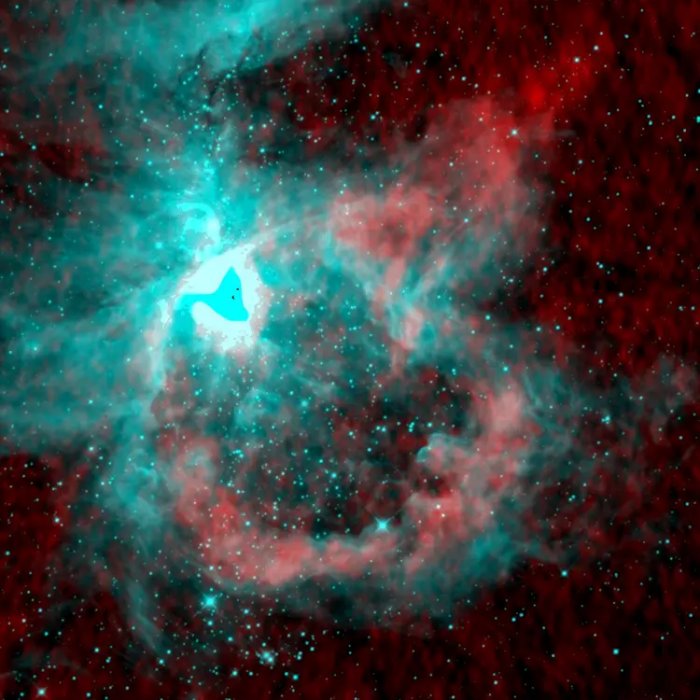
Radio emission from neutral hydrogen atoms in the direction of the Orion Nebula, the most nearby regions of high-mass star formation. Image credit: Juan D. Soler, University of Vienna, with data from the NRAO’s Jansky VLA and NASA’s Wide-field Infrared Survey Explorer (WISE).
The combined observations produced the sharpest maps ever made of neutral hydrogen in that region of massive star formation. The findings expose the complex relationship of star-forming regions with their environment and suggest that the Orion Nebula has been shaped by multiple episodes of stellar feedback rather than a single expanding bubble.
The Orion Nebula is one of the most familiar objects in the night sky. Visible even to the naked eye, it has been studied for centuries and observed with nearly every modern astronomical instrument. Yet astronomers have now discovered that one of its most important components had remained largely hidden.
Using cutting edge some of the world’s most powerful radio telescopes, an international team led by Juan Diego Soler at the University of Vienna has produced the sharpest maps ever made of neutral atomic hydrogen in the Orion Nebula. The observations reveal giant expanding shells, previously unseen cavities, and mysterious elongated structures surrounding the nearest region of massive star formation to Earth.
Hydrogen is the most abundant element in the Universe. In its neutral atomic form, it emits faint radio waves at a wavelength of 21 centimeters, allowing astronomers to trace otherwise invisible gas between the stars.
Complex shell structure
Previous studies suggested that the shell surrounding Orion contains around one thousand times the mass of the Sun. The new hydrogen observations indicate a mass nearly ten times lower. “Measuring mass is fundamental,” Soler says, “because it tells us about the efficiency of these newly formed stars shaping their environment with wind and radiation.”
The new maps also reveal what appears to be a second expanding cavity inside the main shell, along with an elongated “protrusion” of atomic gas extending roughly four light-years outward from the bubble. These structures suggest that the Orion Nebula has been shaped by multiple episodes of stellar feedback rather than a single expanding bubble.
The complexity revealed by these observations challenges the current understanding of star formation, explains Daniel Seifried, co-author of the publication and researcher at the University of Cologne, “These stunning observations serve as a reference for many modern astrophysical simulations investigating the evolution of gas and stars in the Milky Way. These are the kind of images that challenge the theoretical models and numerical simulations that we use to understand how massive stars affect their immediate surroundings.”
“This study is an exciting demonstration of the power of latest-generation radio telescopes to uncover new pieces to the star formation puzzle”, say Co-author Claire Murray from the Space Telescope Science Institute (STScI) in Baltimore, USA.
“Orion is only the beginning. Our newly developed methods show how future interferometers will reveal the hidden structure and dynamics of the interstellar medium—even in regions that astronomers already believed they understood well,” explains first author Soler from the University of Vienna.
Written by Eddie Gonzales Jr. – MessageToEagle.com Staff Writer
Related Posts
-
 Earth’s Inner Core: A mixture Of Solid Fe And Liquid-Like Light Elements
-
 How Do Galaxies Evolve? Possible Missing Link Found
-
 Evolution Of Supernovae In New Light
-
 Record-Breaking Cosmic Explosion Challenges Astronomers’ Understanding Of Gamma-Ray Bursts
-
 Giant Hot Planet May Be Orbiting Vega Star In Constellation Lyra – New Discovery
-
 ‘Bathtub Rings’: Saturn’s Moon Titan Might Be Encrusted With Strange, Unearthly Minerals
-
 A New Galaxy About 37 Million Light-Years Away – Spotted
-
 MUSE Instrument Discovers 72 New Unseen Galaxies In Constellation Of Fornax (The Furnace)
-
 Closest Black Hole To Earth – Found
-
 Medusae Fossae: Explosive Volcanic Eruptions Explain Martian Rock Formation

