
Narwhals Help Uncover Unique Data From The Deepest East Greenland Fjords
Eddie Gonzales Jr. – MessageToEagle.com – They live in some of the most inaccessible waters on Earth, where ocean temperatures hover around freezing. And because they move through areas that humans rarely reach, they have helped researchers with a very special task.
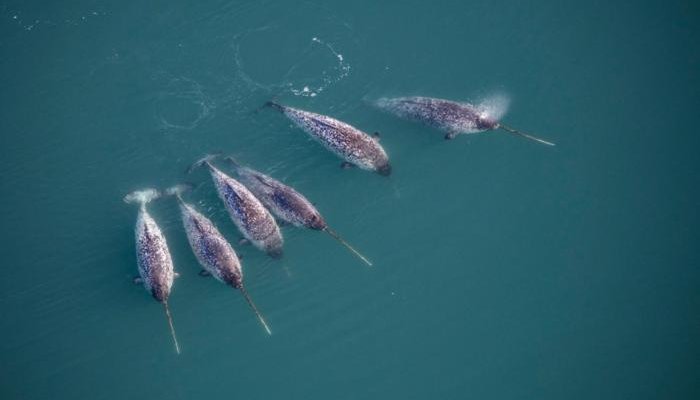
Six narwhals like these were equipped with CTD sensors that measured ocean temperature, salinity and depth. Image credit: Carsten Egevang. University of Copenhagen
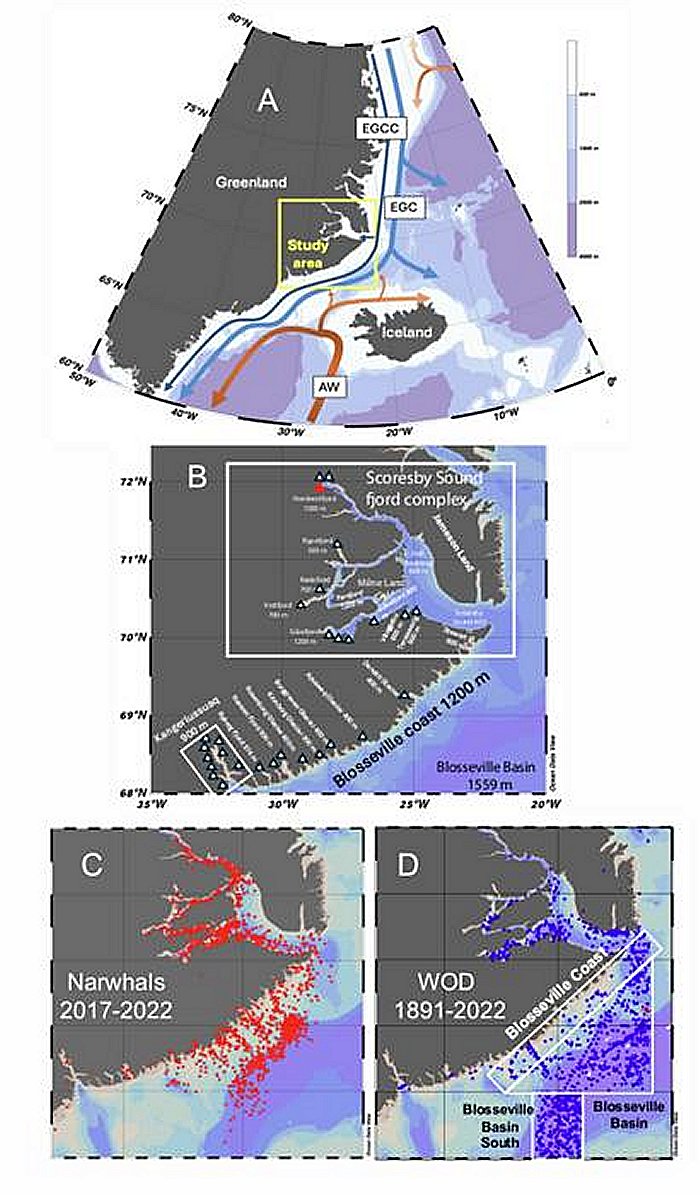 The upper images show the study area. Each red dot in the lower-left image represents a location where measurements were collected by narwhals between 2017 and 2022. In the image on the right, each blue dot represents a ship-based measurement collected between 1891 and 2022. Image credit: Photo: Heide-Jørgensen et al. (2026).
The water in the fjord system is a mixture of cold Polar Water originating in the Arctic and warmer, more saline Atlantic Intermediate Water from the Atlantic Ocean.
But the region has long been one of the major blind spots on the oceanographic map. Where research vessels often must turn back, narwhals can continue swimming.
“Now we suddenly have measurements from places we can use in our models, giving us a much more complete picture of the ocean. It is absolutely fantastic to use the animals in this way,” says Susanne Ditlevsen, Professor at the Department of Mathematical Sciences.
Warm water accelerates glacier melting
In the study, which has just been published in the scientific journal Science Advances, the researchers combined the narwhal measurements with historical oceanographic data from the World Ocean Database (WOD) for the Scoresby Sound region.
“We used the two large datasets to build a robust model showing how temperature, salinity and depth are related. The models show that the layer consisting of Atlantic water has become thicker, while the upper layer of Polar Water has become thinner,” says Susanne Ditlevsen.
The researchers show that warm Atlantic Intermediate Water now reaches deep basins in front of glaciers hundreds of kilometres into the fjord systems.
“This is the water that helps melt the glaciers. We show how the warm water can contribute to accelerating the rate at which glaciers lose ice,” says Mads Peter Heide-Jørgensen.
Helping predict climate change
For the researchers, the results are not only about ocean conditions in East Greenland. They can also help improve the climate models used to predict future climate change.
Melting from Greenland’s glaciers and ice sheet is an important factor in climate research. When glaciers melt, large volumes of freshwater are released into the ocean, which can influence ocean circulation and climate patterns far beyond the Arctic.
“In the large climate models used to predict future climate change, glacier melt plays a major role. That is why it is crucial that we improve our understanding of it, particularly because Greenland contains so much ice,” says Susanne Ditlevsen.
Written by Eddie Gonzales Jr. – MessageToEagle.com Staff Writer
Related Posts
-
 What Octopus And Human Brains Have In Common – New Study
-
 New Feathered Dinosaur Lived In New Mexico 67 Million Years Ago
-
 Last Surviving Flightless Bird Species Rose From The Dead
-
 Visually Stunning Tree Of All Known Life Unveiled Online
-
 We Now Know What The Earliest Animals Looked Like – Scientists Say
-
 Millions Of Bizarre Luminous Creatures Invade The West Coast In U.S And No-One Knows Why
-
 Ocean Water Samples Yield Treasure Trove Of RNA Virus Data
-
 Shaking The Dinosaur Family Tree: How Did ‘Bird-Hipped’ Dinosaurs Evolve?
-
 Strange New Species Of Duck-Billed Dinosaur From Big Bend National Park, Texas – Identified
-
 Largest Salamander Discovered in North America

