
A Gigantic ‘Cat’s Tail’ Tells Of Cosmic Collision 63 Light-Years Away
Eddie Gonzales Jr. – MessageToEagle.com – Sixty-three light-years from Earth, in the small, faint constellation Pictor (Latin for “painter”), lies a strange structure that has puzzled astronomers for the last two years. Nicknamed the “Cat’s Tail,” this dark feature stretches across an abyss of space about a thousand times the average distance between the Earth and the Sun.
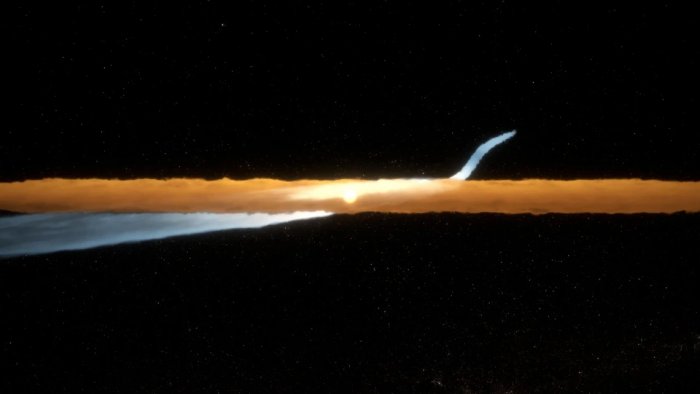
In this artist’s illustration of the Beta Pictoris debris disk – seen edge-on as it appears from Earth – the swirling gas and dust are depicted in orange. A previously discovered secondary disk appears as a whitish feature below the plane of the main disk. On the right, the “Cat’s Tail” feature is visible, reaching far into space. NASA, ESA, CSA, STScI, Ralf Crawford (STScI)
The Cat’s Tail was discovered in a so-called debris disk known as Beta Pictoris – another solar system not unlike ours, but much younger, having formed only a few million years ago. Now, for the first time, astronomers have captured previously unseen details of the Cat’s Tail in visible light, using the Hubble Space Telescope.
Led by University of Arizona planetary scientist Arin Avsar, the team reports its findings in a paper published in The Astrophysical Journal Letters. The combination of new and previous imaging spanning more than 14 years provides new insights into the location and nature of the substructure and further evidence of its likely violent origin.
“The Cat’s Tail is thought to be the aftermath of a collision between large bodies – think something like Pluto,” said Avsar, a doctoral student who works with Daniel Apai’s and Kevin Wagner’s research group at U of A’s Lunar and Planetary Laboratory and Steward Observatory. “Oddly, this feature had previously only been seen with the James Webb Space Telescope, which detects infrared light, but remained invisible at shorter wavelengths, which has puzzled the community for a while.”
With its planets neatly organized into a set of nested orbits around the Sun and leftover space rocks relegated to “designated” asteroid belts, the solar system as we know it today belies its chaotic and violent birth 4.6 billion years ago: a disk of gas and dust swirling around the infant Sun, with space rocks smashing into each other and blowing each other apart, while only a few survived the cosmic jostling, accreted more mass and eventually grew into planets. To learn what the young solar system looked like, astronomers look to other star systems such as Beta Pictoris, a debris disk thought to be in the final stages of planet formation.
“We think the Cat’s Tail has eluded our observations in visible light until now because of what it’s made of,” Avsar explained. “It consists almost entirely of what we call organic refractory material, which is heavily carbon-based. These long chains of carbon atoms absorb visible light, so they’re quite black.”
“We think the Cat’s Tail has eluded our observations in visible light until now because of what it’s made of,” Avsar explained. “It consists almost entirely of what we call organic refractory material, which is heavily carbon-based. These long chains of carbon atoms absorb visible light, so they’re quite black.”
Not only that, but the new observations also supported that the vast cloud – whose length could be as long as 200 trillion house cats lined up tail to snout – consists of micron-sized dust grains that are also extremely porous or “fluffy.” In more astronomical terms, the structure is potentially 1,000 astronomical units long, with one AU being the average distance between the Earth and the sun.
“How you can get dust grains that small that are as porous as we see here, no one really understands, and that’s part of why we study this feature,” Avsar said.
As to what turned a nascent planetary body into micron-sized, surprisingly fluffy dust grains, Avsar said it’s up to speculation, and further research could help clarify the picture.
“It’s possible that the velocities involved in the collisions were so high that the carbon grains vaporized, turned into gas, and then recondensed as they cooled, and that’s how they became so porous,” said co-author Wagner, a NASA Sagan Postdoctoral Fellow at the U of A Steward Observatory.
By combining Hubble’s image data with JWST’s infrared data and applying clever computer modeling, his team teased out information about the Cat’s Tail’s three-dimensional structure. Based on previous observations, astronomers believed that the feature emanated from Beta Pictoris, the star at the center of the debris disk, which appears edge-on when viewed from Earth, and billows out far into space from the observer, fading into the space beyond the disk.
“We find that instead of extending for 1,000 astronomical units behind the star, the Cat’s Tail may extend straight sideways relative to us, and there is no third dimension to it,” Avsar said. “It’s essentially in the same plane of the sky as the star and possibly extends a little bit behind it.”
By using Hubble in a new configuration, Avsar’s team also identified a new feature of the dust halo surrounding Beta Pictoris: a strange warp that the researchers believe is likely caused by the disk interacting with one of the three planets in the system: Beta Pic b, a gas giant about 10 times the mass of Jupiter.
“This gives us another line of evidence into how giant planets influence comets through their immense gravitational force,” Avsar said. “It’s a testament to how much these massive planets really influence their surrounding dust and icy bodies out to hundreds of astronomical units.”
According to Avsar, this offers another clue to the processes that likely shaped the early solar system. When the Kuiper Belt was a mere 20 million years old, it is believed to have had a much higher density of bodies, potentially hundreds of Pluto-sized objects. In a way, the outer giant planets “cleared out” many of those former bodies by perturbing their orbits or ejecting them from the system altogether.
Written by Eddie Gonzales Jr. – MessageToEagle.com Staff Writer
Related Posts
-
 How To Spot Life In The Clouds On Other Worlds
-
 Long-Standing Misunderstanding About Composition Of Jupiter’s Clouds – Resolved
-
 Marsquakes Could Reveal Whether Liquid Water Exists Underground On Red Planet
-
 NASA’s Curiosity Reaches Mars Ridge Where Water Left Debris Pileup
-
 Lafayette Meteorite Shows Evidence Of Liquid Water On Mars 742 Million Years Ago
-
 A New Tatooine-Like Multi-Planetary System Identified
-
 One Of The Milky Way’s Most Extreme Environments Revealed In Webb Images
-
 Most Ancient Quasar In The Universe Discovered By Euclid
-
 9 Phenomena Astronauts Will Encounter At The Moon’s South Pole
-
 Earth-Sized Exoplanet Orbiting Ultracool Dwarf Star SPECULOOS-3 As Small As Jupiter

