


Eddie Gonzales Jr. – MessageToEagle.com – Hess Rise—one of the largest and, at the same time, least explored volcanic plateaus in the world – will be investigated by a team on a flagship German deep-sea research vessel, RV Sonne. The expedition is managed by the GEOMAR Helmholtz Centre for Ocean Research, Kiel, Germany.
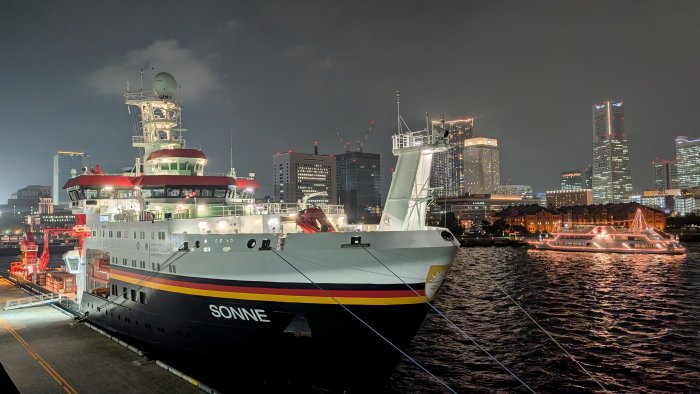
The research vessel SONNE in the port of Yokohama. The destination of the SO320/1 expedition is the Hess Rise—one of the largest and, at the same time, least explored volcanic plateaus in the world. Image credit: Anke Dannowski, GEOMAR
Hess Rise is located in the middle of the North Pacific, between Japan and Canada.
The plateau is roughly T-shaped and extends over a length of about 1,000 kilometers. Due to its distance from the nearest mainland, the research area at Hess Rise is difficult to access and has therefore been the destination of only a few expeditions to date. The last one took place in 1980. For the past two years, Hess Rise and its surroundings have once again become the focus of German and Japanese researchers.
Expedition SO320/1, led by the GEOMAR Helmholtz Centre for Ocean Research Kiel, is now testing various models on the western and northern parts of the plateau that explain how Hess Rise might have formed.
“The Hess Rise is so far from the mainland that we have scheduled eight days at sea just for the transit to the study area,” says expedition leader Dr. Anke Dannowski, a geophysicist at GEOMAR.
“The investigation of Hess Rise will provide insights into the entire geotectonic evolution of the Pacific.”
Oceanic plateaus are found worldwide, both on land and in the oceans. They form as a result of extreme magmatic events in which lava repeatedly erupts in massive flows that accumulate on top of one another. Individual lava flows extend over several hundred kilometers and are tens to several hundred meters thick. The Middle Cretaceous period (115–90 million years ago) in particular was marked by exceptionally intense volcanism, during which at least twelve of the world’s larger oceanic plateaus were formed.
How exactly these structures came into being has not yet been fully clarified.
The third scenario suggests that the Hess Rise is an intraplate plateau, which means it formed away from plate boundaries and was created by a mantle plume. Plumes are currents of hot material that rise from deep within the Earth’s mantle. The researchers also want to find out if the same hotspot formed the nearby Shatsky Rise about 30 million years earlier and then became active again at the Hess Rise.
Up to 40 ocean bottom seismometers (OBS) will be deployed on the seafloor at depths of 2,000 to 5,000 meters. These are deployed from the ship and sink to the seafloor in free fall. There, they operate autonomously and continuously record seafloor movements as well as pressure waves in the water. The measurements are supplemented by ship-based gravimetry, a magnetometer towed by the ship, and seafloor mapping using the ship’s own multibeam echo sounder. The data obtained in this way provides insights into the composition and deep structure of the Hess Rise. Based on the work of the expedition that has now begun, the subsequent SO320/2 cruise will specifically collect rock samples from the seafloor.
Later, the geophysical results will be combined with the geological data, particularly regarding the age of the rocks.
Written by Eddie Gonzales Jr. – MessageToEagle.com Staff Writer