
African Societies Survived Climate Shifts For Millennia Thanks To Livelihood Diversity
Eddie Gonzales Jr. – MessageToEagle.com – Research on African history indicates that livelihood diversity enabled ancient societies to adapt to significant climate shifts.
A recent study suggests that achieving enduring resilience to climate change is not accomplished through uniform solutions, but rather through strategies grounded in ecological suitability, adaptability, and local expertise.
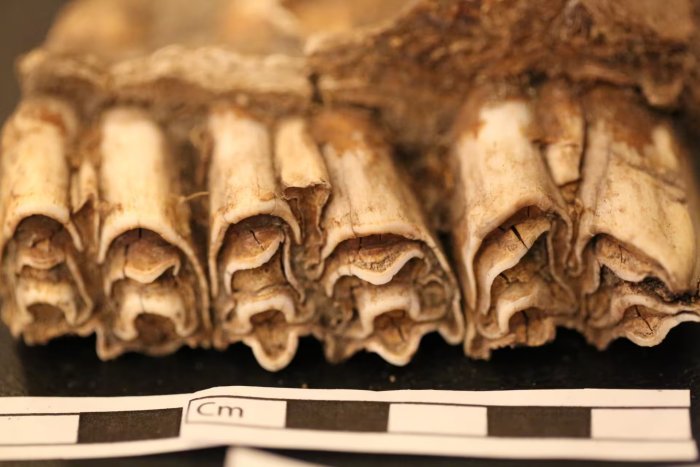
Domesticate bones from Madagascar undergoing isotopic analysis. Courtesy: Leanne N. Phelps
During the Holocene Epoch, which encompasses approximately the last 11,000 years, Africa experienced substantial environmental transformations.
For example, the African Humid Period introduced nearly 9,000 years of wetter conditions across much of the continent before transitioning to increasingly arid climates. As ecosystems evolved and food sources shifted, societies cultivated flexible and locally adapted practices in herding, farming, fishing, and foraging. These strategies enabled them to navigate thousands of years of environmental challenges successfully.
The Africans had to adapt to climate shifts and they did it. In return they could obtain the long-term resilience.
“What we see is not a linear story of progress but a complex mosaic of strategies that helped people stay resilient. That has real lessons for food systems today,” said Leanne N. Phelps, the study’s lead author and an associate research scientist at Lamont-Doherty Earth Observatory, which is part of the Columbia Climate School.
Researchers analyzed a continent-wide isotope dataset from the Holocene epoch to study how ancient African communities adapted to environmental changes. Isotopes from plants are preserved in bones, teeth, and tissues of humans and animals. By examining these tissues, researchers can identify the plants and animals consumed by these communities, allowing them to infer food acquisition methods.
They analyzed C3 plants, like wheat and barley, which thrive in cooler, wetter environments, and C4 plants, like millet and sorghum, which prefer warm, dry conditions. These analyses help researchers understand how communities combined different food sources by examining distinct patterns in human and animal remains.
The team reviewed archaeological records from across Africa to determine the types of livelihoods likely practiced in different areas. They used a method called hierarchical clustering to sort similar isotope data into groups based on shared traits.
Instead of starting with predefined categories, the algorithm looked for natural patterns in the data, grouping individuals with similar profiles into what they call “isotopic niches.” Each niche reflects a unique combination of food consumption linked to one or more of four core activities: herding, farming, fishing and foraging.
Researchers reviewed archaeological records across Africa to identify likely livelihoods in different areas. They used modern climate and elevation data to reconstruct historical environments. This approach defined 10 broad livelihood strategies, tracking their emergence, shifts, and overlaps over time and ecological zones.
For instance, one niche involved C3-based farming in temperate regions such as the Ethiopian highlands and parts of North Africa. Other niches relied on C4 plants and grazing in dry grasslands or aquatic strategies near lakes and rivers. These patterns demonstrate how African societies adapted their food sources to environmental changes in innovative and local ways.
Understanding how ancient societies adapted to climate change helps address current challenges. This research shows that flexible, locally adapted strategies supported long-term resilience in Africa.
Phelps summarizes saying that “if we want climate solutions and global environmental change solutions to work, they need to be rooted in an understanding of the way that people have been using available resources throughout time.”
Written by Eddie Gonzales Jr. – MessageToEagle.com Staff Writer
Related Posts
-
 New Study Reveals 16,000-Year Climate History Of Tropical Andes
-
 Atmospheric Rivers Migrate Towards The Poles And Cause Significant Alterations To Global Weather Patterns
-
 Millions Of Mysterious Pits In The Ocean – Decoded
-
 Why Did Soil Get Wetter Even As The Planet Got Hotter?
-
 Giant Ice Bulldozers: How Glaciers Shaped Life Evolution
-
 Artificial Light At Night Indicate Rapidly Increasing Industrial Activities In The Arctic
-
 Antarctic Ice Melt Triggers Further Melting: Evidence For Cascading Feedbacks 9,000 Years Ago
-
 Cracking The Code Of Thwaites Ice Shelf’s Disintegration
-
 Urea In Atmosphere Revealing Profound Consequences For Climate – Discovered
-
 Researchers Solve 200-Year-Old Volcanic Mystery

