
Ancient Sediment Beneath The Pacific Ocean Reveals Earth’s History
Eddie Gonzales Jr. – MessageToEagle.com – Deep sea sediments hold valuable insights into marine ecosystems and past climates, offering clues to Earth’s environmental future, yet remain understudied, researchers say.
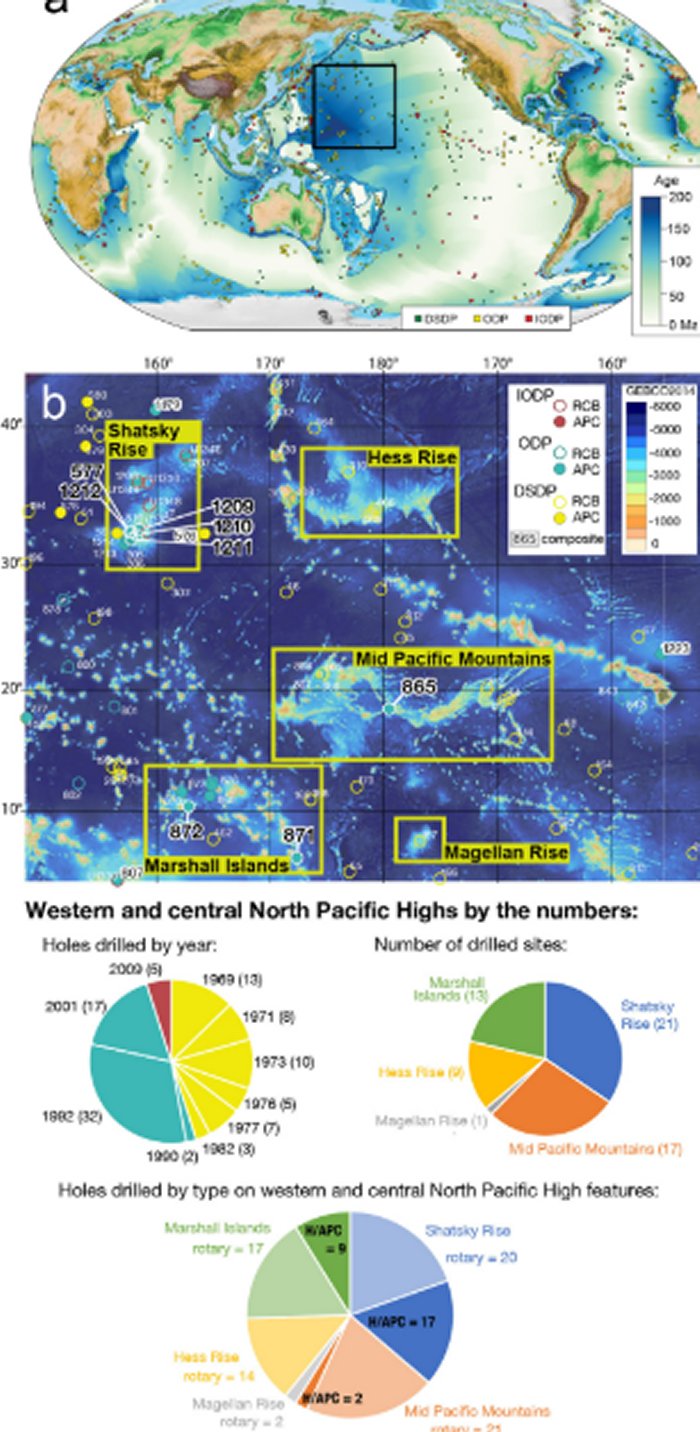
Global distribution of deep-sea drilling sites (a) on a map of seafloor ages and (b) within the western and central North Pacific with Pacific Highs identified on a bathymetric map. Source
The Pacific Ocean, the largest and deepest on Earth, plays a vital role in ecological systems like the carbon cycle. However, much of our scientific knowledge comes from just a few sediment core records collected over the past five decades.
“It’s easy to forget that two-thirds of our planet is covered with salty ocean water, especially when you don’t live near the coast,” said Elizabeth Griffith, co-author of a new paper and a professor in earth sciences at The Ohio State University.
“It’s also hard to realize just how much of it we haven’t explored yet.”
In the past, studying the deep ocean was challenging due to the difficulty in reaching these depths. Today, scientists use scientific ocean drilling with specialized ships and advanced technology to extract sediment cores from the ocean floor.
Sediment cores collected from various locations provide valuable insights into Earth’s history and dynamics. For instance, samples from Pacific Highs—shallow undersea geological features help scientists answer questions about the evolution of life, past extinctions, tectonic and volcanic history, and slight orbital changes.
While only eight of these sites, found in the central and western North Pacific, have ever been explored using modern drilling technologies, discoveries made in these locations offer valuable insights into some of the most dynamic environmental shifts of the past 100 million years, said Griffith.
“When you’re extrapolating from such a huge time and spatial scale, you need more than one or two data points to get complete records and ground truth modeling,” she said.
Yet as global temperatures continue to rise and cores collected from these sites are depleted of material that might help reveal key events, new data is needed to continuously improve future climate models and transform our understanding of Earth’s complex life systems.
To better prioritize research questions best answered by future ocean drilling discoveries, the international scientific ocean drilling community held a workshop in October 2024 at The Ohio State University’s Stone Laboratory.
Participants determined that in order for ocean discovery science to move forward, scientists will need to create both short- and long-term plans for recovering these sediments.
“One of the benefits of the ocean drilling community has always been that it’s a larger effort,” said Griffith. “There’s support for this idea that we’re answering big questions on a scale that you just can’t do in a single lab or just working with a small subset of people.”
Researchers suggest future reconstructions of Earth’s past environments need more data, as gaps in coverage hinder testing hypotheses and validating Pacific Ocean climate models. Current sediment cores are too degraded for some new testing techniques.
The paper also notes that taking the time to dig deep into whatever long-buried secrets our ocean floors hold will also be beneficial in predicting what tomorrow’s climate future might entail, said Griffith. “Warm periods in Earth’s recent history might tell us something about future conditions on Earth and how life will respond to those changes,” she said.
Drillship expeditions enable scientists to study Earth’s challenging environments but require extensive international collaboration. Ocean drilling science must expand these opportunities, yet the recent loss of a U. S. riserless drillship concerns next-generation scientists who fear losing access to vital data could jeopardize the field.
“Working with legacy core material is a crucial part of my research, but it will never replicate the experience of sailing on a deep-sea scientific drilling expedition and fostering international collaboration at sea,” said Batoul Saad, co-author of the paper and a PhD student in earth sciences at Ohio State.
While private and public sector leaders work to preserve U.S. federal research funding, scientific experts suggest identifying new opportunities to expand international, collaborative science and help sustain ocean drilling science.
“As individuals, much of the work of supporting science involves just being curious about the planet that we live on and that sustains us,” said Griffith. “Once you become curious, realizing how much you impact your surroundings leads to better decisions and new scientific discoveries.”
Written by Eddie Gonzales Jr. – MessageToEagle.com Staff Writer
Related Posts
-
 Dinosaur Teeth As Time Capsules Of Climate Data
-
 New Trigger Proposed For Record-Smashing 2022 Tonga Eruption
-
 New Insights From Shakespeare’s England Reveal Striking Parallels To Contemporary Climate Change
-
 African Societies Survived Climate Shifts For Millennia Thanks To Livelihood Diversity
-
 Earth’s Most Ancient Impact Craters Are Disappearing
-
 Frostquakes: A New Earthquake Risk In The North?
-
 High Ocean Heat Storage During The Last Deglaciation – Revealed
-
 A Window To First Life On Earth – Hidden Deep Within An Inhospitable Desert
-
 Investigating New Hydrothermal Vents 3, 000 Meters Deep Off Svalbard
-
 Machine Learning Uncovers 10 Times More Earthquakes In Yellowstone Caldera

