
Asteroids Near White Dwarfs Don’t Break Directly Into Dust
Eddie Gonzales Jr. – MessageToEagle.com – When asteroids travel too close to white dwarfs, the dense remnants of stars that have exhausted their nuclear fuel, powerful gravitational forces can tear them apart.
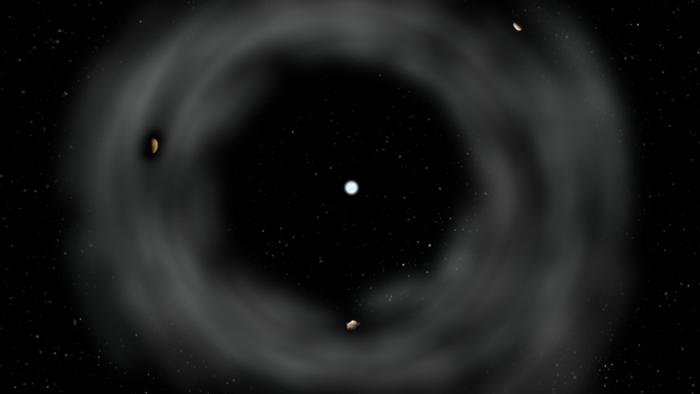
This artist’s illustration shows a white dwarf star surrounded by a debris disk with three asteroids orbiting in the disk. Credit: Pamela L. Gay / PSI
However, new research from the Planetary Science Institute (PSI) suggests that these asteroids don’t immediately break into dust. Instead, most of the mass initially remains in larger fragments, revealing a previously overlooked step in how debris forms around dying stars.
The study, led by PSI Senior Scientist Jordan Steckloff, identifies a “kilometer-size barrier” that limits how much asteroids can break apart under the powerful gravitational forces of white dwarfs.
White dwarfs are often surrounded by disks of planetary debris, including dust from asteroids and other objects the star’s gravity pulls apart. Previous models have generally assumed these objects behave like loosely bound piles of rubble with no internal strength. This lets them break into ever smaller pieces and eventually turn into dust.
However, those models did not account for the strength of rubble-pile asteroids. Tiny attractive forces between their grains and particles help hold them together, preventing them from breaking apart into smaller pieces.
“Nothing is truly strengthless,” Steckloff said. “Tiny attractions between grains called Van der Waals forces give comets and asteroids a minimum strength 10 to 100 times weaker than pulling apart freshly fallen snow.”
Using a physical model that accounts for an asteroid’s internal strength, density, and the gravitational forces acting on it, Steckloff and his team found that most debris mass remains in pieces about 0.1 to 1 kilometer in size.
These fragments are too large to be significantly affected by Poynting-Robertson drag, a process in which stellar radiation gradually causes small particles to spiral inward. Instead, the fragments must undergo additional events or processes, such as collisions or rotational breakup, before they can become the fine dust that we observe around white dwarfs.
We have examples of this in our own Solar System. When Comet Shoemaker-Levy 9 traveled near Jupiter in 1992, the planet’s gravity tore it into these large ~100-1000 m fragments. Those large fragments later collided with the planet. Similar tidal fragmentation has also produced families of comets that pass extremely close to the Sun.
The study also found that asteroid fragments remain on nearly identical orbits after breaking apart. These orbits are potentially keeping debris more concentrated around white dwarfs than previous models predicted.
“Understanding the details of how debris around white dwarfs is produced and evolves is important for putting the observations into context,” says co-author Kat Volk. “This will help us understand what happens to the small bodies in orbit around a star as it undergoes the end stages of its life.”
Written by Eddie Gonzales Jr. – MessageToEagle.com Staff Writer
Related Posts
-
 Wind Speeds On Jupiter Were Measured By Atronomers At The University Of Lisbon
-
 Massive Anomaly Within Earth’s Mantle May Be Remains Of An Ancient Planet
-
 Real Shape Of Scorching-Hot Exoplanet Atmospheres – Revealed
-
 Tiny CosmoCube Satellite Will Use The Dark Side Of the Moon To Eavesdrop
-
 Medieval Japanese Poetry And Ancient Buried Trees Reveal Clues About Unpredictable Space Weather
-
 Old Moon With A Young Crust
-
 Three Newly Discovered Moons Are The Faintest Ever Found Around Uranus And Neptune
-
 A New Tatooine-Like Multi-Planetary System Identified
-
 Mars Became Uninhabitable – Curiosity Rover Reveals How It Happened
-
 NASA’s Lucy Spacecraft Discovers 2nd Asteroid During Dinkinesh Flyby

