
Astronomers Using Subaru Telescope Identified About 1800 Exploding Stars
Eddie Gonzales Jr. – MessageToEagle.com – Astronomers using the Subaru Telescope identified about 1800 new supernovae in the distant Universe, including 58 Type Ia supernovae over 8 billion light-years away.
These findings will help elucidate the expansion of the Universe.
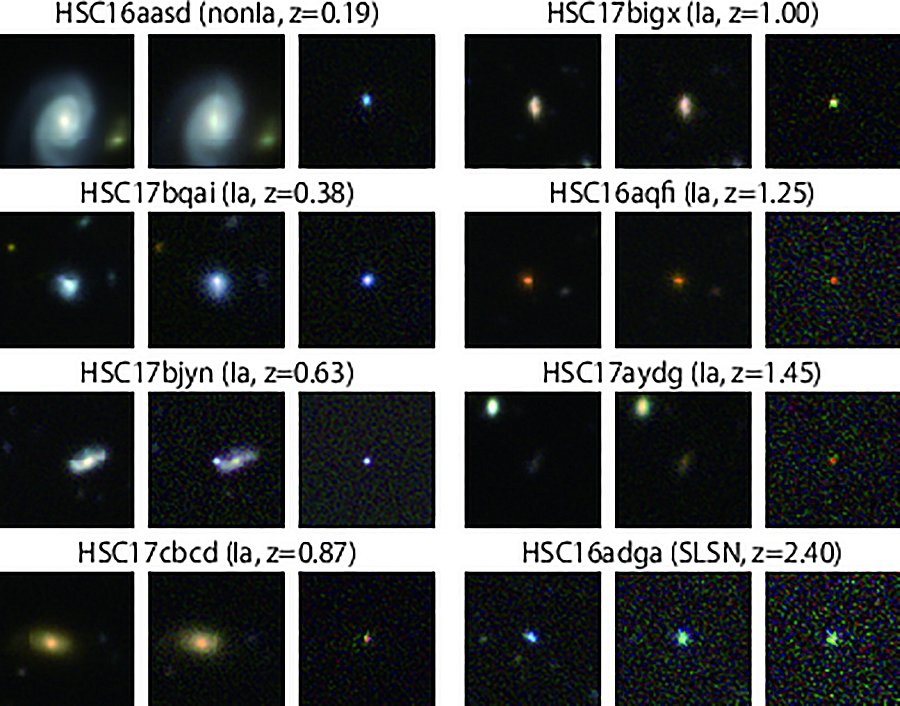 Some supernovae discovered in this study. There are three images for each supernova for before it exploded (left), after it exploded (middle), and supernovae itself (difference of the first two images). (Credit: N. Yasuda et al.) All images of supernovae discovered in this paper can be viewed here (Cooperated by Dr. Michitaro Koike of NAOJ).
A supernova is the name given to an exploding star that has reached the end of its life. The star often becomes as bright as its host galaxy, shining one billion times brighter than the Sun for anytime between a month to six months before dimming down. Supernova classed as Type Ia are useful because their constant maximum brightness allows researchers to calculate how far the star is from Earth.
This is particularly useful for researchers who want to measure the expansion of the Universe.
Supernovae rare celestial events and only a few telescopes are capable to capturing sharp images of distant stars, and the Subaru Telescope is one of them.
By taking repeated images of the same area of night sky over a six month period, the researchers could identify new supernovae by looking for stars that suddenly appeared brighter before gradually fading out.
The team identified 5 super luminous supernovae, and about 400 Type Ia supernovae. Fifty-eight of these Type Ia supernovae were located more than 8 billion light years away from Earth. In comparison, it took researchers using the Hubble Space Telescope about 10 years to discover a total of 50 supernovae located more than 8 billion light years away from Earth.
“The Subaru Telescope and Hyper Suprime-Cam have already helped researchers create a 3D map of dark matter, and observation of primordial black holes, but now this result proves that this instrument has a very high capability finding supernovae very, very far away from Earth,” Kavli Institute for the Physics and Mathematics of the Universe (Kavli IPMU) Professor Naoki Yasuda, said in a press release.
“I want to thank all of my collaborators for their time and effort, and look forward to analyzing our data to see what kind of picture of the Universe it holds.”
The next step will be to use the data to calculate a more accurate expansion of the Universe, and to study how dark energy has changed over time.
Written by Eddie Gonzales Jr. – MessageToEagle.com Staff Writer
Related Posts
-
 At Least 70% Of Martian Lakes Have Yet To Be Discovered – Researchers Say
-
 Korolev Crater On Mars As Newly Photographed By ExoMars Trace Gas Orbiter
-
 Is There Really Dark Matter? Answer Is Hidden In Motion Of Stars Within Small Satellite Galaxies
-
 New Black Hole Breaks The Record
-
 Color-Shifting Asteroid Observed For The First Time In Real-Time
-
 After 15 Years, Pulsar Timing Yields Evidence Of Cosmic Gravitational Wave Background
-
 Our Moon Is Shrinking And Producing Moonquakes
-
 Mysterious Dragonfly 44 Galaxy Has Almost No Stars And Dark Matter Is Lurking Behind Its Existence
-
 Palomar 5 In Focus: Oversized Black Hole Population Discovered In This Star Cluster
-
 New Sample Catalog Of Millions Of Stars Can Help Decipher Chemical History Of The Milky Way

