
Atlantic Ocean Current Could Collapse After 2100 – New Study From Potsdam Researchers
Eddie Gonzales Jr. – MessageToEagle.com – A key system of Atlantic Ocean currents, which also includes the Gulf Stream, could shut down after the year 2100. Its collapse would cut the ocean’s northward heat supply, causing summer droughts and severe winter extremes in northwestern Europe, as well as shifts in tropical rainfall belts.

Image credit: Mylene2401 – Pixabay
This is the conclusion of a new study, with contributions by the Potsdam Institute for Climate Impact Research (PIK).
“Most climate projections stop at 2100. But some of the standard models of the IPCC – the Intergovernmental Panel on Climate Change – have now run centuries into the future and show very worrying results,” says Sybren Drijfhout from the Royal Netherlands Meteorological Institute, the lead author of the study published in Environmental Research Letters.
“The deep overturning in the northern Atlantic slows drastically by 2100 and completely shuts off thereafter in all high-emission scenarios, and even in some intermediate and low-emission scenarios. That shows the shutdown risk is more serious than many people realise.”
Collapse of deep convection in winter as the tipping point
The AMOC carries sun-warmed tropical water northward near the surface and sends colder, denser water back south at depth. This ocean “conveyor belt” helps keep Europe relatively mild and influences weather patterns worldwide. In the simulations, the tipping point that triggers the AMOC shutdown is a collapse of deep convection in winter in the Labrador, Irminger and Nordic Seas. Global heating reduces winter heat loss from the ocean, because the atmosphere is not cool enough. This starts to weaken the vertical mixing of ocean waters: The sea surface stays warmer and lighter, making it less prone to sinking and mixing with deeper waters. This weakens the AMOC, resulting in less warm, salty water flowing northward.
In northern regions, then, surface waters become cooler and less saline, and this reduced salinity makes the surface water even lighter and less likely to sink. This creates a self-reinforcing feedback loop, triggered by atmospheric warming but perpetuated by weakened currents and water desalination.
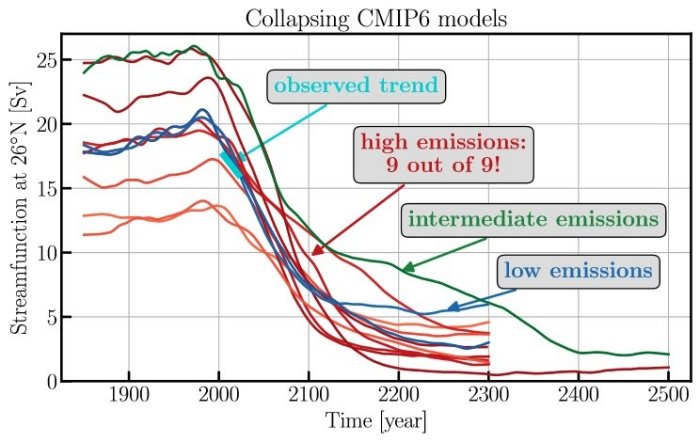
Time-evolution of the AMOC strength at 26°N (where it is observed) in the model simulations in which the AMOC shuts down. The short cyan line shows the observed trend of the observations for 2005-2023, the colour of the lines indicates the emission scenario that was used for the simulations. Graphic: Drijfhout et al.
“In the simulations, the tipping point in key North Atlantic seas typically occurs in the next few decades, which is very concerning,” says Stefan Rahmstorf, Head of PIK’s Earth System Analysis research department and co-author of the study. After the tipping point the shutdown of the AMOC becomes inevitable due to a self-amplifying feedback. The heat released by the far North Atlantic then drops to less than 20 percent of the present amount, in some models almost to zero, according to the study.
Lead author Drijfhout adds that “recent observations in these deep convection regions already show a downward trend over the past five to ten years. It could be variability, but it is consistent with the models’ projections.”
It is crucial to cut emissions fast
To arrive at these results, the research team analysed CMIP6 (Coupled Model Intercomparison Project) simulations, which were used in the latest IPCC Assessment Report, with extended time horizons to years from 2300 to 2500. In all nine high-emission simulations, the models evolve into a weak, shallow circulation state with the deep overturning shutting down; this result is produced in some intermediate and low-emission simulations as well. In every case, this change follows a mid-century collapse of the deep convection in North Atlantic seas.
“A drastic weakening and shutdown of this ocean current system would have severe consequences worldwide,” PIK researcher Rahmstorf points out. “In the models, the currents fully wind down 50 to 100 years after the tipping point is breached. But this may well underestimate the risk: these standard models do not include the extra fresh water from ice loss in Greenland, which would likely push the system even further.
This is why it is crucial to cut emissions fast. It would greatly reduce the risk of an AMOC shutdown, even though it is too late to eliminate it completely.”
Written by Eddie Gonzales Jr. – MessageToEagle.com Staff Writer
Related Posts
-
 Arctic Dust Found To Be A Major Source Of Particles That Form Ice Crystals In Arctic Low-Level Clouds
-
 Scientific Drilling Unravels Historical Mystery Surrounding Santorini
-
 Lakes Worldwide Are Changing Color, Possibly Due To Human Impact
-
 Hidden Forces Causing Continents To Rise – A Long-Standing Mystery Is Solved
-
 Seismic Study Reveals Hidden Megathrust Earthquake Risk Off British Columbia
-
 Peculiar Thin Arc Spans Greenland Fjord – What Might Have Caused It?
-
 Lightning Storms Contribute To The Accelerated Rate Of Sea Ice Melting At The North Pole
-
 Crevasse Icequakes On Alpine Glacier Detected By Fiber Optic Cable On Glacier
-
 Artificial Light At Night Indicate Rapidly Increasing Industrial Activities In The Arctic
-
 Millions In The US May Rely On PFAS-Contaminated Groundwater For Drinking

