
Black Coffee, Hold The Plastic: Innovative Coating And Reducing Exposure To Microplastics
Eddie Gonzales Jr. – MessageToEagle.com – An innovative coating made from renewable, plant-based materials could simplify recycling while reducing exposure to microplastics.
The lining in traditional disposable coffee cups can release plastic particles and be difficult to recycle, but a new plant-based coating can eliminate these issues with your morning brew.
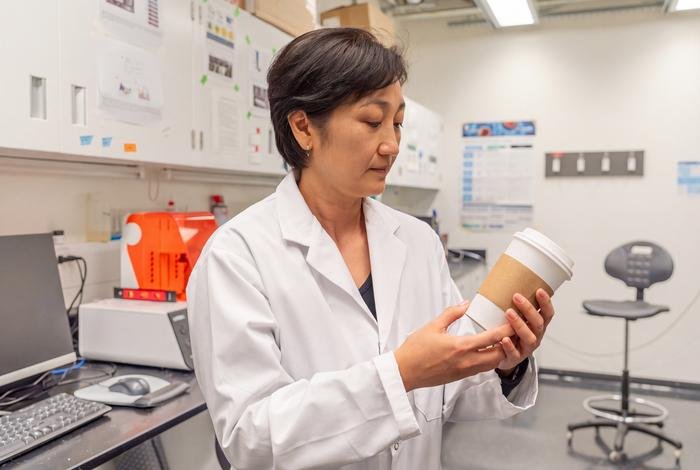
Dr. Shirley Tang, professor of chemistry at the University of Waterloo, led the team that developed a new plant-based coating for paper cups and food packaging (University of Waterloo). Image credit: University of Waterloo
A team of researchers from the University of Waterloo created a durable new coating from cellulose acetate that is reinforced with cellulose nanocrystals. Both components come from plants. Because the coating and the cup are both cellulose-based, the material could simplify paper recycling by reducing the need to separate conventional plastic liners from paper.
The plastic used now comes from fossil fuels and can persist in the environment for centuries after disposal. During testing, the conventional, plastic-lined coffee cups showed surface degradation and particle release, suggesting microplastics could enter the container’s contents and flow into our bodies. The researchers’ cellulose-based coating remained largely intact during the same testing.
“Learning how easily some plastic liners can shed particles was eye-opening,” said Dr. Shirley Tang, professor in Waterloo’s Department of Chemistry. “The fact that we have created such a high-performance all-cellulose coating that doesn’t rely on conventional plastics is what makes this work particularly exciting because there are so many possibilities.”
Researchers found that the plant-based coating remained stable after prolonged exposure to boiling water, food oil, and a variety of solvents. The material also maintained its protective properties when applied to lightweight paper, such as brown paper towels.
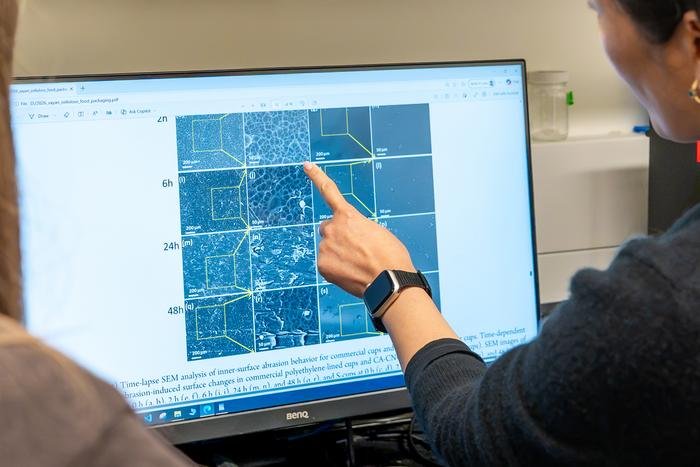
Dr. Shirley Tang points to microscopic images of the plastic lining of a coffee cup that has flaked off. In comparison, the images to the far right show the team’s plant-derived coating staying intact under the same test conditions (University of Waterloo). Image credit: University of Waterloo
“The coating allowed us to use much thinner paper while still achieving the durability needed for beverage containers,” said Dr. Sayan Ganguly, a research associate in the Tang Nanotechnology Lab at Waterloo. “That could reduce the amount of material required to manufacture cups while maintaining performance and lowering costs. These savings could ultimately be passed on to the consumer.”
The project grew out of earlier research into lightweight, sustainable materials for aviation applications. While investigating renewable alternatives for aerospace uses, the team discovered the material’s potential as a protective coating for paper products and packaging.
Beyond coffee cups, the researchers see opportunities for the material in food packaging and other applications where companies wish to replace plastics with renewable alternatives.
Written by Eddie Gonzales Jr. – MessageToEagle.com Staff Writer
Related Posts
-
 Low-Cost Gel Film Can Pluck Drinking Water From Desert Air
-
 New Imaging System Captures Text From Barely Open Books
-
 Researchers Snap First Image Of An ‘Electron Ice’
-
 Expressing And Recognizing Intentions In Robots
-
 Engineers Devised A Chip-Free, Wireless, Electronic ‘Skin’
-
 A Tensor Language Prototype For High-Performance Computers
-
 A New Solid-State Battery Surprises The Researchers Who Created It
-
 Carmen: Small, Tabletop Robot Will Help People To Improve Their Memory, Attention And Executive Functioning At Home
-
 Flying Taxis Will Be Available In 2023
-
 Spray-On Coating Could Make Solar Panels Snow-Resistant

