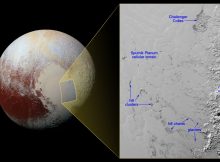
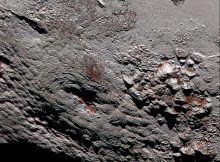
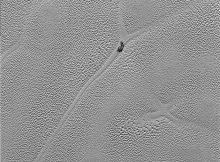
MessageToEagle.com – New images and data from NASA’s New Horizons mission reveals yet another striking feature of Plutos’ mysterious surface – numerous, isolated floating hills. These hills that may
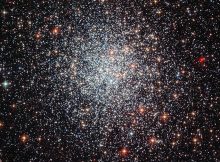
MessageToEagle.com – Globular clusters – glittering, dense swarms of stars – are among the most striking objects in the universe. It had long thought globular clusters formed their
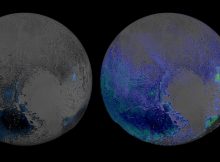
MessageToEagle.com – Water ice is surprisingly abundant on Pluto’s surface, a new map of the dwarf planet reveals. Scientists created the map using data collected by NASA’s New Horizons
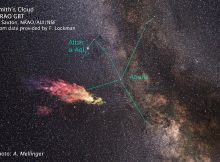
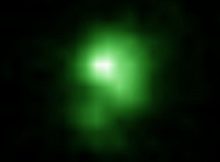
MessageToEagle.com – Since astronomers discovered the Smith Cloud, a giant gas cloud plummeting toward the Milky Way, they have been unable to determine its composition, which would hold clues
MessageToEagle.com – An analysis of three published and two unpublished cuneiform tablets from the British Museum has revealed that Babylonian astronomers used geometry to calculate the motions of Jupiter
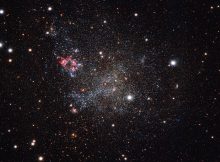
MessageToEagle.com – There is a beautiful small galaxy C 1613 located in the constellation of Cetus (The Sea Monster). It is now confirmed that IC 1613 – well-studied due to its
MesageToEagle.com – An international team of astronomers from UK, USA and Australia have found a planet designated as 2MASS J2126, which was thought to be a free floating or
MessageToEagle.com – Invisible structures shaped like noodles, lasagne sheets or hazelnuts could be floating around in our Galaxy radically challenging our understanding of gas conditions in the Milky Way.
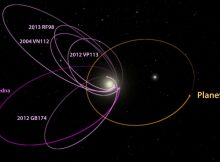
MessageToEagle.com – The mythical “Planet X” may actually be real, and scientists are calling it “Planet Nine.” Astronomers have found evidence for a planet 10 times more massive than
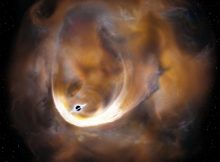
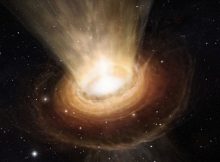
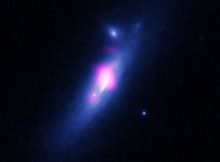
MessageToEagle.com – Astronomers using the Nobeyama 45-m Radio Telescope have detected signs of an invisible black hole with a mass of 100 thousand times the mass of the Sun
MessageToEagle.com – Scientists with NASA’s New Horizons mission have assembled this highest-resolution color view of one of two potential cryovolcanoes spotted on the surface of Pluto by the New
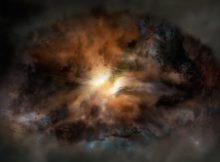
MessageToEagle.com – Astronomers have recently discovered a far-off galaxy W2246-0526, 12.4 billion light-years from Earth, which is the most luminous galaxy known, according to research published in 2015, based on
MessageToEagle.com – About 13 billion years ago, the universe began to heat up and it was so hot and dense that matter was ionized instead of being in a
MessageToEagle.com – Eta Carinae is the most luminous and massive stellar system within 10,000 light-years. It is best known for an enormous eruption seen in the mid-19th century that
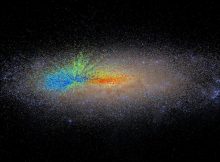
MessageToEagle.com – The first complete age map of the Milky Way shows that the galaxy grew from the inside out. To construct the map, scientists measured the composition and
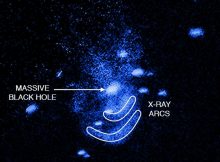
MessageToEagle.com – Astronomers, using NASA’s Chandra X-ray Observatory, have discovered evidence of powerful blasts produced by a giant black hole centered in the small galaxy NGC 5195, located 26
MessageToEagle.com – The first stars were made from completely pristine gas, and astronomers think they formed quite differently from stars today. Astronomers have long theorized the existence of these
MessageToEagle.com – There is a chance – just a chance – that if black holes rule the universe, they could have “switched on” habitable planets, such as Earth,
MessageToEagle.com – A curious X-shaped feature located in the Pluto’s region known as Sputnik Planum, is clearly visible in the image recently delivered home by NASA’s New Horizons spacecraft.
MessageToEagle.com – An unusually star-deprived black hole at the site of two merged galaxies is showing that these massive gravitational voids can shed weight too, according to astronomers. The
MessageToEagle.com – When the Fukang meteorite slammed into the surface of Earth, one suspected this extraterrestrial gemstone could mirror the stellar beauty of the cosmos, and it really did.
MessageToEagle.com – Sophisticated ESO telescopes give astronomers an opportunity to conduct advanced search for the largest gravitationally bound structures in the Universe — galaxy clusters. Observations by the VLT and
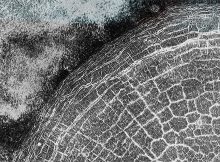
MessageToEagle.com – A lacy web of bright frost-filled fractures fills a crater near the north pole of Mars in this image, acquired Sept. 20, 2015 with the HiRISE camera
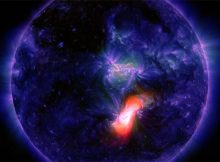
MessageToEagle.com – You can say what you like about our nearest star, but as this latest solar eruption proves, it certainly has impeccable timing. On Monday (Dec. 28), a
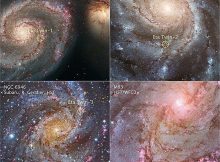
MessageToEagle.com – The Wide Field Planetary Camera 2 (WFPC2) was Hubble’s workhorse camera for many years. One of Hubble’s most important instruments was used to observe just about everything. WFPC2 delivered many