


Eddie Gonzales Jr. – MessageToEagle.com – Increasingly hot, dry and windy conditions could substantially extend the area affected by wildfires across Europe, according to a new study led by the Potsdam Institute for Climate Impact Research (PIK) with contributions from the Senckenberg Society for Nature Research.
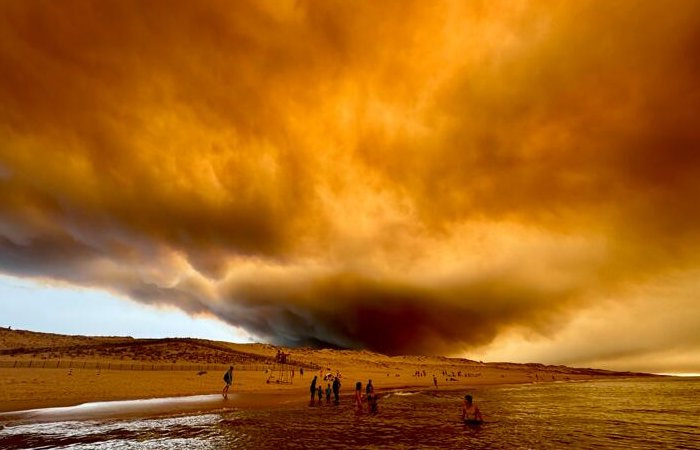
Climate change is intensifying wildfire conditions across Europe, with burned areas projected to increase even under relatively low warming. Photo: Stefan Rahmstorf
In a low emissions scenario (SSP1-2.6), the researchers calculate roughly 39 percent more land would be burnt per year by the end of the century compared to today’s average. In a high emissions scenario (SSP3-7.0), it would be around 192 percent.
While emissions reductions are crucial to reducing the impacts of fires, the results also show that improvements in prevention, early detection and firefighting have a key role to help to reduce the scope of area affected.
“Climate change is driving up fire activity across Europe as hot, dry and windy conditions become more severe,” said Maik Billing, researcher at PIK and lead author of the study published today in Global Change Biology.
“Our results indicate there could be widespread increases in burned area even under comparatively low warming of around 1.8°C. But if we emit more, and global temperatures rise by roughly 3.6°C, we see fires become much more prevalent, especially around the Mediterranean and across much of Western and Central Europe, including areas that to date have not experienced many fires,” Billing added.
The researchers compared the projected annual average in 2070-2100 with the reference modelled period 2000-2030.
Investment needed to keep up with rising fire conditions
The paper also employs a second approach developed by the Senckenberg co-authors that models the effects of human action to prevent, detect and fight fires in a world with higher temperatures. Continued improvements in fire management have the potential to reduce burned area by 92 percent in a 1.8°C future and 72 percent at roughly 3.6°C. However, the authors cautioned that the results could be optimistic when it comes to the efficacy of fire management in a much warmer climate.
“We see fire conditions are increasing, so we need to invest more. If Europe increases investment in wildfire management: training fire crews, proper equipment, good coordination etc., our projections show that this can make a significant difference. But if fires become really extreme, our ability to contain them might break down and we do not know yet where this point is. The recent record fires in France clearly show that we cannot simply extrapolate from the experiences of the past,” commented Senckenberg scientist and study co-author Thomas Hickler.
The findings come amid another severe wildfire season in Europe. According to the European Forest Fire Information System (EFFIS), around 550,000 hectares have burned across the EU as of 12 August 2026, about two and a half times the (20-year) average for this point in the year.
“The fires in France, Spain and Greece show how quickly hot, dry and windy weather conditions can stretch firefighters and their resources,” says Kirsten Thonicke, PIK scientist and co-author of the study.
“With climate change, conditions could become so extreme that we really hit limits to what we can do to prevent and fight fires once they get to a certain size. So, reducing emissions is absolutely essential, together with strengthening local fire management,” Thonicke concluded.
Written by Eddie Gonzales Jr. – MessageToEagle.com Staff Writer