
Climate Change Leads To More “Supercell Thunderstorms” In Europe
Eddie Gonzales Jr. – MessageToEagle.com – Supercell thunderstorms are among the most dangerous weather phenomena in Europe.
These particularly intense thunderstorm cells usually occur in summer. They are characterized by a rotating updraft—that is, rising, warm, moist air—and bring with them violent gusts of wind, large hail, and heavy rainfall. Supercell thunderstorms regularly cause significant property damage, crop losses, traffic disruption, and injuries or even deaths.
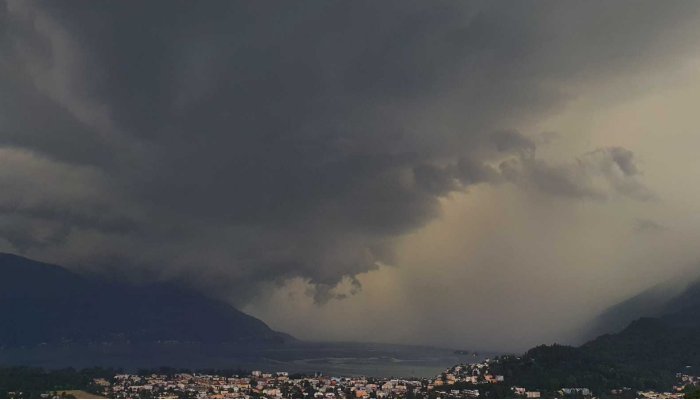
A supercell thunderstorm over Lake Maggiore, photographed from Locarno Monti. (Image: Luca Panziera / MeteoSwiss)
A team of researchers from the University of Bern and ETH Zurich has now succeeded in simulating the frequency of these storms in Europe in greater detail than ever before. The researchers created a high-resolution digital storm map that can depict individual thunderstorm cells much more precisely than previously possible. Using this map, the research team also investigated how climate change will affect the frequency of supercell thunderstorms.
The results of the study show that the Alpine region and parts of Central and Eastern Europe must prepare for significantly more frequent storms – particularly on the northern side of the Alps, supercell thunderstorms could increase by up to 50 percent. This is under a warming scenario of three degrees Celsius compared to the pre-industrial average.
Observations and simulation agree well
Supercell thunderstorms are monitored in Europe via weather radar. However, the individual radar networks in European countries vary in their development and often do not work together. “This makes cross-border, comprehensive recording and analysis difficult,” says corresponding author Monika Feldmann from the Mobiliar Lab for Natural Risks and the Oeschger Centre for Climate Research at the University of Bern.
The researchers therefore used a novel climate model for the first time, which simulates the formation and progression of a supercell thunderstorm with an accuracy of 2.2 kilometers. The simulation was developed as part of the scClim project (see box).
The researchers created a simulation of supercell thunderstorms that ran for eleven years. They compared this with data from actual storms that occurred between 2011 and 2021. “The simulation corresponds well to reality, but shows slightly fewer thunderstorms than actually recorded,” says Feldmann. This is because the model can only represent supercell thunderstorms that are more than 2.2 kilometers across and last longer than an hour. However, some storms are smaller and shorter in duration.
Alpine region remains a “thunderstorm hotspot”
In particular, the simulation shows a “hotspot” for supercell thunderstorms over the Alps, Feldmann adds. This clustering corresponds to observations of around 38 supercell thunderstorms per season on the northern slopes of the Alps and 61 on the southern slopes. With global warming of three degrees Celsius compared to the long-term average, they will continue to cluster in the Alpine region. Accordingly, up to 52 percent more storms are expected on the northern slopes of the Alps, and up to 36 percent more south of the Alps.
In contrast, the simulation shows that the frequency is decreasing on the Iberian Peninsula and in southwest France. Overall, however, an 11 percent increase in supercell thunderstorms is expected across the entire European continent. According to the researchers, this demonstrates how differently climate change can impact Europe.
A few thunderstorms cause the most damage
The project contributes to more accurate forecasting of supercell thunderstorms. Although they account for only a fraction of all thunderstorms, they pose a significant proportion of thunderstorm hazards. They are also a significant driver of financial storm damage. The researchers emphasize the importance of systematically incorporating supercell thunderstorms into weather risk assessments and disaster management strategies. The increase in supercell thunderstorms poses growing challenges to society because the potential damage to infrastructure, agriculture, and private property is increasing, and the population is at greater risk.
Written by Eddie Gonzales Jr. – MessageToEagle.com Staff Writer
Related Posts
-
 The Pacific Slope Of Peru Is Greening And This Is Not Good News
-
 Will Climate Change Turn The Arctic Green?
-
 Climate Change’s Impact On Earth’s Rotation
-
 Why ‘Stealthy’ Volcanoes Erupt Without Warning – Alaska Volcano Could Help
-
 Investigating New Hydrothermal Vents 3, 000 Meters Deep Off Svalbard
-
 Reconstruction Of Antarctic Glaciers Using 1, 000 Historical Photos To Show Pre-Collapse State
-
 Some Of Today’s Earthquakes May Be Aftershocks From Quakes In The 1800s
-
 How Waves And Mixing Drive Coastal Upwelling Systems
-
 New Trigger Proposed For Record-Smashing 2022 Tonga Eruption
-
 Meltwater Flowing Beneath Antarctic Glaciers May Be Accelerating Their Retreat

