


Eddie Gonzales Jr. – MessageToEagle.com – Comets didn’t seed life on Earth after all, a new study suggests, potentially overturning a century-old idea.
The theory that comets delivered the molecular building blocks for life on Earth is long-standing, since comets are known to carry many of these molecules.
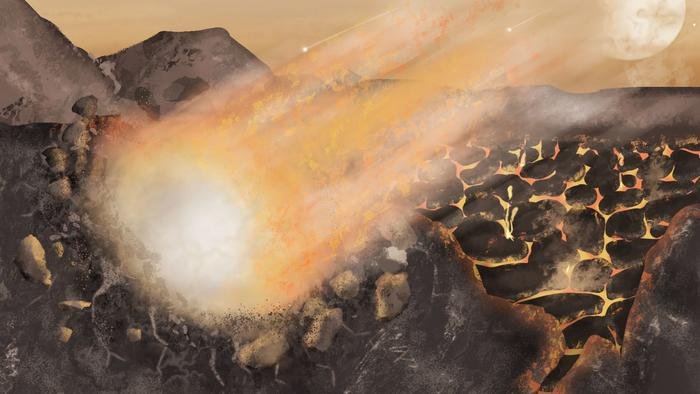
Illustration of cometary impact. Image credit: Scarlett White – Image source – University of Cambridge
However, a new study challenges this idea.
The researchers, led by the University of Cambridge, found the cometary delivery of these building blocks would be – at best – a ‘one-off fluke’, and not the steady rain of prebiotic molecules that had been theorized.
Using computer modeling, the researchers determined that comets travel too fast and at too sharp an angle to Earth’s atmosphere for the fragile organic molecules to survive: they would almost certainly vaporize on impact with the surface. However, the researchers also found that another planet in our system – Mars – could be a slightly more promising candidate for cometary delivery of prebiotic molecules, although this is still highly unlikely. The results are published in the journal Scientific Reports.
“Historically, scientists thought that comets were important for the origin of life on Earth, because they carried carbon- and nitrogen-bearing molecules, so these giant space snowballs were almost like a ‘get out of jail free card’ that brought all the molecules a planet would need to seed life,” said lead author Dr Richard Anslow from Cambridge’s Institute of Astronomy. “It’s kind of a romantic idea, but our results suggest it’s highly unlikely.”
In 2023, Anslow and several of his co-authors on the current paper theorized that in systems where planets orbit closely together, comets might slow down by ‘bouncing’ from one planet to the next, delivering organic molecules as they went.
Building on the earlier study, Anslow and his colleagues investigated whether such a scenario might be possible in our own Solar System. “We’re learning more and more all the time about how our Solar System and the Earth formed, and pulling this together with lots of different advances in modeling, which allowed us to investigate this idea that has been around for close to a century,” he said.
However, the new study shows just how rare that scenario is. The researchers used recent advances in comet impact simulations, comet-atmosphere interactions, and dynamic modeling of the origin and evolution of comets to conduct their study. Taken together, the researchers found that while the successful delivery of prebiotic molecules cannot be ruled out completely, it would be extremely unlikely.
For their study, the researchers focused on hydrogen cyanide (HCN), an important prebiotic molecule that is regularly found on Solar System comets. Their simulations showed that even if HCN molecules survived impact with Earth, impacts delivering a useful concentration were extremely uncommon.
The number of comets hitting the Earth declined rapidly in our planet’s first 500 million years, and there were, at most, a handful of opportunities in Earth’s early history for HCN delivery on a comet. Even if HCN carried on a comet made it to Earth’s surface, it would not have stayed concentrated for long, meaning any prebiotic chemistry would have needed to progress very quickly after impact, which the researchers say is highly unlikely.
“It would really have to be a one-in-a-million occurrence, because not only would you need an impact at just the right speed and just the right angle, you would also need everything to happen after that point, in terms of the concentration and the speed at which the chemical origins of life got going,” said Anslow. “We can’t rule out for certain that it happened that way. But it seems to be a really rare occurrence – at best, a one-off fluke.”
So where did the molecular seeds of life on Earth come from? The researchers say there are several possibilities, including the synthesis of these molecules after asteroid impacts, which hit Earth far more frequently than comets. Or chemical precursors formed through processes on Earth itself, without any outside interference.
Although cometary delivery of HCN and other prebiotic molecules to Earth seems highly unlikely, the researchers found that one of our closest neighbors could be a better candidate. Because Mars is smaller than Earth and currently has a much thinner atmosphere, comets would have been much more likely to reach the planet’s surface during the Solar System’s development, when comets were far more frequent visitors.
“This is not to say it definitely happened on Mars, of course, but suggests it would be unlikely if it happened on Earth and didn’t happen on Mars,” said Anslow. “Or the other, perhaps more likely, alternative is that it didn’t happen on either planet.”
The researchers say their results could be useful when searching for life in other systems, especially when the successors to the James Webb Space Telescope (JWST), such as the proposed Habitable Worlds Observatory, come online. Identifying systems where ‘bouncing’ comets could exist could be one way that future astronomers could narrow their search.
Written by Eddie Gonzales Jr. – MessageToEagle.com Staff Writer