
Continental Uplift And Its Critical Role In East Antarctic Ice Sheet Formation
Eddie Gonzales Jr. – MessageToEagle.com – The formation of Antarctica’s vast East Antarctic Ice Sheet – the largest and oldest ice sheet on Earth – may have been driven not only by falling atmospheric carbon dioxide but also by the slow uplift of the continent itself, according to a new study.
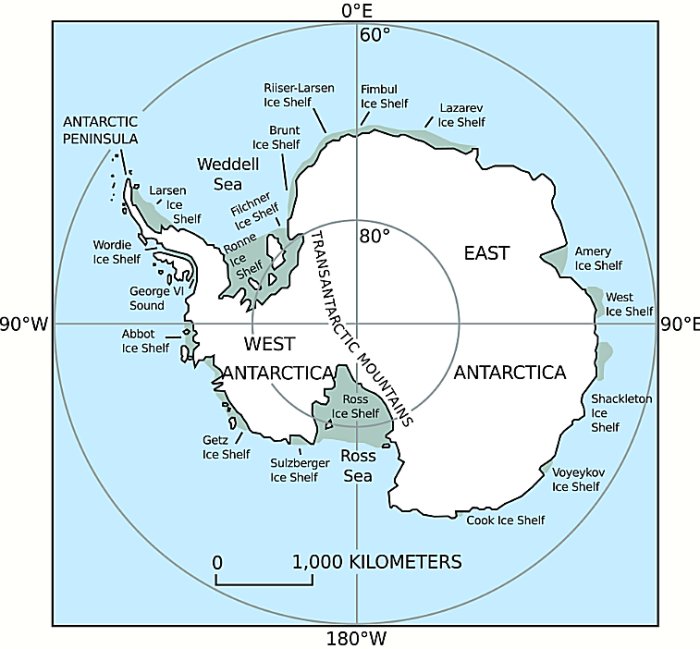
Map of Antarctica. – https://pubs.usgs.gov/fs/2005/3055/
The study shows how interactions among tectonics, topography, climate, and ice-sheet dynamics can fundamentally shape Earth’s long-term climate evolution.
Its formation roughly 34 million years ago is widely attributed to a decline in atmospheric carbon dioxide (CO2), which triggered global cooling and glaciation. However, if the decline of CO2 alone drove this glaciation, a broad, synchronous cooling affecting both hemispheres should be evident. Instead, the Northern Hemisphere did not glaciate until more than 20 million years later, and evidence suggests that some parts of the Southern Ocean remained relatively warm for millions of years after the EAIS began to grow.
So how did the EAIS form?
Researhers argue that uplift of the Antarctic continent may have played a critical role alongside falling CO2 levels. To test this theory, the team used a variety of geodynamic models, topographic reconstructions, ice-sheet models, and energy balance models to understand the long-term interaction between tectonic uplift, climate, and ice growth during the Eocene in the Dronning Maud Land and Gamburstev Mountain regions of Antarctica.
The authors found that the formation of the EAIS was the culmination of a chain of geological and climatic events that began more than 120 million years earlier with the breakup of the Gondwana supercontinent.
This tectonic reorganization gradually uplifted Antarctica’s interior regions, creating high-altitude plateaus and mountain ranges that became cold enough to sustain extensive snow and ice accumulation by 45-40 million years ago. This regional uplift enabled rapid ice-sheet expansion, despite the surrounding Southern Ocean being relatively warm.
Source – American Association for the Advancement of Science via EurekAlert
Written by Eddie Gonzales Jr. – MessageToEagle.com Staff Writer
Related Posts
-
 Oceans Emit More Sulfur And Cool The Climate More Than Previously Thought
-
 Surprising Mechanism: Volcano Cleans Up After Itself By Removing Methane From The Air
-
 Extinct Volcanoes Are Abundant Source Of Rare Earth Elements
-
 Unraveling The Mysteries Of Fog In Complex Terrain
-
 Gibraltar Subduction Zone Will Contribute To Forming An Atlantic Ring Of Fire – New Study
-
 New GPS Technology Can Measure Daily Ice Loss In Greenland
-
 Artificial Light At Night Indicate Rapidly Increasing Industrial Activities In The Arctic
-
 Machine Learning Uncovers 10 Times More Earthquakes In Yellowstone Caldera
-
 Ancient Plant Wax Reveals How Global Warming Affects Methane In Arctic Lakes
-
 Largest Ice Shelf In Antarctica Lurches Forward Once/Twice Each Day

