
First Ice Core From The European Alps Dating Back To The Last Ice Age – Found
Eddie Gonzales Jr. – MessageToEagle.com – Ice cores serve as valuable archives, containing evidence that spans 12,000 years of human and environmental history. They provide crucial insights into past climates, atmospheric conditions, and even human activities over millennia.
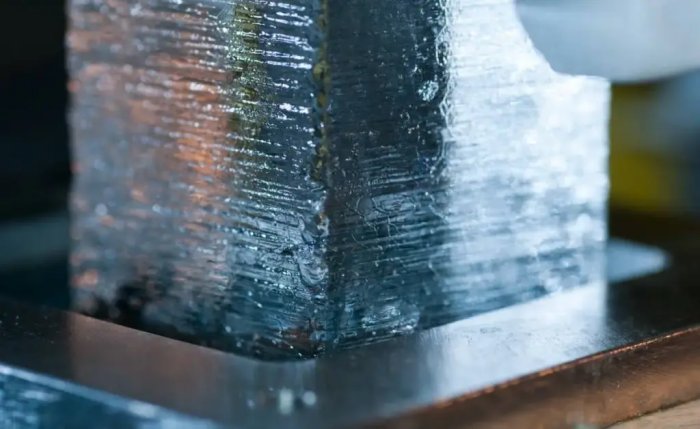
An ice sample on the melter during continuous ice core chemical analyses in the lab (credit: Sylvain Masclin).
Glaciers hold layers of history preserved in ice, offering unique insights into Earth’s past that can also help us interpret the future. Trapped amidst the frozen water are microscopic deposits of dust, pollen, and even pollutants that scientists can use to examine environmental changes through time.
DRI’s Ice Core Lab has used this technique to highlight atmospheric lead pollution and economic turbulence in Ancient Rome. Now, their latest study found that a glacier in the French Alps dates back the last Ice Age – the oldest known glacier ice in the region. Serving as a record that spans through the development of agriculture in Western Europe and the advent of industrialization, the glacier holds insights into an era of rapid change.
The new study, published in the June issue of PNAS Nexus, examines a 40-meter long ice core from Mont Blanc’s Dôme du Goûter. Using radiocarbon dating techniques, the research team found that the glacier provides an intact record of aerosols and climate dating back at least 12,000 years.
Aerosols are small droplets and particles in the air such as desert dust, sea salts, sulfur from volcanic eruptions, soot from forest fires, as well as pollutants and other emissions from human activities. Glacier ice offers the most detailed record of past atmospheric aerosols, and this is the first ice core record from the European region that extends back to the last climatic transition. Aerosols play an important role in regional climate through their interactions with clouds and solar radiation, and the insights offered by the ice record can help inform accurate climate modeling for both the past and future.
“For the first time, we have a fairly complete Alpine record of atmospheric and precipitation chemistry going all the way back to the Mesolithic Period,” said Joe McConnell, Director of DRI’s Ice Core lab who co-authored the study.
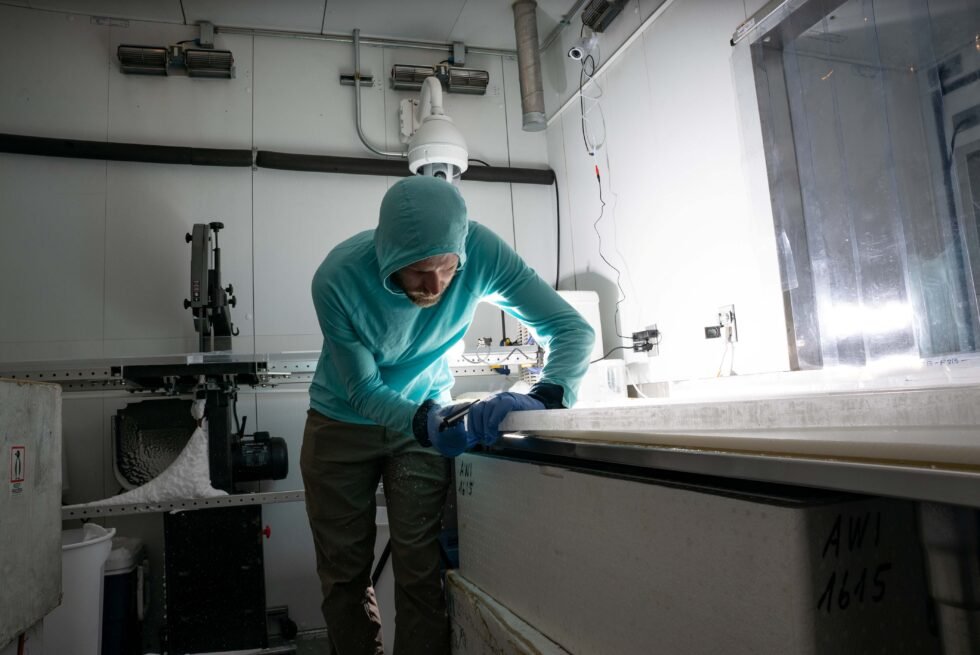
Study coauthor Nathan Chellman carefully preparing longitudinal ice core samples for high-resolution measurements in DRI’s Ice Core Lab (credit: Jessi LeMay).
“And that’s a big deal, because you have two major climate states – glacial and interglacial – and to get a record of atmospheric precipitation chemistry across that huge climate change tells you the most extreme natural aerosol concentrations that you’d expect. On top of that, you have humans going from hunter-gatherers with a very low population through the development of agriculture, domestication of animals, mining, etc, and then a vast population increase and the clearing of land. All of that is happening around this ice core site. It spans the full range of natural and anthropogenic change, and it’s right in the center of Europe – where much of Western civilization evolved.”
The glacier’s location in the Alps is important because it serves as a more intact record of Europe’s local climate than those found in distant Arctic ice. Many aerosols play important roles in driving Earth’s climate, so scientists would like to know how sources and concentrations in the air have varied in the past.
“Ice cores collected from glaciers and ice sheets can provide such information, but since these droplets and particles stay in the air only for a few days to maybe a week, records developed from glaciers close to the sources often are the most informative,” said lead author, Michel Legrand.
The ice core analyzed in this study was first collected in 1999 by some of the study’s French authors. It was stored in a freezer in France for more than 20 years before McConnell and his team brought it to DRI’s Ice Core Lab in Reno, Nevada, where specialized equipment and methods known as continuous flow analysis allowed it to be melted down and the chemistry measured, layer by icy layer.
“Determining what year or period of time a layer in the ice represents can be challenging, so here we used a unique combination of radiometric methods to establish the chronology in the ice,” said coauthor Werner Aeschbach.
“We were relieved to find that even under the unusually warm climate of the 20th century, the cold temperatures at over 14,000 feet near Mont Blanc’s peak had preserved the glacier so that the ice record hadn’t yet been impacted by melting,” said co-author Nathan Chellman.
Written by Eddie Gonzales Jr. – MessageToEagle.com Staff Writer
Related Posts
-
 Lightning Storms Contribute To The Accelerated Rate Of Sea Ice Melting At The North Pole
-
 600-Million-Year-Old Ocean Water From Himalayas Provides Clues To Earth’s Past
-
 Alaska’s Rusting Waters: Pristine Rivers And Streams Turning Orange
-
 Super Bolt Lightning Over the Mediterranean Sea and the Altiplano – A Possible Cause
-
 Scientists Discover Key To Taming Unrest At Italy’s Campi Flegrei
-
 Giant Ice Bulldozers: How Glaciers Shaped Life Evolution
-
 Wind Patterns Can Predict Record-Low Antarctic Sea Ice Months In Advance
-
 Ancient Sediment Beneath The Pacific Ocean Reveals Earth’s History
-
 Heat From The Sun Affects Seismic Activity On Earth
-
 20 Million Years Of ‘Hot Spot’ Magmatism Under The Cocos Plate – Unearthed

