
Football-Field-Sized Balloon Takes Flight Over Antarctica In Quest For Dark Matter Answers
Eddie Gonzales Jr. – MessageToEagle.com – A groundbreaking scientific experiment aimed at detecting dark matter in space launched from Antarctica on December 15, with significant contributions from the University of Hawai’i at Manoa.
The General AntiParticle Spectrometer (GAPS) experiment is suspended from a football-field-sized balloon approximately 24 miles above Antarctica to search for rare cosmic antimatter that could help unlock the mysteries of dark matter, one of physics’ most perplexing phenomena.
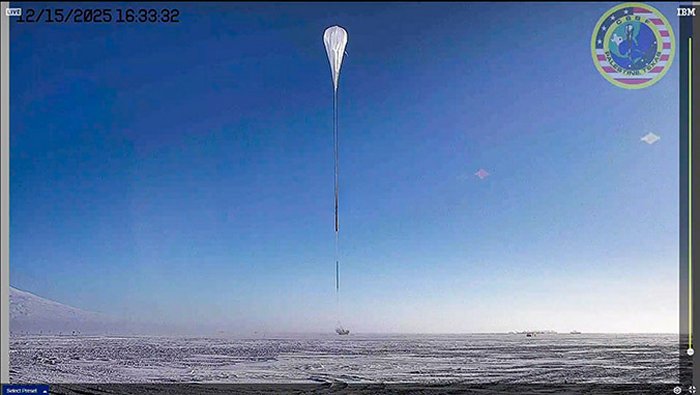
A snapshot of the GAPS experiment launch on December 15. Source
Dark matter makes up about 85% of all the mass in our universe, yet we can’t see it or directly detect it—we only know it exists because of how it affects things around it through gravity. Understanding dark matter would help us grasp what most of the universe is actually made of and potentially reveal fundamental new physics that could revolutionize our understanding of how everything works.
International partners work on mystery
UH Manoa received $1.4 million, part of a larger NASA grant, in support of the project, and has been playing a leading role in developing the experiment, which is executed in collaboration with researchers from Columbia University, UCLA and Northeastern University, alongside international partners from Japan, Italy and China.
“This experiment puts Hawai?i at the forefront of one of the biggest mysteries in modern physics,” said Philip von Doetinchem, project lead and UH Manoa Department of Physics and Astronomy professor. “Our students and researchers at UH Manoa are helping lead a quest to understand what makes up a large fraction of our universe, showing that groundbreaking science is happening right here in our islands.”
The UH GAPS flight operations team is composed of Research Corporation of UH researcher Achim Stoessl, graduate student Grace Tytus and Doetinchem. In addition, Cory Gerrity was instrumental for on-campus detector development tasks during the pandemic, which was also supported by undergraduate student Hershel Weiner.
The experiment seeks to detect antiprotons and antideuterons (antimatter particles that are used in research to study dark matter and other phenomena), which scientists believe could provide crucial evidence about the nature of dark matter. While researchers have observed dark matter’s gravitational effects, its fundamental properties remain unknown.
GAPS utilizes NASA balloon facilities similar to previous Antarctic experiments, including one that recently challenged standard physics models. The project builds on years of preparation, including extensive detector calibration work at UH Manoa and integration testing at multiple NASA facilities.
Written by Eddie Gonzales Jr. – MessageToEagle.com Staff Writer
Related Posts
-
 Star Formation That Began As Early As 250 Million Years After The Big Bang
-
 NASA’s Fermi Detects First Gamma-Ray Eclipses From ‘Spider’ Star Systems
-
 Comets’ Heads Can Be Green, But Never Their Tails: After 90 Years, We Finally Know Why
-
 NASA’s Spitzer Space Telescope Ended Its Great Mission
-
 NASA Finds India’s Vikram Lunar Lander With Help Of A Chennai Engineer
-
 Radio Black Hole Trio Lights Up in Rare Galaxy Merger
-
 Japanese Jumping Robotic Rovers Deliver Amazing Images From Surface Of Asteroid Ryugu
-
 Mystery Crater Potentially Caused By Relative Of Dinosaur-Killing Asteroid
-
 NASA’s James Webb Telescope Images Star Formation Fireworks
-
 Quadruple Stars That May Spark Supernova Explosions – Spotted

