


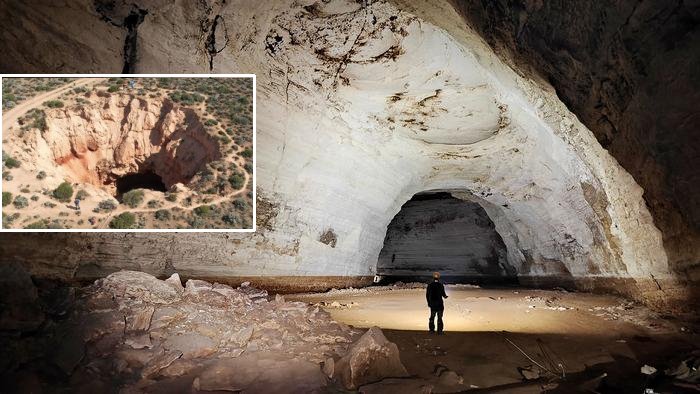


Eddie Gonzales Jr. – MessageToEagle.com – Mysterious trenches stretching for kilometers across southern Australia’s Nullarbor Plain have been revealed as the surface footprints of deep, hidden ancient cave systems.
New research from Curtin University found that shallow, sediment-filled trenches formed as underground caves gradually collapsed and eventually reached the surface.
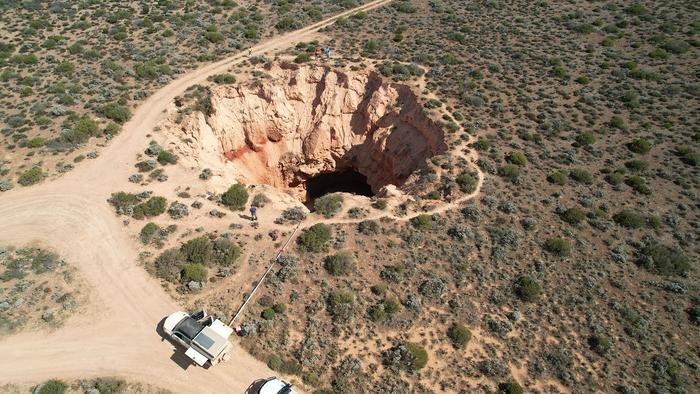
Nullarbor Plain cave opening. Image credit: Matej Lipar
This challenges the idea that they were carved out by flowing water, as their appearance might suggest.
The findings provide a new way to identify hidden cave systems in dry landscapes on Earth and could help scientists interpret similar features on Mars and other planetary surfaces.
Lead author Dr Matej Lipar, who at the time of the research was an Adjunct Research Fellow in Curtin’s School of Earth and Planetary Sciences, and is now at the Anton Melik Geographical Institute at the Research Centre of the Slovenian Academy of Sciences and Arts (ZRC SAZU), said the trenches were difficult to recognise as evidence of underground caves because their surface features were so subtle.
“From the surface, these features can look remarkably like shallow valleys or drainage channels, but our evidence shows they have a very different origin,” Dr Lipar said
“By combining mapping, geophysical surveys, cave records and sediment analysis, we found these trenches are linked to deep cave systems beneath the Nullarbor Plain.
“Over time, the cave roofs progressively collapsed causing sagging of overlying material, eventually creating shallow depressions at the surface.”
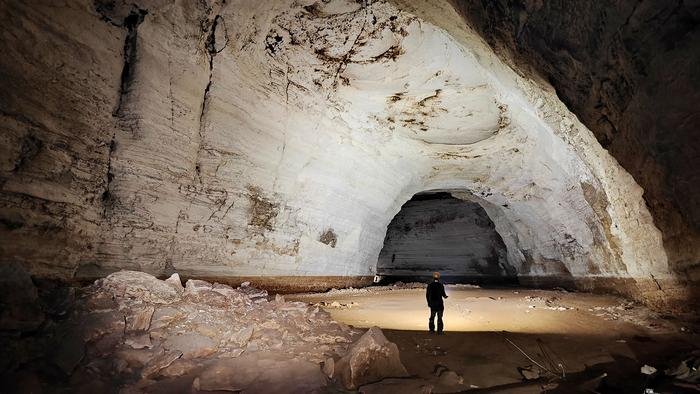
Researchers explore underground cave. Image credit: Matej Lipar
Dr Lipar said the trenches can range from several kilometres to more than 20 kilometres long and are generally 100 to 500 metres wide, but at less than nine metres deep are hard to see on the huge expanse of the Nullarbor Plain.
“Because the landscape is so vast, it appears to be a flat, endless plain. But when we created exaggerated digital models of the terrain, the trenches became much easier to see and identify.” Dr Lipar said.
“Unlike typical valleys, the trenches don’t have connected streams or other signs that water once flowed through them. Instead, geophysical surveys found deep underground cavities, while several trenches lined up with known caves and areas where the ground has collapsed.”
The researchers also identified a progression from obvious cave-connected collapse features in the west to wider, more subtle trenches further east, showing how cave collapse can progressively reach the surface depending on the thickness of rock.
Curtin co-author Associate Professor Milo Barham, from the Curtin Frontier Institute for Geoscience Solutions (CFIGS) and School of Earth and Planetary Sciences, said the findings could change how scientists interpret similar subtle landscape features elsewhere.
“Cave systems are not always obvious from the surface, but the dry and stable landscape of the Nullarbor is excellent for removing a lot of “noise” to allow us to recognise subtle landscape characteristics,” Associate Professor Barham said.
“This gives us a useful set of indicators for identifying hidden cave systems elsewhere – including on other planets such as Mars.
“Caves are important as they can preserve evidence of past environments on Earth and impact our engineering and access to clean drinking water, while potential caves on other planets could provide protected subsurface environments relevant to the search for evidence of extraterrestrial life or act as bases for future astronauts.”
Written by Eddie Gonzales Jr. – MessageToEagle.com Staff Writer