


Eddie Gonzales Jr. – MessageToEagle.com – About 17 percent of Earth’s land is covered by permafrost, and many other regions freeze seasonally. As climate change causes more freeze-thaw cycles and damages permafrost, ice-driven processes may be releasing iron and other trace elements faster than current environmental models predict.
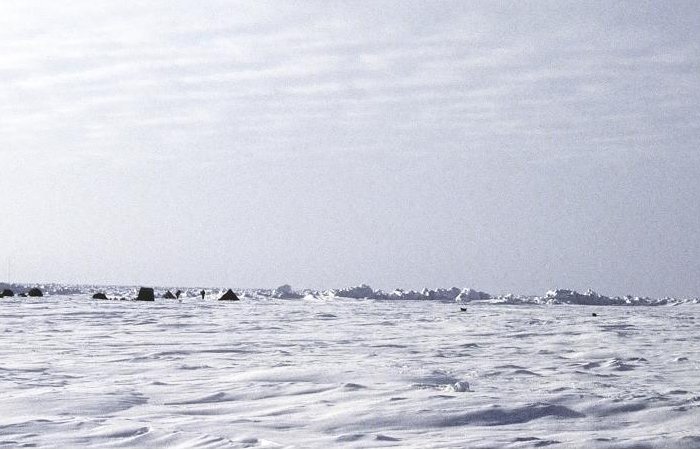
Multi-year pack ice at the Geographic North Pole . In mid-April 1990, the flat ice floes here showed a thickness of 2.5 meters. Image credit: – CC BY-SA 4.0
“To understand how climate change affects natural systems, we also need to understand the chemistry inside ice,” says Jean-François Boily, Professor at the Department of Chemistry, who led the study.
Iron is a key nutrient that controls algae growth in lakes and oceans, binds carbon in soils, and affects water color and quality. Changes in iron release could therefore have cascading effects on ecosystems from mountain streams to Arctic coastlines.
The stronger the binding, the greater the boost
The research group looked at how different dissolved salts, found everywhere in nature, affect iron minerals. They specifically examined the dissolution of goethite, a rust-colored iron mineral abundant in soils, sediments, and dust.
“The result was remarkably clear. Ice boosted the dissolution rate for every salt that binds to iron, and the stronger the binding, the greater the boost,” says Jean-François Boily. “This reveals a simple rule: If you know how strongly a substance binds to iron, you can likely estimate how much ice will amplify its.”
Fluoride, the strongest binder tested, released more than four times as much iron in ice as in liquid water. Sulfate, a weaker binder, showed a smaller but still measurable boost. Perchlorate, which barely interacts with iron at all, produced no dissolution in either phase.
Valuable tool for modeling
The mechanism lies in what happens when water freezes. Substances that cannot be incorporated into the ice are concentrated into tiny pockets of remaining liquid trapped between ice crystals. In these environments, where salt concentrations can increase up to 500-fold, chemical reactions can proceed much faster, which helps explain the increased breakdown of minerals observed in the study.
“What surprised us most was how consistent this effect appeared across the compounds we tested. If the pattern holds more broadly, we could potentially predict ice-enhanced mineral breakdown based on a single chemical property. That would be a valuable tool for environmental modeling,” says Jean-François Boily.
Written by Eddie Gonzales Jr. – MessageToEagle.com Staff Writer