
Investigating New Hydrothermal Vents 3, 000 Meters Deep Off Svalbard
Eddie Gonzales Jr. – MessageToEagle.com – Hydrothermal vents exist globally at tectonic plate junctions, with many fields yet undiscovered. In 2022, the MARIA S. MERIAN expedition found the first hydrothermal vent field on the 500-km Knipovich Ridge near Svalbard.
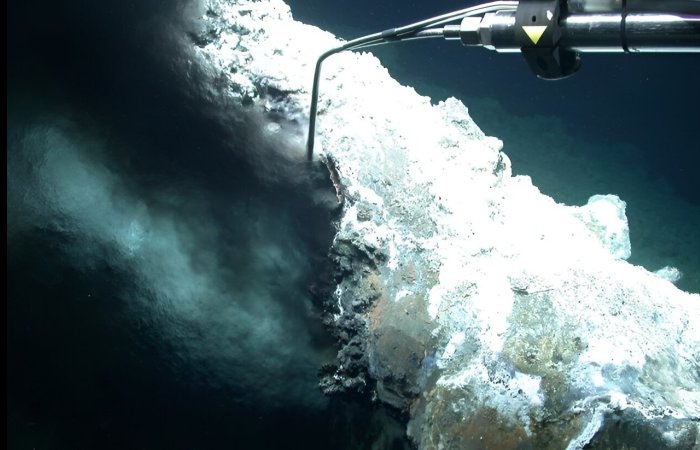
The temperature measurement at the outflow opening of the black smoker revealed fluid temperatures greater than 300°C. Credit: University of Bremen
An international research team, led by Prof. Dr. Gerhard Bohrmann from MARUM and the University of Bremen, reports their discovery in Scientific Reports.
Hydrothermal vents are seeps on the sea floor from which hot liquids escape.
“Water penetrates into the ocean floor where it is heated by magma. The overheated water then rises back to the sea floor through cracks and fissures. On its way up the fluid become enriched in minerals and materials dissolved out of the oceanic crustal rocks. These fluids often seep out again at the sea floor through tube-like chimneys called black smokers, where metal-rich minerals are then precipitated,” explains Prof. Gerhard Bohrmann of MARUM and chief scientist of the MARIA S. MERIAN (MSM 109) expedition.
The remote-controlled submersible MARUM-QUEST sampled a newly discovered hydrothermal field at depths over 3, 000 meters. Named Jøtul after a Nordic mythological giant, the field is on the 500-kilometer Knipovich Ridge.
The ridge is located in the triangle between Greenland, Norway, and Svalbard, marking the boundary of the North American and European tectonic plates. This type of boundary, where plates separate, is called a spreading ridge.
The Jøtul Field is on a very slow spreading ridge, with plates growing less than two centimeters yearly. The expedition studied hydrothermal activity on this understudied ridge type, examining escaping fluids and the characteristics of active and inactive smokers in the area.
“The Jøtul Field is a discovery of scientific interest not only because of its location in the ocean but also due to its climate significance, which was revealed by our detection of very high concentrations of methane in the fluid samples, among other things,” reports Gerhard Bohrmann.
The amount of methane from the Jøtul Field that eventually escapes directly into the atmosphere, where it then acts as a greenhouse gas; it still needs further studies. There is also little known about the organisms living chemosynthetically in the Jøtul Field.
A new expedition of the MARIA S. MERIAN will start in late summer of this year and will focus on exploring and sampling of as yet unknown areas of the Jøtul Field.
With extensive data from the Jøtul Field it will be possible to make comparisons with the few already known hydrothermal fields in the Arctic province, such as the Aurora Field and Loki’s Castle.
source – University of Bremen
Written by Eddie Gonzales Jr. – MessageToEagle.com Staff Writer
Related Posts
-
 Were Our Blue Oceans Once Green?
-
 Rare Thunderstorm Near The North Pole: An Indicator Of A Warming Arctic?
-
 A Window To First Life On Earth – Hidden Deep Within An Inhospitable Desert
-
 Hidden Forces Causing Continents To Rise – A Long-Standing Mystery Is Solved
-
 It’s Not Too Late To Save The West Antarctic Ice Sheet – New Study
-
 Deep-Sea Metallic Minerals Produce ‘Dark Oxygen’ By Splitting Water
-
 Black Carbon In Fire Clouds Developing From High-Intensity Wildfires – Study
-
 Rapid Methane Release Mechanism At The Front Of Retreating Ice Sheets – New Study
-
 Scientific Drilling Unravels Historical Mystery Surrounding Santorini
-
 Computer Simulation Provides 4,000 Scenarios For A Climate Turnaround

