
Legendary Harald ‘Bluetooth’ King of Denmark – ‘Who Made The Danes Christian’
A. Sutherland – MessageToEagle.com –“… Harald who conquered for himself the whole of Denmark and Norway and made the Danes Christian.” – Inscription on the Jelling Stone.
Harald Bluetooth was the younger son of Gorm the Old and Queen Thyra. His father who was also called Gorm the Languid was the first historically recognized King of Denmark, reigning from c. 936 to his death c. 958.
The year of Bluetooth’s birth is unknown; however, according to records of his achievements, he was born sometime around 920 AD.

Harald “Bluetooth” Gormsson was King of Denmark for nearly 30 years beginning in approximately 958 AD when his brother and favored son of Gorm the Old was killed in England during attacks near Ireland.
During his reign, Bluetooth united the outlying tribes of Denmark. He defended his people from many Norwegian and German incursions while overseeing the completion of vast construction projects that strengthened his country’s defenses.
He proved to be a skilled leader of his nation both on and off the battlefield.

This 12th-century gilt plate from Tamdrup Church in Denmark is the oldest illustration of King Harold Bluetooth’s baptism.
Bluetooth is equally known for casting off the Norse pagan traditions and, becoming a devout Christian who strove to peacefully convert the people of Denmark during his rule.
He also commissioned many important construction projects in his country during his reign.
In Bluetooth’s legacy there are so-called “runestones” – monuments that usually honored the dead and their deeds.
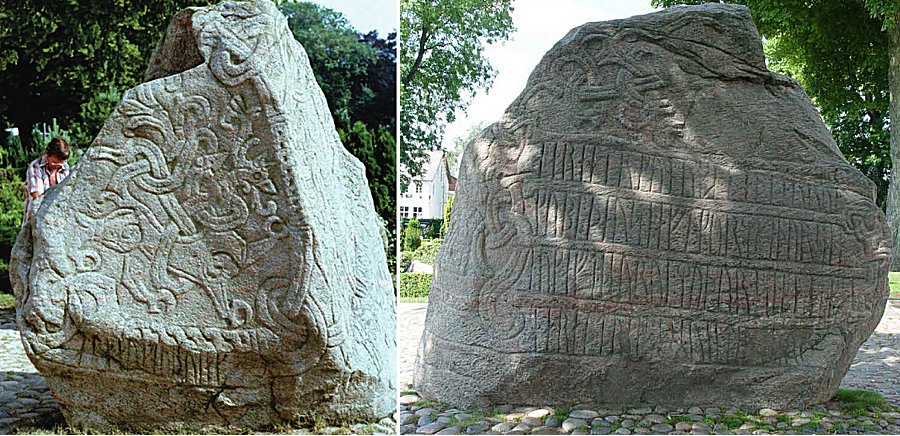
He used the very best counselors and craftsmen for the job. The carving on the stone was carried out by two people: the decorations came first, and then the runes were struck by a runic craftsman. It took about a full year to complete the entire job.
Bluetooth wanted to be remembered for some specific achievements; therefore he erected a runic stone intended to last forever.
He converted to Christianity in 965 and erected a runestone in Jelling, with the inscription:
“… Harald who conquered for himself the whole of Denmark and Norway and made the Danes Christian.”
This runestone is today considered the most well- known example of runic inscriptions in Denmark. Featuring an easily distinguished image of Christ on the cross, the Jelling Stone erected by Bluetooth is often referred to as the “Baptism Certificate of Denmark,” which symbolizes the end of the polytheistic traditions followed by much of the Danish population.
He also honored his parents by Commissioning a second Jelling Stone, which was found in the town of Jelling, Denmark.
Harald “Bluetooth” Gormsson died of wounds received in an uprising against him in 985 or 986.
The success of Harald Bluetooth and people like him was evidence that the Viking Age was beginning to wane.
MessageToEagle.com via AncientPages.com
Expand for referencesRelated Posts
-
 Mystery Of The 1,700-Year-Old ‘Salt’ Mummy With Long White Hair
-
 Lake Huron Was Home To A 9,000-Year-Old Civilization – Underwater Structures And Artifacts Reveal
-
 Is Rh Negative Blood Type Of Extraterrestrial Origin?
-
 What Can The Fate Of Ancient Cities Teach Us About Surviving Climate Change
-
 Denisovans Or Homo Sapiens: Who Were The First To Settle Permanently On The Tibetan Plateau?
-
 Does The Aachen Cathedral Offer Evidence Our Calendar Is ‘Missing’ 297 Years?
-
 Orthodox Church In Black Sea Region Looted By Treasure Hunters
-
 Lost Ancient Texts Of The Star Catalogue Composed By The Greek Astronomer Hipparchus Found
-
 Emerald Production In Eastern Desert Of Roman Egypt – New Evidence
-
 Ji Gong: Legendary Ancient Monk Who Defended People Against Injustice

