


Eddie Gonzales Jr. – MessageToEagle.com – Euclid, launched in 2023, has now discovered 31 new quasars in the early Universe, pushing back to a time when the cosmos was just 5% of its current age.
Quasars represent a brief phase in a galaxy’s life during which large amounts of material spiral into the central supermassive black hole, releasing enormous amounts of energy.
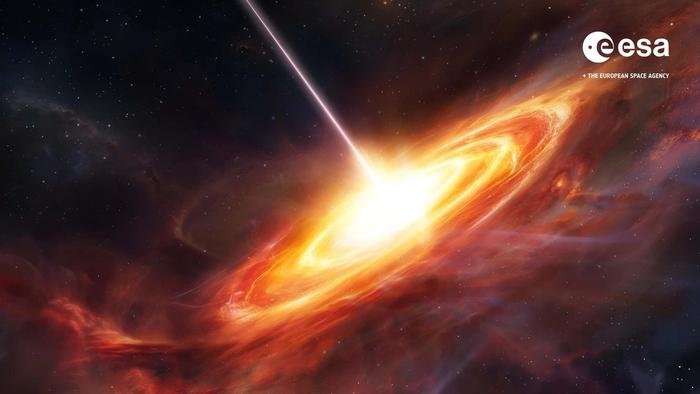
Artist’s concept of an ancient quasar.Image source
In this phase, the galaxy’s nucleus shines more brightly than anything else in the Universe, often outshining the rest of its host galaxy by hundreds to thousands of times.
We’ve been hunting for the Universe’s very first quasars for decades. These objects reveal what was happening during the earliest days of the cosmos, including how the first supermassive black holes and galaxies took shape. However, quasars from this time are difficult to find. They’re rare, as few galaxies had yet had time to grow big enough, and their primordial light is both faint and easy to confuse with that from stars lying closer to us.
“These early quasars date back to the Universe’s infancy,” says Daming Yang of Leiden University in the Netherlands, lead author of the Euclid discovery paper. “By finding and studying them, we can better understand how these enormous systems formed and grew so quickly – one of the greatest mysteries in astrophysics.”
“Euclid is a true game-changer.” adds Daming. “Before, we could only find a handful of the very brightest ancient quasars, but Euclid lets us search far more efficiently across huge areas of sky to capture much fainter light. It’s a unique tool for quasar hunting.”
The earliest quasars we knew of until now were just the tip of the iceberg: the rare and bright outliers that have been easiest to spot. We simply hadn’t found enough quasars from the Universe’s early days to study them properly as a group. Euclid’s new finding changes all that, capturing not just the bright outliers but most of the ancient quasar population.
The discovery adds 12 new quasars at a ‘redshift’ – a measure of distance and motion related to how light moves through our expanding cosmos – of 7 or above, corresponding to the first 770 million years of the Universe.
The two most ancient of the batch, EUCL J172902.75+641018.1 and EUCL J125308.55+705432.3, have redshifts of 7.77 and 7.69, respectively, setting a new record for the most ancient quasars ever found. Both lie just over 13 billion light-years away, and emerged during the Universe’s first 670 million years.
“This finding more than doubles the number of quasars we know of that are so ancient,” says Antonio La Marca, an ESA Research Fellow in the Euclid team. Discovering the first 10 or so quasars at a redshift of 7 or above took astronomers more than a decade – but Euclid has already discovered more than that in a single year.
“The Euclid team has taken a true ‘census’ of quasars at the dawn of the Universe for the first time,” adds Antonio. “It’s a big step towards understanding these fascinating objects on a more fundamental level.”
The second most ancient quasar found by Daming and colleagues was recently studied in more detail by Silvia Belladitta, postdoctoral researcher at the Max Planck Institute for Astronomy in Germany and collaborators. These observations showed that the quasar is embedded in a dusty, gas-filled galaxy that is furiously forming new stars, hinting at what the host galaxy of an early supermassive black hole may be like.
The quasars hark back to a fascinating period in cosmic history known as the ‘epoch of reionisation’: when everything shifted from being cold and dark (the ‘dark ages’) to hot and ‘ionised’ (split apart by energetic light). This transitional epoch was a crucial era that set the stage for everything we see today.
“Ancient quasars are rare discoveries. They’re interesting in themselves, but also time machines that enable us to explore the early Universe and understand how the first generation of galaxies came to be,” says ESA Euclid Project Scientist Valeria Pettorino.
“Euclid’s capabilities are unrivalled. The telescope combines a large area, depth, sharp imaging, and unique space-based infrared vision in a way that lets us pick out rare, extremely distant objects far more efficiently than before.
And it’s not just the telescope: the data processing is only possible thanks to thousands of Euclid Consortium scientists and engineers working together to deliver scientific discoveries, sifting through enormous datasets to identify rare, distant quasars that we can study further using telescopes on the ground.”
The 31 quasars reported here were discovered in data from the Euclid Wide Survey, which will cover more than one-third of the total sky once complete. Euclid will reveal the secrets of the dark Universe; the telescope is exploring its composition, history, evolution, and mapping out its large-scale structure, observing billions of galaxies – and revealing many quasars – as it does so.
Written by Eddie Gonzales Jr. – MessageToEagle.com Staff Writer