
New Massive Duck-Billed Dinosaur Species Identified
Eddie Gonzales Jr. – MessageToEagle.com – There’s a new dinosaur species on the block. An international team, including a biologist from Penn State Lehigh Valley, discovered that a 75-million-year-old fossil classified as a different dinosaur is its own massive, duck-billed species.
Working with the New Mexico Museum of Natural History & Science, the team named the newly identified species Ahshiselsaurus wimani as a nod to the area where it was first found in 1916.
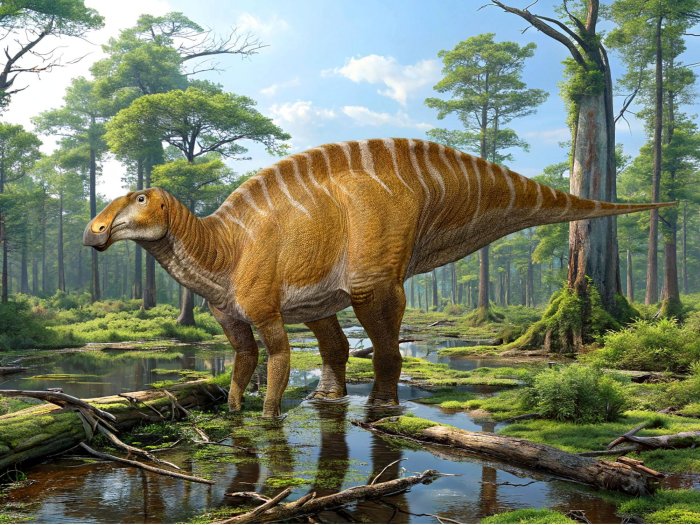
A new massive duck-billed dinosaur species has been discovered in New Mexico. A team of researchers including D. Edward Malinzak, assistant teaching professor of biology at Penn State Lehigh Valley, discovered the specimen. Credit: NMMNHS/Sergey Krasovskiy. All Rights Reserved.
D. Edward Malinzak, assistant teaching professor of biology at Penn State Lehigh Valley since 2021, and the team published their findings in the Bulletin of the New Mexico Museum of Natural History and Science. The revelations came after a new analysis of fossils found in New Mexico.
The newly identified species is part of the herbivorous duck-billed hadrosaurid family that includes numerous other species. The team conducted an anatomical and morphological comparison of the specimens against other fossils in the hadrosaurid genera and species to make this determination.
“Hadrosauridae, a family of large herbivorous dinosaurs, were among the most abundant dinosaurs of Late Cretaceous terrestrial ecosystems of the Western Interior Basin of North America for about 20 million years,” said Sebastian Dalman, a paleontologist at Montana State University and lead author on the study. “The holotype specimen consists of an incomplete diagnostic skull, several isolated cranial elements including the right jugal, quadrate, dentary and surangular, and a series of articulated cervical vertebrae.”
A holotype specimen refers to the fossil or collection of fossil pieces used to officially categorize a new species. Ahshiselsaurus wimani was originally classified in 1935 as a specimen of the hadrosaurid genus Kritosaurus, which Malinzak said now, 90 years later, appears to be incorrect.
“Kritosaurus is still a valid genus with species of its own,” Malinzak said. “We took a specimen that was lumped in as an individual of Kritosaurus and determined it had significantly distinct anatomical features to warrant being its own genus and species.”

D. Edward Malinzak is an assistant teaching professor of biology at Penn State Lehigh Valley. Credit: Ryan Abramson. All Rights Reserved. Source
The researchers more closely examined the bones of the specimen now named Ahshiselsaurus wimani and compared them with bones of other hadrosaurid specimens. They also used the physical characteristics of the fossils to conduct a phylogenetic analysis, a method that uses available data to predict evolutionary relationships among species.
“As a general rule … skulls are really the basis for identifying differences in animals,” said Anthony Fiorillo, co-author, and executive director of the New Mexico Museum of Natural History and Science. “When you have a skull and you’re noticing differences, that carries more weight than, say, you found a toe bone that looks different from that toe bone.”
Malinzak also credited the discovery as additional evidence supporting the history of dinosaur migration throughout North America and taxonomic exchange between North and South America — the new species is part of a larger group that spread north from New Mexico and into Canada, as well as through Central America into South America. The dinosaur diversity could also provide information about the ecosystems in which they lived, further informing theories about what ultimately caused their extinction, he said.
“What we’re noticing is the Southwest is a ‘stock’ for some animals that migrate to the North,” Malinzak said. “We’re seeing changes environmentally. It seems that at a few different times, groups of organisms from the southern part of the continent migrated northward. During one of these events, the ancestors of the new hadrosaur migrated north, replacing another hadrosaur group, while others also spread into South America. Later, as new forms migrated to North America from Asia, the descendants of the earlier migrants returned to the southern part of the continent where descendants of the older lineage continued to thrive. The lineages appear to have co-existed in the region for a time. It showed that this group not only exploded with diversity across the continent at one point, but also contributed to the world-wide spread of this group in the Late Cretaceous.”
He explained that although Ahshiselsaurus wimani was previously misidentified as a specimen of Kritosaurus, the species actually appears stratigraphically lower than Kritosaurus, meaning it appears deeper in the rock layers and suggests it is older. The finding indicated that the Southwest’s climate was an ideal ecosystem for various groups of dinosaurs, Malinzak said.
“The ecosystem was more diverse than initially considered,” Malinzak said. “It supports the idea that the environment you’re in drives your adaptation. If a new group is well-adapted to an environment it migrates to, it can ‘unseat’ existing species — if the territory has undergone environmental change and the ‘home team’ has yet to adapt.”
Malinzak incorporated methods from the study into his Lehigh Valley “BIOL 220W: Populations and Communities” course to give his students the opportunity to apply their knowledge to real research.
“I was able to show my students what information our team used, how we ran the calculations, and how we were able to determine dispersal and divergence events,” he said. “The method helped the students take the idea of studying relationships from a theoretical idea to a tangible process to follow.”
Aníbal Torres, chief academic officer at Penn State Lehigh Valley, praised the depth of expertise reflected in this work.
“Dr. Malinzak brings exceptional passion and commitment to his field,” he said. “That dedication consistently drives meaningful and high-quality scholarship.”
Next, Malinzak said the team will continue studying the newly identified species, along with other fossil specimens discovered in the Southwest.
“This discovery reveals that we should revisit some of the specimens of other animals previously collected in this area,” Malinzak said. “We’re examining how evolutionary relationships are shaping the pictures of these animals and trying to make sense of how these relationships came to be, along with the ecological pressures that drove them. New discoveries and information help us answer current questions, but they also help us to pose new questions as well. Our present work is not the end result. — It’s more like, ‘You made one lap, but there are more laps still to go in the race.’ We’re making progress.”
Written by Eddie Gonzales Jr. – MessageToEagle.com Staff Writer
Related Posts
-
 Strange And Rare Discovery – Hundreds Of From The Time Of The Pharaohs Discovered In Portugal
-
 490-Million-Year-Old Trilobites Fossils Reveal Ancient Map
-
 Mystery Of The First Dinosaurs Deepens – Is The Supercontinent Gondwana The Answer?
-
 1. 5-Million-Year-Old Footprints Of Two Human Ancestor Species At The Same Location – Discovered
-
 Hollow Bones That Let Dinosaurs Become Giants Evolved At Least Three Times Independently
-
 An Australian Anthropologist Presents Forensic Facial Reconstruction Of The Hobbit’s Face
-
 Earliest Sea Scorpion From China Found In End-Ordovician Anji Biota In Zhejiang
-
 Predatory Dinosaurs Such As T. rex Sported Lizard-Like Lips – Study Suggests
-
 Giant Human-Sized Penguins Ruled The World After Dinosaurs Died Out
-
 Extraordinary Fossils From The End Of The Age Of The Dinosaurs – Study

