
Radio Black Hole Trio Lights Up in Rare Galaxy Merger
Eddie Gonzales Jr. – MessageToEagle.com – First confirmed system of three radio-bright active galactic nuclei reveals how supermassive black holes grow as galaxies collide.
Astronomers from the U.S. Naval Research Laboratory (NRL), in conjunction with scientists from the U.S. Naval Observatory (USNO) and NASA Goddard Space Flight Center (NASA GSFC), using U.S. National Science Foundation National Radio Astronomy Observatory (NSF NRAO) instruments have confirmed the first known triple system in which all three galaxies host actively feeding, radio-bright supermassive black holes.
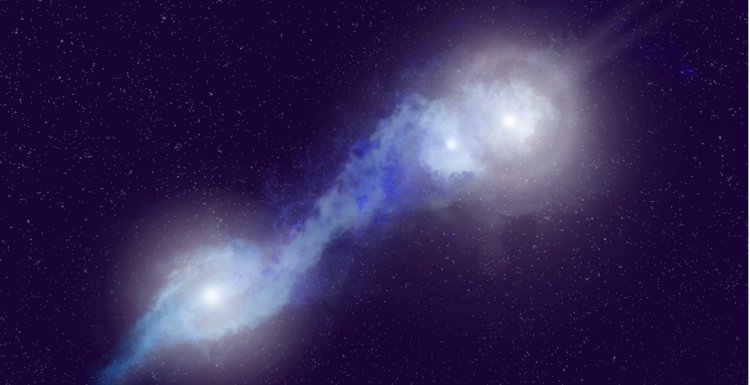
Artist’s impression of a rare trio of merging galaxies, J121/1219+1035, which host three actively feeding, radio-bright supermassive black holes and whose jets light up the surrounding gas. Credit: NSF/AUI/NSF NRAO/P. Vosteen
The system is cataloged as J1218/1219+1035 and located about 1.2 billion light-years from Earth, and it contains three interacting galaxies whose central supermassive black holes are all actively accreting material and shining brightly in the radio regime. High-resolution observations from the U.S. National Science Foundation Very Large Array (NSF VLA) and the U.S. National Science Foundation Very Long Baseline Array (NSF VLBA) reveal compact, synchrotron-emitting radio cores in each galaxy, confirming that all three host active galactic nuclei (AGN) powered by growing black holes. This makes J1218/1219+1035 the first confirmed “triple radio AGN” and only the third known triple AGN system in the nearby universe.
The three galaxies in J1218/1219+1035 were caught in the act of merging, with nuclear separations of roughly 22 and 97 thousand light-years, forming a dynamically bound group whose tidal features trace their mutual interactions. Such triple systems are a key but rarely observed prediction of hierarchical galaxy evolution, in which large galaxies like the Milky Way grow by repeatedly colliding and merging with smaller companions. By capturing three actively feeding black holes in the same merging group, the new observations provide an excellent laboratory for testing how galaxy encounters drive gas into galactic centers and ignite black hole growth.
J1218/1219+1035 was originally flagged as an unusual system using mid-infrared data from NASA’s Wide-field Infrared Survey Explorer (WISE), which suggested at least two obscured AGN lurking in an interacting pair of galaxies. Follow-up optical spectroscopy confirmed an AGN in one nucleus and revealed a “composite” signature in another, but left the true nature of the third galaxy ambiguous because its emission could also arise from star formation or shocks.
Only with new, ultra-sharp radio imaging from the NSF VLA—at frequencies of 3, 10, and 15 GHz—did astronomers uncover compact radio cores precisely aligned with all three optical galaxies, demonstrating that each hosts an AGN that is bright in radio emission and likely driving small-scale jets or outflows.
The radio spectra of the three cores show signatures consistent with non-thermal synchrotron emission from AGN, including two sources with typical steep spectra and a third with an even steeper spectrum that may indicate unresolved jet activity. NSF VLBA observations, while not detecting a compact milliarcsecond-scale core, set a brightness-temperature limit for the central galaxy that exceeds what is expected from star formation alone, further supporting an AGN origin for the radio emission.
Together, these measurements confirm that J1218/1219+1035 is not just a triple AGN, but a uniquely radio-active one in which all three black holes are simultaneously “lit up” in the radio sky.
“Triple active galaxies like this are incredibly rare, and catching one in the middle of a merger gives us a front-row seat to how massive galaxies and their black holes grow together,” said Dr. Emma Schwartzman of the U.S. Naval Research Laboratory, lead of the study. “By observing that all three black holes in this system are radio-bright and actively launching jets, we’ve moved triple radio AGN from theory into reality and opened a new window into the life cycle of supermassive black holes.”
To characterize J1218/1219+1035, the team used the VLA in its highest-resolution A configuration, achieving sub-arcsecond imaging at multiple frequencies to isolate each galaxy’s radio core. Complementary NSF VLBA observations at 4.9 GHz provided milliarcsecond-scale constraints on the compactness and brightness temperature of the central source. Upcoming near-infrared imaging and X-ray observations are planned to map the galaxies’ tidal structures in more detail and probe the high-energy output of each AGN, building a more complete picture of this rare triple system.
With only two other confirmed triple AGN systems known locally, expanding the sample of such objects is crucial for understanding how frequently multiple black holes interact and eventually merge. The discovery of J1218/1219+1035 highlights the power of combining mid-infrared selection with sensitive, high-resolution radio imaging to uncover complex AGN systems that may be hidden or ambiguous at optical and X-ray wavelengths.
The researchers suggest that future surveys and targeted follow-up with facilities like the NSF VLA and NSF VLBA will be essential for revealing more triple AGN and tracing how black hole triplets shape the growth of galaxies over cosmic time.
Written by Eddie Gonzales Jr. – MessageToEagle.com Staff Writer
Related Posts
-
 Turbulent And ‘Most Luminous Galaxy’ Is Ripping Itself Apart
-
 Martian Moon Deimos Reveals A Big Secret
-
 An X-Ray Explosion On A White Dwarf Observed For The First Time
-
 Our Sun Is Different From Other Solar-Like Stars – Surprising Discovery
-
 Startling Discovery Reveals Oxygen On Mars Doesn’t Behave By Known Chemistry
-
 Neptune Is Cooler Than We thought – New Observations
-
 Quadruple Stars That May Spark Supernova Explosions – Spotted
-
 ‘Tadpole’ Molecular Cloud Appears To Be Playing Around Black Hole
-
 Can You Create A Universe From Nothing?
-
 We Have 100 Million Black Holes In Our Galaxy – Cosmic Study Reveals

