


Eddie Gonzales Jr. – MessageToEagle.com – How does a volcano tick? What’s happening in the earth beneath it? Where do tremors – called tremors – occur, caused by magma or gases that force their way up through vents?
Prof. Dr. Miriam Christina Reiss, a volcano seismologist at Johannes Gutenberg University Mainz (JGU), and her team have located such tremors at the Oldoinyo Lengai volcano in Tanzania.
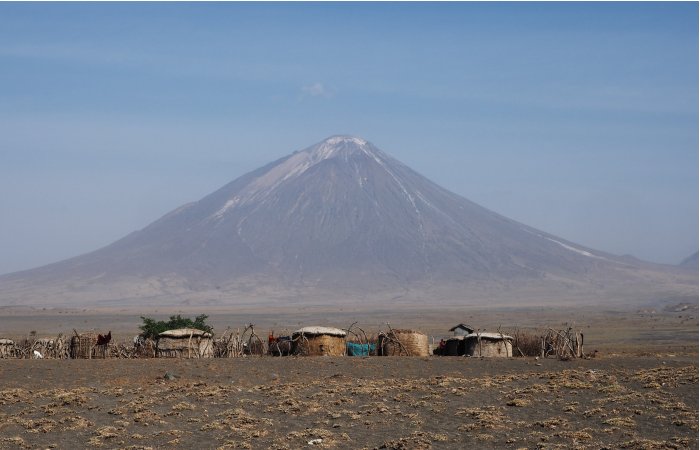
Oldoinyo Lengai in Tanzania is the only active carbonatite volcano on Earth. Image credit: Miriam Reiss
“We were not only able to detect the tremors, but also determine their location in three spatial directions—that is, their position and depth in the ground,” reports Reiss. “The variety of different tremor signals we detected was also astonishing.” The results provide new insights into the transport of magma and gas in the Earth and thus improve our understanding of the dynamics of volcanoes. This also has social relevance: In the long term, the researchers hope to improve the prediction of volcanic eruptions.
Tremors provide evidence of volcanic activity
If magma pushes from the depths of the earth in and around a volcano to the surface, this can lead to tremors. If the magma generates great pressure, the rock fractures, potentially resulting in earthquakes. Other processes only result in slight vibrations, known as tremors, for example, when magma forces its way through existing channels in the ground, or when gases are released from the magma, or when pressure fluctuations occur in the transport channels. “For volcano seismology, it is extremely interesting to study the signals and wave types that arise when magma moves underground,” says Reiss. Two questions in particular concern the researcher: Where exactly do the tremors originate? And what process leads to their formation? Ultimately, the corresponding data can be used to draw conclusions about the condition of the volcano.
Reiss and her team therefore collected relevant data at Oldoinyo Lengai over a period of one and a half years. To do this, the researchers positioned numerous seismometers – measuring devices that detect Earth’s vibrations – around the volcano. Back in Mainz, they then analyzed the data, initially from a nine-week period. “For the first time, we were able to determine the exact location where tremors occur,” says Reiss. “This allowed us to discover that two types of tremors appear to be related: They occurred at different depths – one about five kilometers deep, the other at the base of the volcano – and at different times. It seems clear that these signals are related, meaning we have a system that is directly interconnected.”
Furthermore, the variety of different tremor signals the team detected was surprisingly large. The reason for this is likely that the tremors originated from different areas of the volcano, each with different characteristics and triggered by different processes.
The volcano studied, Oldoinyo Lengai, is unique: It is the only active carbonatite volcano on Earth, meaning its magma has a different composition than that of other fire-breathing mountains. Its magma is also more fluid and, with a maximum temperature of around 550 degrees Celsius, comparatively cold – magma typically has temperatures of 650 to 1200 degrees Celsius. “The results were particularly surprising because the magma is very fluid, and it was therefore more likely that there would be few to no tremors, as the interaction with the surrounding rock might be less pronounced,” says Reiss.
The current results from Reiss and her team take volcanic seismology a step forward, providing valuable insights into the dynamics of volcanoes.
“Tremors occur when magma is moving – including during impending volcanic eruptions,” says Reiss. “But which tremors are harbingers of an eruption? And which are merely a kind of background bubbling? Our results lay the foundation for improving the prediction of eruptions.”
Their findings were recently published in the renowned scientific journal Communications Earth & Environment .
Written by Eddie Gonzales Jr. – MessageToEagle.com Staff Writer