




Eddie Gonzales Jr. – MessageToEagle.com – Decades of warming have relaxed cold-temperature constraints on mountain plant distribution, resulting in increased species numbers on mountaintops. An international research team led by scientists from the University of Vienna, together with BOKU University and the Austrian Academy of Sciences, now shows that these changes also create a rising number of losers.
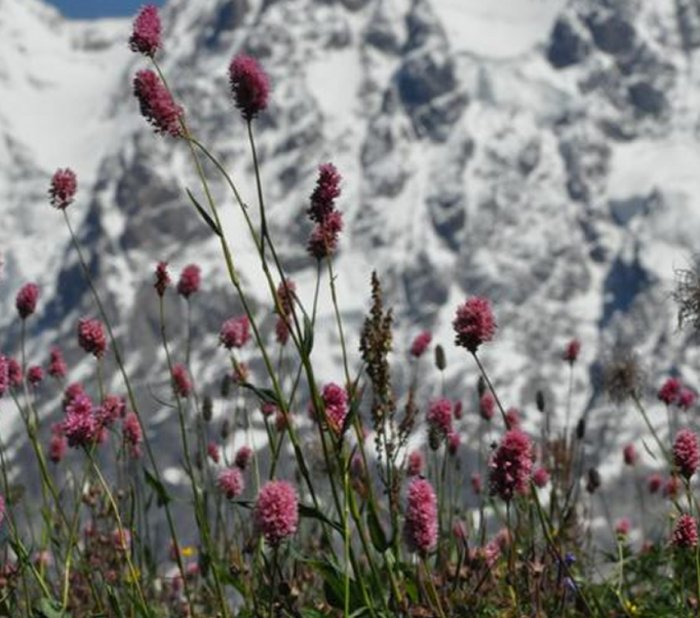
Polygonum carneum () in front of the main ridge of the Greater Caucasus near Ushguli in Georgia at an altitude of approximately 2700 m. Image credit: Stefan Dullinger
The disappearance of plants from summits can take decades, but it has accelerated over the past 20 years. Rising biodiversity is, hence, only part of the story and overlooks an important aspect of recent summit vegetation dynamics.
Until a few decades ago, short vegetation periods, low temperature sums and year-round frost risk made alpine landscapes difficult to colonize for many species of the European flora. However, accelerating climate warming has relaxed these constraints. Species have hence started to expand their ranges upward and mountaintop vegetation has consequently become more species-rich. However, the research team demonstrates that this apparent success story also has its downside: while total species numbers are rising, loss rates are increasing, too, and the losses primarily struck specialists of high-elevation ecosystems.
The scientists analysed the vegetation of 62 European summits which have been surveyed for their species composition four times between 2001 and 2022 as part of the global monitoring initiative GLORIA. The data demonstrate that the percentage of species not re-detected was increasing with each survey. Species with a centre of distribution above the focal summit were overrepresented in the group of lost species.
Loss rates increase with magnitude of warming and towards lower species’ range margins
The results of the study suggest that climate warming drives these local extinctions.
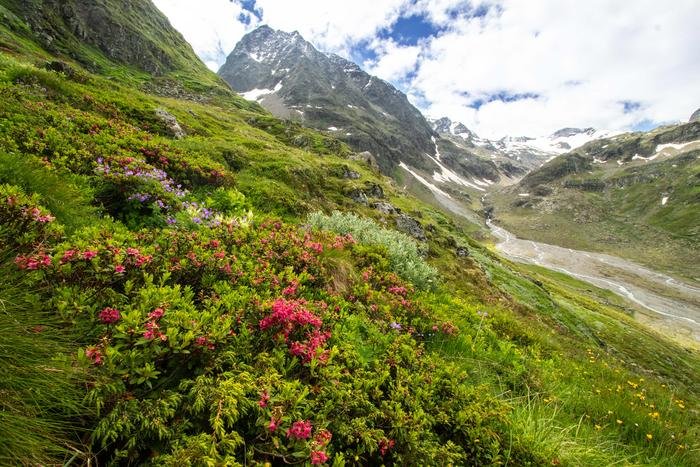
Rhododendron ferrugineum (rusty-leaved alpenrose) on the western slopes of Mount Schrankogel in Tyrol (Austria) in front of Bockkogel. Image credit: Kryštof Chytrý
“The data clearly show that species were more likely to disappear from summits which experienced stronger warming. This correlation was even stronger than the temporal trend”, explains first author Johannes Wessely from the University of Vienna. In addition, local extinction likelihood increases towards the lower elevational margin of current species distributions.
“Put differently, when species already grow on warmer-than-average sites they become more sensitive to further temperature increase”, adds Harald Pauli, the coordinator of GLORIA at the Austrian Academy of Sciences and Boku University.
Pay-off of an extinction debt?
Specialists of high elevations tend to be particularly stress tolerant and long-living. Their local extinction can hence lag behind the onset of environmental changes that trigger these extinctions, resulting in the accumulation of an extinction debt in biological communities. These lag times were already supposed to be a main reason why colonizations by new species have so far been documented more frequently than extinctions of former residents in alpine vegetation.
The results of the current study are in line with this interpretation: local extinctions of species are preceded by longer phases of population decline. Hence higher current extinction rates could be the response to changes that occurred or at least started already decades in the past.
“They could consequently indicate that an extinction debt starts to be paid off. However, whether this interpretation holds true needs further investigation”, emphasizes project coordinator Stefan Dullinger.
Written by Eddie Gonzales Jr. – MessageToEagle.com Staff Writer