
Roombas: Domestic Robots For Additional Household Tasks
Eddie Gonzales Jr. – MessageToEagle.com – Computer scientists at the University of Bath think not. They propose over 100 ways to reprogram these devices for additional helpful tasks around the home, keeping them active during downtime.
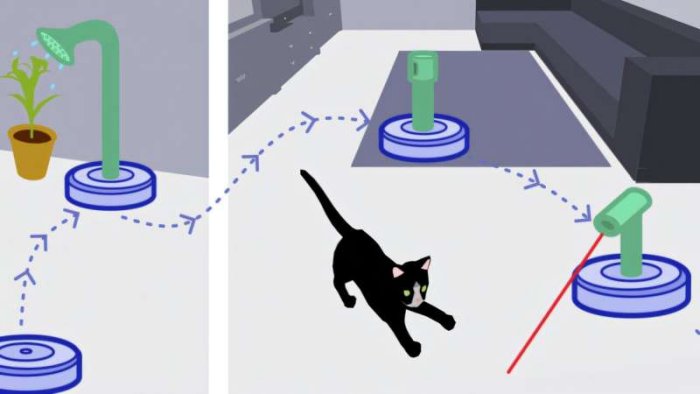
Domestic robots, such as robot vacuum cleaners, spend most of their day idle – researchers propose ways to work them harder to make our own lives easier. Credit: Adwait Sharma & Yoshiaki Shiokawa, University of Bath
New functions could include playing with the cat, watering plants, carrying groceries from car to kitchen, delivering breakfast in bed and closing windows when it rains.
Researchers identified 100 functions that domestic cleaning robots could, with some fine-tuning, perform during idle periods. They then demonstrated the technical feasibility of working robots harder by reprogramming a Roomba, a popular robot vacuum cleaner, to perform four functions:
Mobile wireless charger: The robot, fitted with a holder, charged a phone, navigating the home to find the phone user when mobile charging was needed.
Workout projector: Equipped with a projector, the robot displayed workout videos on a wall. When it was time for floor exercises, it seamlessly shifted the projection to the ceiling, ensuring uninterrupted viewing.
Home monitor: The robot monitored the home remotely, providing live video and task control, such as observing the oven while the user watched and controlled it.
Work-status signpost: Fitted with a screen signaling “meeting in progress,” the robot could be sent to a specific location (such as outside a room) to deter disturbances.
“Mobile domestic robots, like robot vacuum cleaners and lawnmowers, are perceived as limited, single-task devices but there is a strong argument that they are under-used for practical tasks. For most of the day, they sit idle.
“We should be extending their utility beyond their primary tasks by programming them to physically navigate the home to perform a range of additional functions. Just think how much more efficiently households would run if Roombas could be converted into household assistants,” Yoshiaki Shiokawa, first author of the study and a Ph.D. student in the Department of Computer Science at Bath, said.
“Our study proved that after making minimal adjustments, a Roomba can serve multiple roles around the home.”
Research has shown that stationary smart devices, like smart speakers, thermostats, and security cameras, can perform idle tasks such as updating software. Additionally, robots can indicate they are powered on and ready using subtle cues like fading lights or gentle movement, even when inactive.
The new study is the first to explore domestic robots’ mobility, repurposing idle time for tasks like home maintenance, on-demand assistance, and pet care. Future mobile robots could achieve these tasks with robot-compatible bases, extendable arms, and attachable carts.
Domestic robots like vacuum cleaners and lawnmowers are becoming more popular, with an expected annual market growth of 18. 8% by 2028. A new study shows that a robot vacuum typically cleans for one hour and 47 minutes daily.
“Idle time presents unique opportunities for value-adding interactions and it aligns with the growing need for adaptable robots and integrated systems that can seamlessly fit into our daily lives. A robot vacuum could, for instance, use its idle time to monitor home security, water the plants or assist an older person to stand from a sitting position. These tasks tap into the robot’s advanced sensors, as well as its mobility, study co-author and supervisor Dr. Adwait Sharma said.
Additional functions proposed by the study’s authors include:
– searching for lost items
– managing smart devices, for instance by changing a TV channel
– assisting a user in taking a family photo
– scanning the fridge and suggesting items to purchase
– entertaining children
– playing a card game
– interacting with a pet
– cleaning pet litter boxes and bowls
– detecting unusual sounds and navigating within the home to inspect the situation
– checking if doors are locked
– cooking in parallel with a user
– wiping a table
– clearing and sorting food waste while a meal is being prepared
– notifying family members when a meal is ready by knocking on doors
– organizing items and tidying up, for instance toys
– moving plants for sunlight
– clearing paths and alerting users to tripping hazards
– receiving and delivering packages when the user is busy
The research team also included Dr. Aditya Shekhar Nittala, Asst. Prof. at the University of Calgary (Canada), alongside master’s student Winnie Chen and Professor Jason Alexander from the Department of Computer Science at the University of Bath.
Written by Eddie Gonzales Jr. – MessageToEagle.com Staff Writer
Related Posts
-
 Making Methane From Carbon Dioxide: Carbon Capture Grows More Affordable
-
 An Invisible Coating To Make Wood ‘Fireproof’
-
 Ancient Egyptian Blue Used To Create New Nanomaterial 100,000 Times Thinner Than A Human Hair
-
 Researchers Design Extreme Heat Exchanger Using Metal 3D Printing
-
 Researchers Say ‘Unusual’ Metamaterial Could Double Capacity Of Wireless Networks
-
 Artificial Intelligence Is Creating A New, External Thought Process Beyond Our Minds
-
 Self-Powered, Printable Smart Sensors Created From Emerging Semiconductors Could Mean Cheaper, Greener Internet Of Things
-
 Amazing New Shape-Shifting Material – It Changes Shape Using Heat And Light
-
 New Algorithm Searches Historic Documents To Discover Noteworthy People
-
 Low-Cost, Portable, Paper Battery Powered By Bacteria – Developed

