


Eddie Gonzales Jr. – MessageToEagle.com – A collection of fossilized dinosaur bones from Wyoming features tooth marks that provide evidence that some bites were likely created by Tyrannosaurus rex, according to a new study.
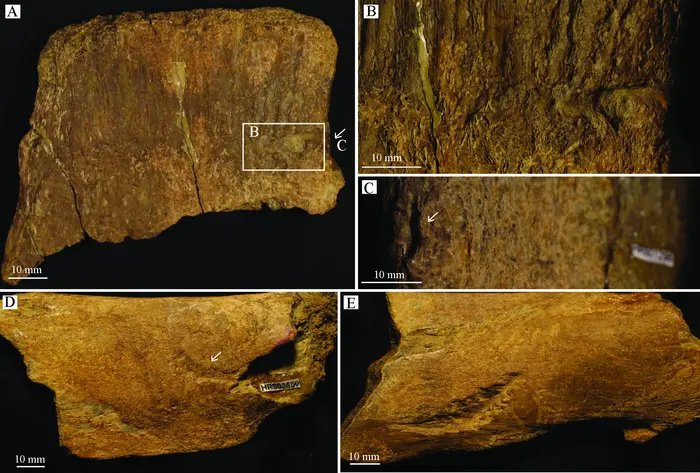
Tooth trace types on neural spine fragments. A) Punctures on opposing surfaces in neural spine HRS01295. The image only depicts one of the punctures indicated by the white box. An arrow indicates the location of the other puncture not visible in the image. B) A magnified view of the puncture within the white box area on Fig 4A. C) A view of the puncture opposing the puncture on Fig 4B and indicated by arrow on Fig 4A. D) Neural spine fragment HRS03650 with a score indicated by an arrow. E) A view of the opposing surface from HRS03650 (Fig 4D) shows a deep and curved score with associated tooth trace ichnotaxon Linichnus serratus. Image credit: C. T. Siviero et al., 2026, PLOS One, CC-BY 4.0
Tooth marks on fossilized bones offer scientists unique insights into ecosystems and animal behavior millions of years ago. This study describes and identifies several types of punctures, holes, and other marks on fossils that appear to be tooth marks. The researchers developed a guide, based on previously published research and their new findings, for interpreting tooth traces on fossils.
The research by Bethania C. T. Siviero from Loma Linda University, USA, and colleagues examined over 3,000 bones from northeastern Wyoming from the late Cretaceous period, about 72 – 66 million years ago. Most of the bones were from Edmontosaurus annectens, a large, duck-billed herbivorous dinosaur.
Just 12 of the bones had tooth traces. Four of those bones had distinct tooth mark patterns, and based on the shape and spacing of these marks, the researchers believe they came from T. rex. Some of the other tooth traces may have been created by other contemporaneous carnivores, including other dinosaurs and crocodilians.
Most of the bones with tooth marks show no evidence of any healing around the marks, meaning that these marks were probably made around or after the animals’ deaths. This, along with previous research on bones from this site, indicates that not only may some of the animals have been predated, but also that their carcasses may have been exposed to the elements and scavenged, before eventually being buried and fossilized.
Tooth marks in fossils often look like punctures or furrows, but similar marks can form on bones for a variety of other reasons, such joint disease, or erosion after the animal has died. If researchers want to study prehistoric ecology and animal behavior using bite marks, they need to ensure that these really are bite marks. By laying out a set of criteria for identifying tooth marks in fossil bones, this study helps to hone a vital paleontological research tool.
The authors add: “Correctly identifying bone depressions and perforations is important because not all of these features are tooth marks. Some are caused by diseases, while others result from post-mortem processes such as insect activity or other processes due to bone exposure. Distinguishing between these different types of bone modifications is essential, as they can provide valuable information about an animal’s condition before death as well as the processes that affected its remains after death.”
“The study of tooth marks on fossil bones is important because it provides valuable insights into animal behavior and interactions between species.”
Source – PLOS – via Eurekalert
Written by Eddie Gonzales Jr. – MessageToEagle.com Staff Writer