
Unexpectedly Large Hominins Identified From 1.4-Million-Year-Old Footprints By An African Lake
Jan Bartek – MessageToEagle.com – A new study documents a set of fossil footprints preserving a snapshot of “fossil behavior” from an ancient hominin group along a lakeshore in northern Kenya around 1.4 million years ago.
An international team from the US and Kenya discovered tracks of eight Paranthropus boisei individuals, an extinct relative of modern humans, together at a single site.
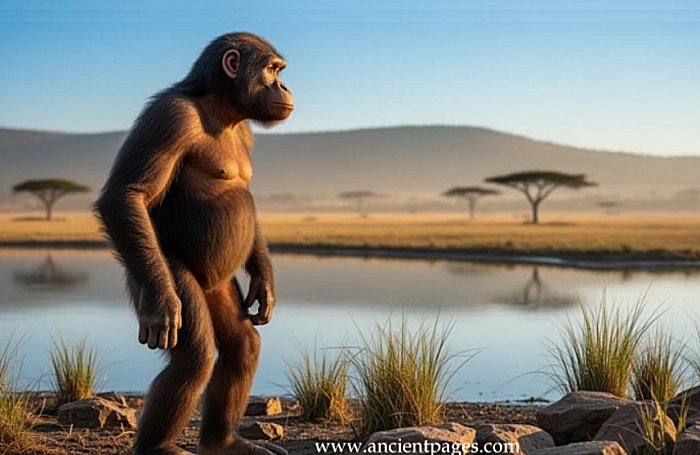
All appear to be adults, with some significantly larger than previous estimates based on limited fossil remains.
Unexpectedly Large Body Size
The team used analytical methods developed in 2024 to identify the tracks as Paranthropus boisei, based on foot anatomy and movement patterns. The footprints suggest unexpectedly large, human-like body sizes, up to 1.8 meters tall and about 75 kilograms, according to lead author Kevin Hatala of Chatham University and the Max Planck Institute for Evolutionary Anthropology.
Previously, most Paranthropus boisei fossils were limited to skulls, providing little information about their postcranial anatomy. These new findings challenge earlier views that Paranthropus boisei was much smaller than contemporary Homo erectus, a possible direct ancestor of modern humans.
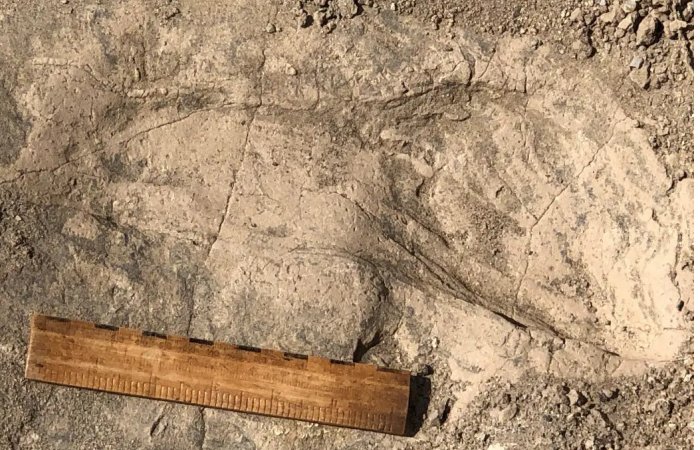
One of the large, 1.4-million-year-old footprints that the team excavated. A 6-inch (~15 cm) ruler is shown for scale. Credit: Kay Behrensmeyer
Fossil footprints form rapidly and provide valuable insight into hominin behavior and group dynamics. “The fact that eight, mostly adult male, Paranthropus boisei individuals seemingly traveled together as a group, without females or children, hints at a complex social structure in this species,” says co-author Neil Roach of Harvard University. “They may have lived in large groups, where males competed for mates, but also tolerated each other at times for safety in a dangerous environment.”
This discovery provides important behavioral insights into Paranthropus boisei, a species that coexisted with early Homo but followed a distinct evolutionary path.
An increasing number of ancient human footprints found in lake margin environments suggests these areas were important habitats with essential resources for our extinct relatives. “To me, it is amazing that we have the same kind of lake margin deposits in two areas of East Turkana that are 40 kilometers apart, at about the same age,” says co-author Kay Behrensmeyer of the Smithsonian Institution.
The research team has now documented hundreds of hominin footprints at over six sites in the region. Behrensmeyer notes, “If we can understand what geological conditions allowed these tracks to be preserved, we should know more about why hominins continued to return to the lake shore environment over more than 100,000 years.”
Building A Photo Album Of The Past
The team will return to Kenya this year to continue research at these unique fossil footprint sites. “Each site represents a snapshot of our past, and we are quickly building a photo album with several different windows to hominin anatomy, locomotion, behavior, and environments during the Early Pleistocene,” says Hatala.
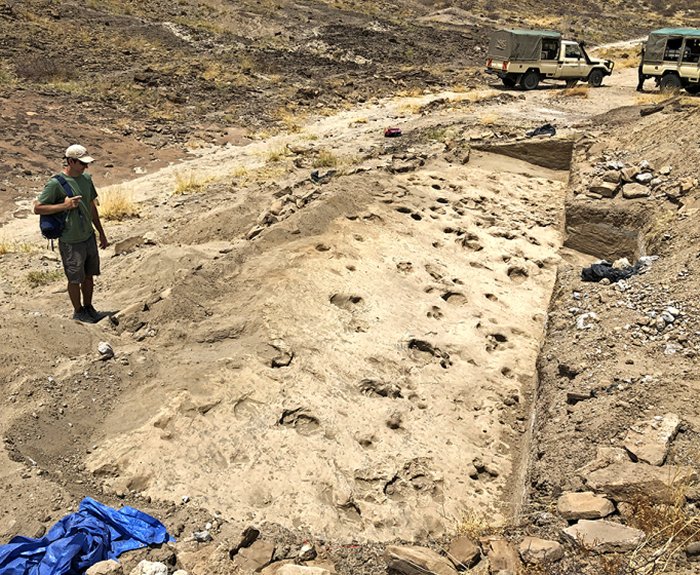
Credit: Kay Behrensmeyer
Co-author Purity Kiura of the National Museums of Kenya adds, “The discovery of these fossil footprints along the margins of Lake Turkana reinforces the region’s global importance in understanding human evolution, preserving remarkable evidence of how our ancient relatives lived 1.4 million years ago. It further strengthens Kenya’s position as one of the world’s leading paleoanthropological landscapes and highlights our responsibility to protect this irreplaceable heritage.”
See also: More Archaeology News
By combining new analytical methods with exceptional fossil footprint sites, the study shows that ancient tracks can reveal the anatomy and movement of extinct human relatives and offer rare insights into their social lives and environments.
Source: Max-Planck-Gesellschaft
Written by Jan Bartek – MessageToEagle.com – AncientPages.com Staff Writer
Related Posts
-
 First Animals On Earth Could Have Evolved Much Earlier Than The Oldest Fossils Suggest
-
 Ancient Marine Fossils Shed New Light On Longstanding Climate Puzzle
-
 North America’s Fossil Of A Strange Prehistoric Marine Predator – Identified As New Species
-
 Soft Tissue From A 183 Million-Year-Old Jurassic Plesiosaur – Analysed
-
 Why Ancestors Of Modern Birds Survived When All The Dinosaurs Died
-
 New Pterosaur Species With Hundreds Of Tiny Hooked Teeth Discovered
-
 30,000 Soft-Bodied Fossils Found In China Shed Light On Life Evolution 500 Million Years Ago
-
 Discovery Of Oldest Fossils Re-Writes History Of Bisons In North America
-
 Fossils Of Flying Reptiles In The Sahara 100 Million Years Ago – Investigated
-
 World’s Oldest Fossil Is Almost As Old As The Earth – Life Was Present On Earth Much Longer Than Previously Thought

