
WASP-127b: Unique Exoplanet Rich In Multiple Metals And Signs Of Water – Found
MessageToEagle.com – Traces of metals have been discovered by researchers observing WASP-127b, a giant gaseous planet.
A team from the University of Cambridge and the Instituto de Astrofísica de Canarias (IAC) in Spain used the Gran Telescopio Canarias (GTC) found also that WASP-127b has partly clear skies.
WASP-127b has a radius 1.4 times larger than Jupiter but has only 20% of its mass. Such a planet has no analogue in our solar system and is rare even within the thousands of exoplanets discovered to date. It takes just over four days to orbit its parent star and its surface temperature is around 1400 K (1127° C).
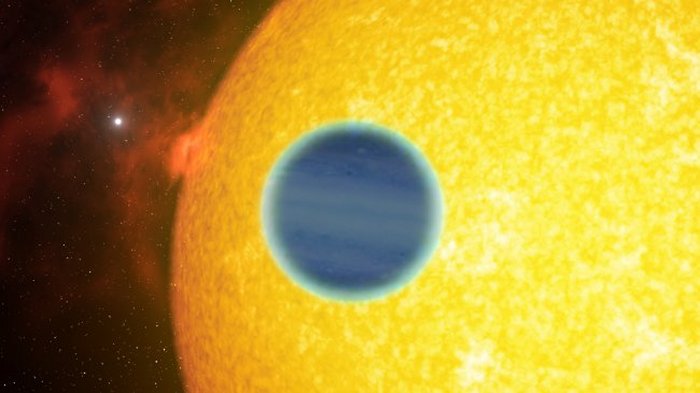
The observations of WASP-127b reveal the presence of a large concentration of alkali metals in its atmosphere, allowing simultaneous detections of sodium, potassium and lithium for the first time in an exoplanet. The sodium and potassium absorptions are very broad, which is characteristic of relatively clear atmospheres. According to modelling work done by the researchers, the skies of WASP-127b are approximately 50% clear.
“The particular characteristics of this planet allowed us to perform a detailed study of its rich atmospheric composition,” said Dr Guo Chen, a postdoctoral researcher at IAC and the study’s first author. “The presence of lithium is important to understand the evolutionary history of the planetary system and could shed light on the mechanisms of planet formation.”
The planet’s host star, WASP-127, is also lithium rich, which could point to an AGB star – a bright red giant thousands of times brighter than the sun – or a supernova having enriched the cloud of material from which this system originated.
The researchers also found possible signs of water.
“While this detection is not statistically significant, as water features are weak in the visible range, our data indicate that additional observations in the near-infrared should be able to detect it,” said co-author Enric Pallé, also from IAC.
Researchers believe this exoplanet will be an important planet for future studies with space telescopes such as the James Webb Telescope, the successor to the Hubble Telescope. These future studies will reveal the detailed nature of WASP-127b as a benchmark for this new class of very low-density exoplanets.
Paper
MessageToEagle.com
Related Posts
-
 Rare Binary Star Features Weirdly Round Orbit – Researchers Report
-
 The Messy Death Of A Star – Observed By James Webb Space Telescope
-
 ALMA Helps To Map Extreme Galaxy Environments And Star Formation In Virgo Cluster
-
 Remarkable Quasar Located In The Constellation Crater Observed By NASA’s JWST
-
 Debris Disk Around The Star Contains A 1.4 Jupiter-Mass Planet
-
 Small Planet Detected About 600-Light-Years Away From Earth In Constellation Chameleon
-
 Cosmic Mystery – Two Identical Exoplanets With Different Atmosphere – How Is It Possible?
-
 Team Confirms Existence Of New Earth Trojan Asteroid
-
 10 Most Bizarre And Record Breaking Alien Worlds
-
 Heavy Metals On Earth Originate From Supernova Explosion

