
Why ‘Stealthy’ Volcanoes Erupt Without Warning – Alaska Volcano Could Help
Eddie Gonzales Jr. – MessageToEagle.com – Some volcanoes don’t give much — or any — warning before they go off. Veniaminof, Alaska, is one of them: it is a ‘stealthy’ volcano, which doesn’t show the traditional warning signs of an impending eruption, like the ground deforming or earthquakes.
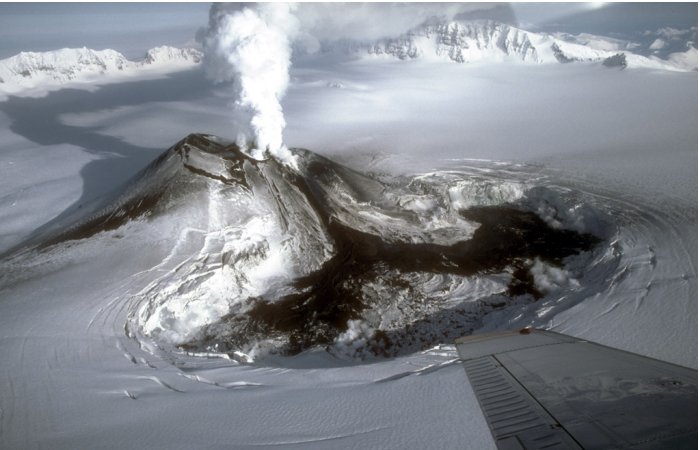
Steam rising from the intracaldera cinder cone at Veniaminof volcano in the waning stages of the 1983 to 1984 eruption. Cooling lava flows fill a pit about 2.3×1.0 km (1.4×0.6 mi) that has been melted in the summit ice cap. Aerial view looking northeast. M.E. Yount, U.S. Geological Survey – Public Domain
Now scientists have developed a way of modelling its behavior which could more effectively monitor potential eruptions and provide warning to people in the path of danger. Many stealthy volcanoes, like Stromboli in Italy or Popocatépetl in Mexico, are close to major air routes or large communities, so this modelling could save lives.
When volcanoes are preparing to erupt, scientists rely on typical signs to warn people living nearby: deformation of the ground and earthquakes, caused by underground chambers filling up with magma and volcanic gas. But some volcanoes, called ‘stealthy’ volcanoes, don’t give obvious warning signs. Now scientists studying Veniaminof, Alaska, have developed a model which could explain and predict stealthy eruptions.
“Despite major advances in monitoring, some volcanoes erupt with little or no detectable precursors, significantly increasing the risk to nearby populations,” said Dr Yuyu Li of the University of Illinois, lead author of the study in Frontiers in Earth Science. “Some of these volcanoes are located near major air routes or close to communities: examples include Popocatépetl and Colima in Mexico, Merapi in Indonesia, Galeras in Colombia, and Stromboli in Italy.
“Our work helps explain how this happens, by identifying the key internal conditions — such as low magma supply and warm host rock — that make eruptions stealthy.”
Warning signs
Veniaminof is an ice-clad volcano in the Aleutian Arc of Alaska. It’s carefully monitored, but only two of its 13 eruptions since 1993 have been preceded by enough signs to alert observing scientists. In fact, a 2021 eruption wasn’t caught until three days after it had started.
“Veniaminof is a case study in how a volcano can appear quiet while still being primed to erupt,” said Li. “It is one of the most active volcanoes in Alaska. In recent decades, it has produced several VEI 3 eruptions — moderate-sized explosive events that can send ash up to 15 km high, disrupt air traffic, and pose regional hazards to nearby communities and infrastructure — often without clear warning signs.”
To understand Veniaminof better, the scientists used monitoring data over three summer seasons immediately before the 2018 stealthy eruption, which produced only ambiguous warning signs immediately before it happened. They created a model of the volcano’s behavior in different conditions which would change the impact of a filling magma reservoir on the ground above: six potential volumes of magma reservoir, a range of magma flow rates and reservoir depths, and three shapes of reservoir.
They then compared the models to the data to see which matched best, and which conditions produced eruptions, stealthy or otherwise.
Written by Eddie Gonzales Jr. – MessageToEagle.com Staff Writer
Related Posts
-
 Earth’s ‘Dirty Mirror’ Effect Accelerates Climate Change
-
 Underside Of The North American Continent Is Dripping Away In Blobs Of Rock
-
 20 Million Years Of ‘Hot Spot’ Magmatism Under The Cocos Plate – Unearthed
-
 Researchers Defend Their Theory That Molecular Oxygen Existed On Earth 2.5 Billion Years Ago
-
 Record Highs In North Sea: German Bight Reaches Warmest Temperature Ever
-
 Study Reveals How Mini Sand Dunes Form
-
 York U Research Sheds Light On Earliest Days Of Earth’s Formation
-
 “Ocean Skin”: Sliver Of Cool Surface Water Helps The Ocean Absorb More Carbon
-
 Machine Learning Uncovers 10 Times More Earthquakes In Yellowstone Caldera
-
 Researchers Solve One of Earth’s Ancient Volcanic Mysteries

