
Why The Foam On Belgian Beers Lasts So Long
Eddie Gonzales Jr. – MessageToEagle.com – Researchers at ETH Zurich have discovered the holy grail of brewing: the recipe for stable beer foam. But their findings aren’t just beneficial for breweries.
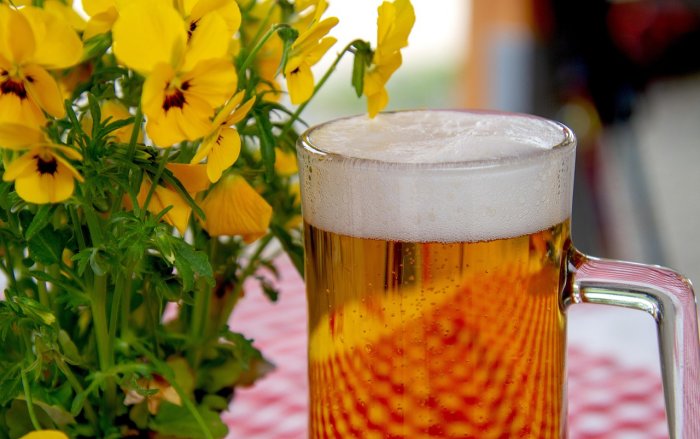
Image source
Summertime is beer time – even though alcoholic beer consumption is declining in Switzerland. And for beer lovers, nothing beats a head of foam sitting atop the golden, sparkling beer.
But with many beers, this dream quickly shatters, and the foam collapses before you can even take the first sip. However, there are also beers where the head lasts a long time.
Researchers at ETH Zurich led by Jan Vermant, Professor of Soft Materials, have now discovered why this is the case. Their study has just been published in the journal Physics of Fluids. The Belgian and his colleagues have been working on it for seven years. It all began with a simple question to a Belgian brewer: “How do you control the brewing process?” – “By observing the foam,” was the answer.
Today, ETH scientists understand the mechanisms behind the perfect beer foam. And perhaps in the future, beer drinkers will be able to admire the foam in their glasses a little longer before quenching their thirst.
Triple beats double and single
In this study, the materials scientists showed that among the Belgian beers examined, “Tripel” beers have the most stable foam, followed by “Dubbel” beers. The least stable foam is found in “Singel” beers, which are less intensively fermented and have the lowest alcohol content.
The ETH researchers also examined two lagers from major Swiss breweries. The foam stability of these beers is comparable to that of Belgian ales, although the physics behind foam stability is different. Interestingly, one of the Swiss lagers tested did not perform as well in terms of foam stability. “Thanks to our new findings, we could definitely improve that,” says Jan Vermant.
Surface tension instead of viscosity
Until now, researchers assumed that the stability of beer foam depends primarily on protein-rich layers on the surface of the bubbles (see ETH News ): The proteins originate from the barley malt and influence the surface viscosity, i.e. its flowability, as well as the surface tension.
But the new experiments show that the crucial mechanism is more complex and depends strongly on the type of beer.
In lager beers, the decisive factor is how elastic yet viscous the surface of the bubbles is (viscoelasticity). This is influenced by the proteins present in the beer and their denaturation: The more proteins present in the beer, the stiffer the film around the bubbles becomes and the more stable the foam becomes.
Written by Eddie Gonzales Jr. – MessageToEagle.com Staff Writer
Related Posts
-
 Dark Matter Shaping The Universe Sprang From Rapidly Condensing Particles – New Theory
-
 Fastest Possible Speed Of Sound Discovered
-
 Electrostatics Influence The Movement Of Drops On Surfaces
-
 Physicists Probe Quark‑Gluon Plasma Temperatures, Helping Paint More Detailed Picture Of Big Bang
-
 A Mystery On The Path To Smaller, Lighter Batteries – Solved
-
 Strange Radio Pulses Detected Coming From Ice In Antarctica
-
 Neutrinos Are Lighter Than 0.8 Electronvolts: Experiment Limits Neutrino Mass With Unprecedented Precision
-
 Rotating Black Holes May Serve As Gentle Portals For Hyperspace Travel
-
 Past Present And Future Exist All At Once – Unravelling Secrets Of Quantum Physics
-
 Researchers Address Quantum Computing Security Challenges

