


Eddie Gonzales Jr. – MessageToEagle.com – The young and evolving planetary system of the 23-million-year-old star Beta Pictoris (short: Beta Pic) is regarded as an iconic circumstellar dust disc, which hosts at least three giant gas planets. Discovered already in 2008 by direct imaging, Beta Pic b is the most massive of those planets, measuring approximately 11 Jupiter masses. It orbits its host star on a wide trajectory, taking about 23 years for one revolution.
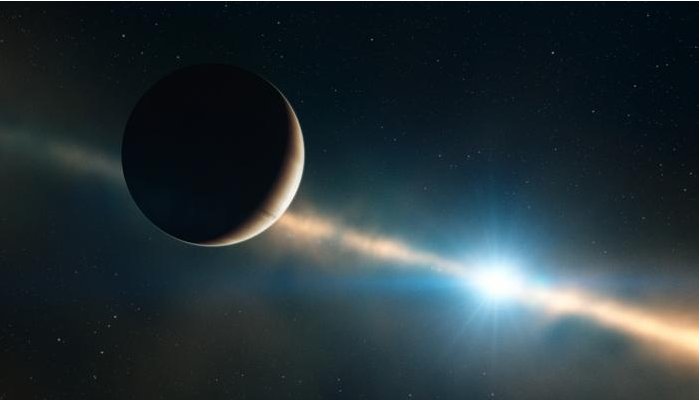
This artist’s impression shows how the planet inside the disc of Beta Pictoris may look. (source). Image /Image credit: ESO/L. Calçada
Astronomers from the Max Planck Institute for Astronomy (MPIA) in Heidelberg, Germany, the Observatoire de la Côte d’Azur (OCA), Nice, France and others observed Beta Pic b to investigate the planet’s origin and potential atmospheric variability with the recently upgraded GRAVITY+ instrument. It is mounted to the Very Large Telescope Interferometer (VLTI), operated by the European Southern Observatory (ESO) at the Paranal Site in Chile.
“The GRAVITY+ interferometric instrument is highly stable […], making it uniquely capable of high-fidelity characterization of directly imaged exoplanets”, says co-author and MPIA scientist Jonas Sauter. GRAVITY+ is an upgrade of the original GRAVITY instrument, equipped with improved adaptive optics.
The researchers applied a method proposed a few years ago to identify a planet’s birthplace inside its planet-forming disc. By measuring the relative abundance ratio between two different versions of carbon (C) locked inside carbon monoxide (CO) gas in Beta Pic b’s atmosphere, it should be possible to infer whether the planet formed outside or inside a region in the disc where carbon monoxide was present as ice. Considering the irradiation by the host star heating the disc from its centre, this would directly translate to the distance from the star at which the planet formed. The radius at which the temperature is low enough to turn gas into ice is commonly referred to as the snowline.
The technical term for the different forms of an element, such as carbon, is an isotope. Isotopes exhibit the same number of positively charged protons in the nucleus of an atom, but differ in the number of neutral neutrons, like in the two carbon isotopes 12C and 13C. As a consequence, they have slightly different masses but exhibit similar chemical properties. In space, carbon is often found in association with oxygen, forming 12CO and 13CO molecules.
Interestingly, in an earlier attempt to assess the diagnostic ratio between 12CO and the somewhat heavier 13CO, MPIA scientist Matthieu Ravet utilised the original GRAVITY instrument before its upgrade, yielding a comparatively low ratio. Still, following the rationale of the scenario mentioned above, this face value suggests that Beta Pic b might have grown in the outer disc beyond the snowline by accumulating CO ice rather than CO gas.
However, at a range of about 10 au (astronomical unit = the mean distance between the Sun and the Earth; 1 au = 149.6 million km) from the host star, Beta Pic b currently circles the disc clearly between the star and the snowline, where CO should have been present predominantly as a gas. Assuming the result was correct, this finding would indicate Beta Pic b may have migrated through the disc.
Using GRAVITY+, researchers now derived an updated and more precise 12CO/13CO abundance ratio in Beta Pic b’s atmosphere, which is significantly higher than the earlier value. While 12CO is clearly detected and its content is straightforward to determine, measuring 13CO requires a more sophisticated approach. Interestingly, the ratio is consistent with the value reported in the companion paper by González Picos et al. (2026), who employed a different instrument. This demonstrates the improved data quality GRAVITY+ delivers compared to its original design. The previous GRAVITY result was clearly affected by systematic uncertainties.
In addition, the astronomers also found subtle hints that the observed levels of flux coming from the planet vary over time. Despite its low significance, the dominating variations seem to be linked to the planet’s rotation period of approximately 8.7 hours. If true, this may hint at clouds or chemical processes in Beta Pic b’s atmosphere. However, more sensitive observations are required to confirm the result.
“The ability to accurately constrain both isotopologues and potential rotational variability using ground-based observations of a bona fide planet such as Beta Pictoris b demonstrates the exceptional data quality achieved with the updated GRAVITY+ instrument,” according to von Stauffenberg, the main author of the study.
In the proposed scheme to recover a gas giant’s birthplace, the new, more precise 12CO/13CO abundance ratio clearly shifts Beta Pic b into the warmer, inner range of the natal planet-forming disc, consistent with the planet’s current location. In addition, the ratio broadly matches values commonly found in the Solar System and the interstellar medium (ISM), which pervades the space between the stars in the Milky Way. The overwhelming majority of about a dozen young giant gas planets probed for the CO ratio show similar values.
This consistency may actually be bad news, because the carbon isotope abundance ratio doesn’t seem to be that diagnostic after all, when used as a probe to identify a planet’s distance from its host star. The most likely explanation is that any potential variance during planet formation is too small to be caught by the proposed method. This means that the 12CO/13CO ratio currently fails to be sufficiently decisive to tell us anything specific about individual planet-forming environments.
“It is still difficult to utilise 13CO as a formation tracer of giant planets, due to the uncertainties that still persist in the models and measurements,” she said.
Therefore, it is very likely astronomers are missing some crucial physics that govern CO ice chemistry in planet-forming discs. Thus, the 12CO/13CO ratio may not tell us much about the differences between the milder gaseous environments and the cold, CO-ice-laden realm after all. For now, it seems the wide-orbit giant gas planets refuse to reveal their origins. New tools that can distinguish between planet formation scenarios are needed, and GRAVITY+ may play a vital role in finding and evaluating them.
Written by Eddie Gonzales Jr. – MessageToEagle.com Staff Writer