
45-Million-Year-Old Sea Crocodile Species Discovered In The Ancient Mediterranean
Eddie Gonzales Jr. – MessageToEagle.com – The species Herugavialis cairensis was discovered in Egypt in the same rock formation from which the Great Sphinx of Giza was carved more than 4,000 years ago. In addition, the skull is missing the tip of its snout, just as the Great Sphinx is missing the tip of its nose.
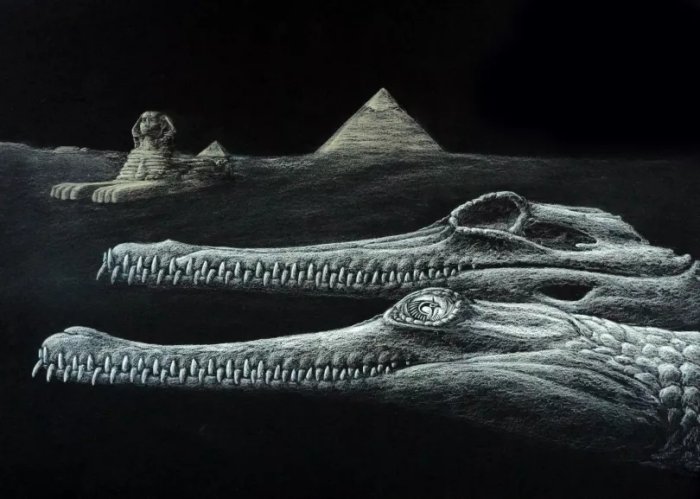
Artist’s impression of the new species. Credit: Adel Lee
“Given this coincidence, we decided to name the new crocodile after the Egyptian god Heru, who was possibly the inspiration for this monument,” said co-author Professor Philip Mannion (UCL Earth Sciences).
The new species is a gavial – one of a group of fish-eating crocodiles characterized by long, thin snouts. Only two gavial species are alive today, in the Indian subcontinent and Southeast Asia. Both are critically endangered. The fossil record shows gavials once lived nearly worldwide, particularly across South America and the Caribbean, but also in Africa, Asia and Europe, including the Isle of Sheppey in the UK, over more than 100 million years.
The research team, from the UK, Sweden, Germany and Egypt, analyzed several fossils, including a nearly complete skull, that were discovered in the 1920s in the 45-million-year-old Mokattam Formation. At the time, they were misidentified as belonging to the still-living species Tomistoma schlegelii (also known as the “false gharial”).
The researchers used CT (computed tomography) scanning to look inside the skull and identified several features that distinguished it from Tomistoma, including a raised ridge around the eyes.
Herugavialis was not the only crocodile in prehistoric Egypt, whose coastal regions were submerged by the Mediterranean at the time. The shallow marine environments that covered these regions were also home to at least two other gavial species.
Lead author Dr Paul Burke, who carried out the work while at UCL Earth Sciences and is now based at the Swedish Museum of Natural History, said: “Gavials are critically endangered today, but they have so much history that few people know about. They lived all over the world, from Europe and the Americas to Asia.
“A number of gavials lived in the Mediterranean region. In fact, throughout much of the last 50 million years, this region hosted a high diversity of crocodiles, with a shallow sea covering much of what is now southern Europe and northern Africa.
“This crocodile diversity fluctuated over time, seemingly corresponding to changes in global temperature and sea level. Then, about six million years ago, the Mediterranean got cut off from the Atlantic Ocean and dried up, losing much of its water, resulting in the loss of all crocodiles in the region.”
The skull of Herugavialis is kept at the State Museum of Natural History in Stuttgart and was first described in a 1927 study by Lorenz Müller.
Written by Eddie Gonzales Jr. – MessageToEagle.com Staff Writer
Related Posts
-
 Researchers Replicate The Bite Of Ancient Marine Predators
-
 Predatory Dinosaurs Such As T. rex Sported Lizard-Like Lips – Study Suggests
-
 Earliest Long-Snouted Fossil Crocodile From Egypt Reveals African Origins Of Seagoing Crocs
-
 The World’s Oldest RNA Extracted From Woolly Mammoth
-
 Iconic Diplodocus Discovered In Spain – First Evidence Outside North America
-
 Hollow Bones That Let Dinosaurs Become Giants Evolved At Least Three Times Independently
-
 ‘Teen’ Pachycephalosaur From Mongolia’s Gobi Desert Lived Around 108 Million Years Ago
-
 Have Paleontologists Solved The Weird 300 Million-Year-Old Tully Monster Mystery?
-
 Last Supper Of 15-Million-Year-Old Freshwater Fish
-
 Tyrannosaur Teeth Discovered In Bexhill-On-Sea With Help Of Retired Quarryman

