
The Gas Around Milky Way’s Central Black Hole Is Rich In Metals – Study
Eddie Gonzales Jr. – MessageToEagle.com – Research advances understanding of the processes that fuel our galaxy’s supermassive black hole.
Researchers at McGill University’s Trottier Space Institute found that the gas orbiting Sagittarius A (Sgr A*), the supermassive black hole at the center of the Milky Way, is metal-rich.
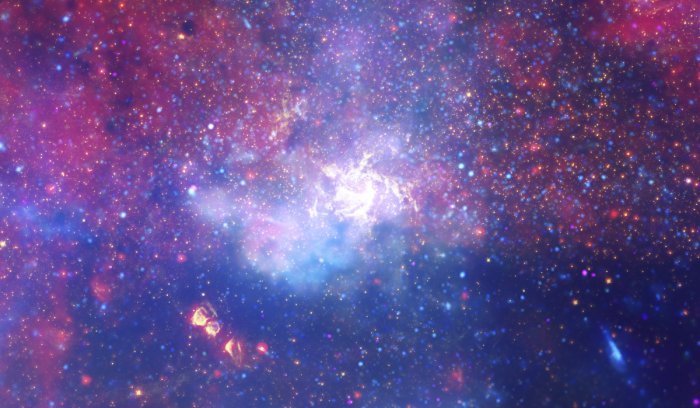
Image by NASA, ESA, SSC, CXC, STScI.
They said the metal enrichment likely came from stars that exploded and released material into the black hole’s surroundings over time.
The team also learned this gas is similar in composition to many of the stars in the black hole’s orbit, suggesting the gas and stars may have formed together.
Sgr A* is closer to Earth, and therefore easier to see, than any other supermassive black hole. These findings could advance understanding of how metals are distributed around supermassive black holes in more distant galaxies, as well as the processes that supplied Earth with many of these elements, the researchers suggested.
In astronomy, metals include any element (e.g., carbon, oxygen, iron or gold) heavier than helium and hydrogen. Their presence influences how quickly gases cool, which in turn influences how readily the gas can be drawn into a black hole, the researchers said.
“We know there’s a black hole at the center of our galaxy pulling material into itself, but we see that it’s eating a lot less material than other supermassive black holes, and more slowly,” said Nicole Ford, lead author and a PhD student in Professor Daryl Haggard’s research group in the Department of Physics. “Part of understanding why this is happening means looking at the properties of the materials available for it to consume, including gas, dust and the stars orbiting around it.”
Data from the James Webb telescope

Gas swirling around the center of our Galaxy. The animation shows the gas at different infrared wavelengths, demonstrating how it moves around the black hole Sagittarius A*, marked by a white star icon. Image credit: JWST, NASA, STScI, CSA, ESA, ESO/VLT.
The study was conducted with data gathered using the James Webb Space Telescope (JWST), launched five years ago.
The telescope measures infrared light across a wide range of wavelengths with unprecedented spectral and spatial resolution, allowing the team to distinguish the heat signatures of multiple gas clouds orbiting near the black hole. It also enabled them to precisely measure the metal composition of each gas cloud.
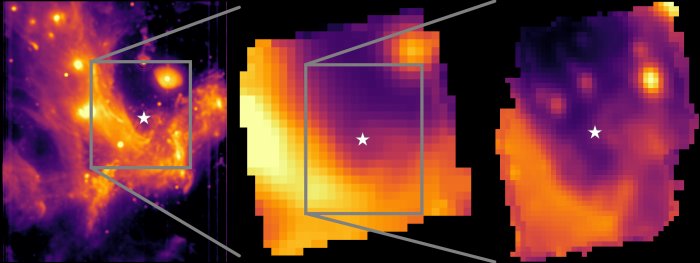
Three views of the center of our Galaxy in infrared light, with the location of the black hole Sagittarius A* marked by a white star. From left to right, the images zoom in and show the region at different wavelengths. Credits: JWST, NASA, STScI, CSA, ESA, ESO/VLT. Additional image data courtesy of Rainer Schödel (Dinh et al., 2024).
The findings complement a recent study led by Banting Postdoctoral Fellow Mayura Balakrishnan, which tested whether the gas preserved evidence of previous bursts of energy from the black hole. The results found that local conditions shape the gas emission, making it difficult to isolate the black hole’s influence. Rather than ruling out past outbursts, this shows that the surrounding gas cannot provide a reliable history of the black hole’s activity.
Ford said that understanding how the black hole attracts material will require comparing these observations with simulations of how gas evolves over longer timescales.
Written by Eddie Gonzales Jr., MessageToEagle.com Staff Writer
Related Posts
-
 Sun-Like Star EK Draconis: Fiery Dragon’s Breath May Scorch Young Planets
-
 Spectacular Galaxy NGC 1559 Featured By Hubble Space Telescope
-
 Evidence Of Cosmic Explosions With Missing Black Holes – New Study
-
 Liquid Water On Exomoons Of Free-Floating Planets
-
 Unraveling Secrets Of Stellar Halos With Subaru Telescope
-
 Three Supermassive Black Holes – Each With A Mass Of 90 Million Suns Discovered In Irregular Galaxy NGC 6240
-
 Hot Jupiters And Missing Water Mystery
-
 Star J0815+4729 Identified As One Of The First Stars Formed In The Milky Way
-
 On April 7, NASA’s OSIRIS-REx Mission Says Farewell To Asteroid Bennu Before Departing For Earth
-
 ‘Diamond Rain’ On Giant Icy Planets – More Common Than Previously Thought?

