
Amasia – New Future Supercontinent
Question: When will a new supercontinent form on Earth?
Answer: Scientists have already named our next new supercontinent. It’s name is Amasia.
Geological record reveals that in the past 2 billion years, there have been three supercontinents. The oldest known supercontinent, Nuna, came together about 1.8 billion years ago. The next, Rodinia, existed about 1 billion years ago, and the most recent, Pangaea, came together about 300 million years ago.
See also: Stunning View Of What Supercontinent Pangea Looks Like Mapped With Modern Borders
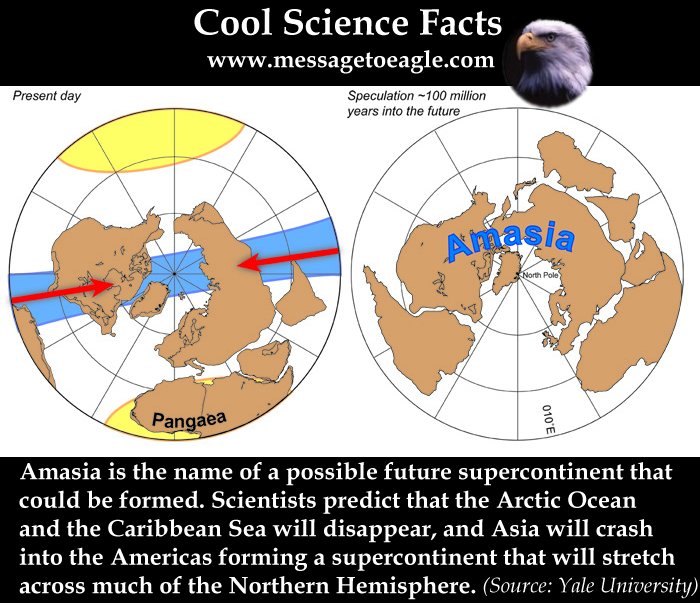
Amasia, is a possible future supercontinent that could be formed. Scientists predict that the Arctic Ocean and the Caribbean Sea will disappear, and Asia will crash into the Americas forming a supercontinent that will stretch across much of the Northern Hemisphere.
This prediction relies mostly on the fact that the Pacific Plate is already subducting under Eurasia and North America, a process which if continued will eventually cause the Pacific to close.
Previous studies suggest that supercontinents last about 100 million years or so before they break apart, setting the pieces adrift to start another cycle.
MessageToEagle.com
Source:
Related Posts
-
 Silbo Gomero: Whistling Language Used On The Canary Islands
-
 Our Universe Is A Gigantic And Wonderfully Detailed Holographic Illusion
-
 Is There Anything I Can Do To Keep My Brain Healthy In Older Age?
-
 Huge Molten Iron River Is Moving Rapidly Beneath Our Feet – It’s Heading Towards Europe
-
 Mamenchisaurus Hochuanensis: Dinosaur With The Longest Neck For Its Body Size
-
 How Long Does Human Brain Develop?
-
 Collision Between The Milky Way And Andromeda Galaxy
-
 Could A Huge Earthquake Sink A Whole Country?
-
 Himiko Cloud: Most Massive Object In The Early Universe
-
 Great Attractor: Mysterious Gravitational Anomaly Beyond Hydra-Centaurus Supercluster

