
Tristan da Cunha: The Remotest Inhabited Island
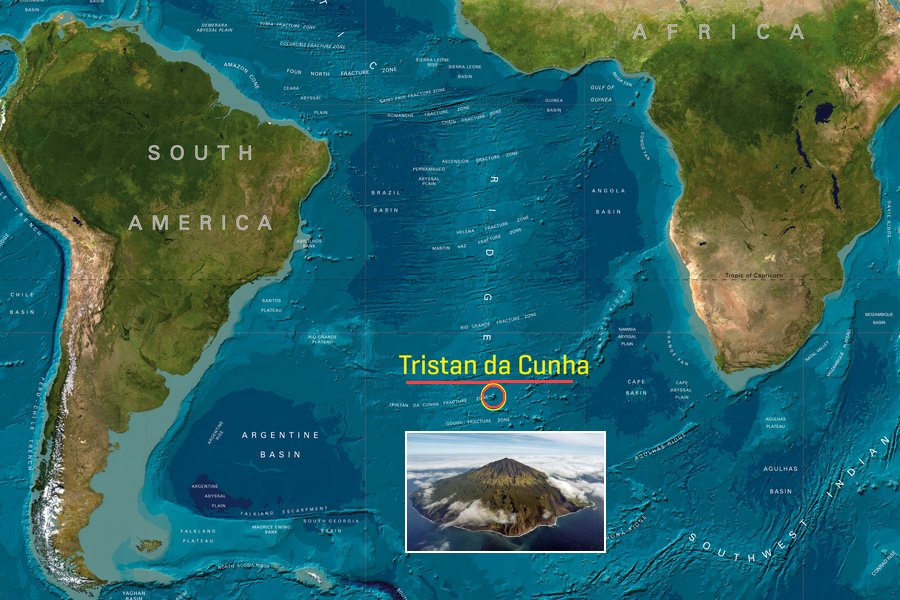
MessageToEagle.com – Tristan da Cunha is a 38-square-mile volcanic outpost and the remotest inhabited island in the world, according to the Guinness Book of Records.
It’s situated 1,510 miles southwest of its nearest neighbor, St. Helena, and 1,950 miles west of Africa. Discovered by the Portuguese admiral of the same name in 1506, and settled in 1810, the isle belongs to Great Britain and has a few hundred residents.
Coming in a close second – and often wrongly cited as the most distant land – is Easter Island, located 1,260 miles east of its nearest neighbor, Pitcairn Island, and 2,300 miles west of South America.
See also: Amasia – New Future Supercontinent
The mountainous 64-square-mile island was settled around the 5th century, supposedly by people who were lost at sea. They had no contact with the outside world for more than a millennium, giving them plenty of time to construct more than 1,000 enormous stone figures, called moai, for which the island is most famous.
On Easter Sunday, 1722, however, Dutch settlers moved in and gave the island its name. Today, 2,000 people inhabit the Chilean territory. They share one paved road, a small airport, and a few hours of television per day.
MessageToEagle.com
Expand for referencesReferences:
Related Posts
-
 Richat Structure: Mysterious Ancient Eye Of The Sahara Desert – No One Knows Why Is It Nearly Circular
-
 World’s Largest Underground Lake Lies Inside The Dragon’s Brеаth Cave
-
 World’s Longest Underground River Flows Beneath The Yucatán Peninsula
-
 Beautiful Ladybird Spider Is One Of Britain’s Rarest Spiders
-
 Does Weightlessness Affect Astronauts’ Dreams and Sleep?
-
 El Niño And Its Effects On The Planet
-
 Ilha de Queimada Grande: The Snake Island Is World’s Deadliest Island
-
 What Is The Color Of The Sky On An Exoplanet?
-
 The Higgs Particle Could Have Ended The Universe By Now – Here’s Why We’re Still Here
-
 Amasia – New Future Supercontinent

