
‘Little Lion’ Galaxy Could Shed Light On Big Bang, New Study
MessageToEagle.com – Astronomers at Indiana University recently found that a galaxy nicknamed Leoncino, or “little lion,” contains the lowest level of heavy chemical elements, or “metals,” ever observed in a gravitationally bound system of stars.
The Little Lion galaxy (also called Leoncino) that is located 30 million light-years from Earth in the constellation Leo Minor, may shed light on the nature of the Big Bang. The galaxy is a blast from the distant past of the visible universe.
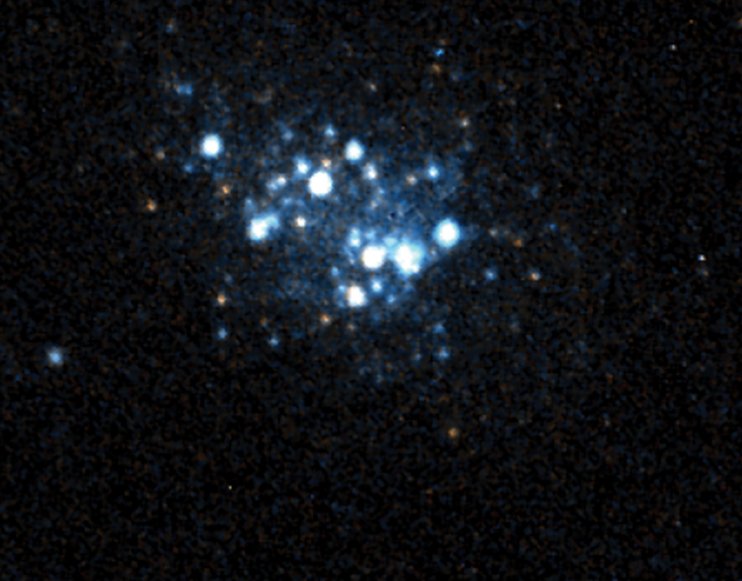
“Finding the most metal-poor galaxy ever is exciting since it could help contribute to a quantitative test of the Big Bang,” Professor John J. Salzer of Indiana University Bloomington said.
“There are relatively few ways to explore conditions at the birth of the universe, but low-metal galaxies are among the most promising.”
To find these low-metal galaxies, however, astronomers must look far from home.
Our own Milky Way galaxy is a poor source of data due to the high level of heavier elements created over time by “stellar processing,” in which stars churn out heavier elements through nucleosynthesis and then distribute these atoms back into the galaxy when they explode as supernovae.
“Low metal abundance is essentially a sign that very little stellar activity has taken place compared to most galaxies,” Alec S. Hirschauer, a graduate student in the IU Bloomington College of Arts and Sciences’ Department of Astronomy, said.

Leoncino (Officially, the “little lion” is named AGC 198691) is considered a member of the “local universe,” a region of space within about 1 billion light years from Earth and estimated to contain several million galaxies, of which only a small portion have been cataloged.
Aside from low levels of heavier elements, Leoncino is unique in several other ways.
A so-called “dwarf galaxy,” it’s only about 1,000 light years in diameter and composed of several million stars.
The Milky Way, by comparison, contains an estimated 200 billion to 400 billion stars.
A galaxy previously recognized to possess the lowest metal abundance was identified in 2005; however, Leoncino has an estimated 29 percent lower metal abundance.
Leoncino is also blue in color, due to the presence of recently formed hot stars, but surprisingly dim, with the lowest luminosity level ever observed in a system of its type.
“We’re eager to continue to explore this mysterious galaxy,” said Salzer, who is pursuing observing time on other telescopes, including the Hubble Space Telescope, to delve deeper into this fascinating object. “Low-metal-abundance galaxies are extremely rare, so we want to learn everything we can.”
The study appears in the Astrophysical Journal.
MessageToEagle.com
Expand for referencesReferences:
Related Posts
-
 Star That Survived A Supernova
-
 Milky Way May Be Surrounded By 80 Up To 100 More Satellite Galaxies Orbiting At Close Distances
-
 The Edge Of The Milky Way’s Star-Forming Disc – Revealed
-
 Is It Possible That Alien Worlds Orbit A Supermassive Black Hole?
-
 Does This Exoplanet Have A Sibling Sharing The Same Orbit?
-
 Questions And Answers About The First Image Of Supermassive Black Hole In M87
-
 Asteroid Bennu’s Mysterious Particle Events – Explained
-
 Cosmic Mystery – What Huge Object Caused The Hole In One Of Saturn’s Rings?
-
 Hubble Finds A Protoplanet That Could Upend Planet Formation Models
-
 Weather Map Of Distant Planet-Like Object With Clouds Of Hot Dust And Droplets Of Molten Iron

