
Ancient Disc-Shaped Copper Ingots Found In Shipwreck At Bulgaria’s Sea Coast
Conny Waters – MessageToEagle.com – A set of ancient copper ingots shaped as discs have been found in a shipwreck near a Black Sea cape in Southeast Bulgaria.

The disc-shaped copper ingots found in a Late Bronze Age shipwreck are seen here, with a photo of Bulgaria’s Maslen Nos cape in the background. Photo: Burgas Regional Museum of History
The discovery sheds light on the maritime trade of the Ancient Thracians during the Late Bronze Age (second half of the 2nd millennium BC).
The artifacts are similar to those recovered from two famous ancient shipwrecks found on the Mediterranean coast of Turkey, at Gelidonya and Uluburun.
The disc-like Late Bronze Age copper ingots in question have been discovered inside a Late Bronze Age shipwreck near Bulgaria’s Maslen Nos, i.e. “Oily Cape”, alongside with other artifacts.
According to Archaeology in Bulgaria, the Late Bronze Age copper ingots were part of the load carried by an ancient ship whose wreck has been found near Bulgaria’s Maslen Nos cape, close to the town of Primorsko, Burgas District.
The ancient copper ingots in question differ from Bronze Age copper ingots discovered in Bulgaria’s interior, and, instead, are similar to copper ingots discovered in far more famous shipwrecks on the coast of Southern Anatolia, Turkey, at the Gelidonya Cape and the Uluburun Cape.
 A map showing the locations of the Uluburun and Gelidonya shipwrecks in Turkey and the Maslen Nos shipwreck in Bulgaria – disc-shaped Late Bronze Age copper ingots have been discovered at all three places. Map: BAS Library
The Gelidonya shipwreck is that of a Late Bronze Age (from ca. 1,200 BC) ship from Mycenae. It was located at a depth of 27 meters (89 feet) in 1954 and started to be excavated in 1960. In addition to disc-shaped copper ingots, the Mycenaean shipwreck at Turkey’s Gelidonya Cape also contained tin ingots, merchant weights, and Mycenaean pottery.
The Uluburun Cape shipwreck, also on Turkey’s southern, Mediterranean coast, also dates back to the Late Bronze Age, more specifically, the 14th century BC.
It was discovered in 1982 of between 8 and 17 meters (26 – 56 feet), and was explored between 1984 and 1994.
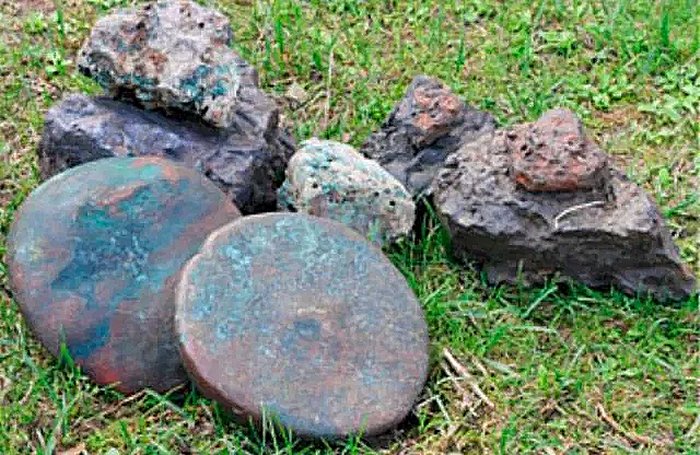
The disc-like copper ingots found in the Late Bronze Age shipwreck at Bulgaria’s Maslen Nos cape. Photo: Burgas Regional Museum of History
The discovery and characteristics of the disc-like Late Bronze Age copper ingots found on Bulgaria’s Black Sea coast at Maslen Nos were presented in Bulgaria’s Burgas by archaeologist Miroslav Klasnakov in February 2020.
“Analogous to similar finds from explored shipwrecks at the capes of Gelidonya and Uluburun in Turkey, the “copper cakes” from the Bulgarian Black Sea coast are also dated to the Late Bronze Age,” archaeologist Miroslav Klasnakov said.
“Unlike the ingots [of the same period], which are shaped like a stretched-out ox skin, found in [the interior] of today’s Bulgaria, however, relatively far to the west of the sea coast, these ones [from Maslen Nos] have a disc-like shape, and are found only beneath the water.”
The ancient copper ingots found at Maslen Nos shed light on the maritime trade contacts between the Ancient Thracian tribes, which inhabited the region of the Strandzha Mountain in today’s Southeast Bulgaria and Northeast European Turkey.
At the same time, the artifacts offer insights into the mining of metals and metallurgy in the Strandzha Mountain during the Late Bronze Age.
Written by Conny Waters – MessageToEagle.com – AncientPages.com Staff Writer
Related Posts
-
 Disappearance Of Neanderthals: Were Inbreeding And Demographic Shifts Responsible?
-
 ‘Green’ Saudi Arabia Was Home To A 350,000-Year-Old Human Settlement
-
 What Was Asphalt Doing On A 9,000-Year-Old Skull Discovered In The Judean Desert
-
 Rare Find Provides New Insight Into Etruscan Life Under Rome
-
 Mystery Of How Ancient Maya Accurately Predicted Solar Eclipses Solved
-
 Mystery Of The ‘Griffin Warrior’ Grave: Ancient Greek Lord Of The Rings Discovery
-
 Dragon Man: New Species Of Human May Replace Neanderthals As Our Closest Relative
-
 World’s Oldest Depiction Of Plants Cooked In Ancient Pottery Discovered
-
 Were Mysterious Fire Pits Found At La Quemada Used As Giant Torches?
-
 Runes Were Just As Advanced As Roman Alphabet Writing – New Study

