
“Bright Spots”: Nine Successful Peatlands And How They Give Positive Results Thanks To Proper Restoration
Eddie Gonzales Jr. – MessageToEagle.com – A recent international study in Ambio shares nine peatland success stories from different countries, giving a more hopeful view of the climate and biodiversity challenges.
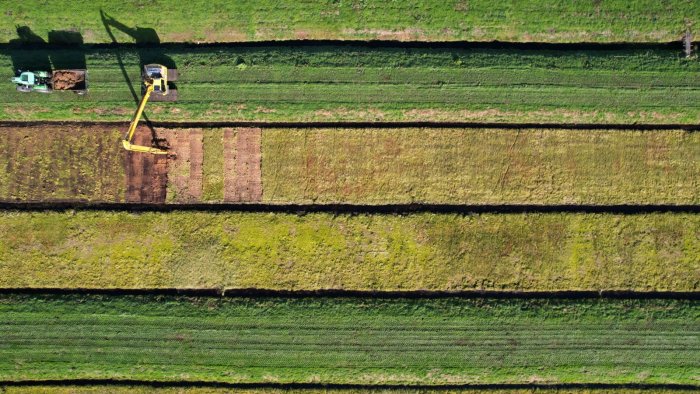
Sphagnum paludiculture harvest: the sustainable farming of peat moss on wet or rewetted peatlands. Photo: Ralph Temmink
While peatlands are often discussed in terms of degradation, greenhouse gas emissions, and biodiversity loss, the study shows that conservation, rewetting, restoration, and sustainable use are already delivering tangible results.
The study was co-led by researchers from the Copernicus Institute of Sustainable Development at Utrecht University and the University of Greifswald, partner in the Greifswald Mire Centre and the Collaborative Research Centre WETSCAPES2.0.
“Peat researchers spend much of their time documenting loss, degradation and the urgent need for action,” says co-leading author Renske Vroom from the University of Greifswald and WETSCAPES2.0. “Those realities remain important, but they are only part of the story. We wanted to highlight examples that show what is possible when people work together to protect and restore peatlands.”
Bright spots for peatland action
The authors use the term “bright spots” to describe initiatives that have achieved notable successes in peatland conservation, rewetting, restoration, sustainable use or public engagement. The nine examples range from large-scale rewetting programmes in Indonesia and community-led restoration in Malaysia to wet agriculture initiatives and artistic projects such as Turba Tol in Tierra del Fuego.
Together, the examples show that there is no single pathway to successful peatland restoration. Instead, progress depends on solutions that fit local ecological, social and political contexts. Many of the bright spots are built on long-term collaboration between researchers, policymakers, land managers, local communities and Indigenous knowledge holders. “The key to peatland restoration is working together,” says Ralph Temmink, Assistant Professor of Ecology and Nature Restoration at Utrecht University and co-author of the study. “The most successful projects combine science, policy and local knowledge to create solutions that last.”
Keeping peatlands wet and productive
One approach highlighted in the study is paludiculture: the productive use of wet and rewetted peatlands. Unlike conventional agriculture on drained peatlands, paludiculture keeps peat soils wet while allowing them to remain economically productive. This helps reduce greenhouse gas emissions from decomposing peat while creating new opportunities for landowners and local communities. Positive examples are found in Germany, where with researchers, farmers and businesses work together to establish new value chains based on wetland biomass, including materials for packaging, textiles and construction.
From local success to global action
The study shows that peatland restoration can succeed under very different conditions and deliver benefits for climate protection, biodiversity and local communities. The findings provide lessons for future policy and restoration programmes at a time when countries are working to meet climate and biodiversity targets.
“We hope these examples encourage people to look beyond the challenges and recognise that progress is already happening,” says Vroom. “At the same time, they remind us of the urgency of scaling up action.”
Written by Eddie Gonzales Jr. – MessageToEagle.com Staff Writer
Related Posts
-
 Forest Damage In Europe To Rise By Around 20% By 2100 Even If Warming Is Limited To 2°C
-
 Feedback Loops Accelerate Warming, Other Atmospheric Changes In Arctic
-
 Grasslands Vanish At Rapid Rate – New Study Finds
-
 A Variety Of “Snowflakes” That Can Be Observed In The Ocean
-
 Baltic Sea: Record Low Sea Levels – Will There Be A Major Inflow Of Saltwater From The North Sea?
-
 Adrift Like Shackleton: Robot Float Survives Antarctic Ice
-
 Arctic River Deltas At Risk: Rapid Climate Change Threatens Carbon Storage Function
-
 Floods, Coastal Erosion, Sea-Level Rise – Europe Must Prepare Practical And Effective Strategy
-
 HKUST Researchers Unlock Why Arctic Ice Melt Paused
-
 How Climate Change Contributed To The Fall Of The Tang Dynasty

