
Floods, Coastal Erosion, Sea-Level Rise – Europe Must Prepare Practical And Effective Strategy
Eddie Gonzales Jr. – MessageToEagle.com – When floods, coastal erosion, or rising sea levels threaten homes and infrastructure, European countries are turning to managed retreat far more often than many people realize. However, this managed retreat is not a last resort, but a practical, increasingly common strategy for protecting communities and reducing long-term risk.
A new German–Dutch study led by Kiel University in collaboration with the Dutch research institute Deltares systematically documents the extent and diversity of such measures in Europe for the first time.
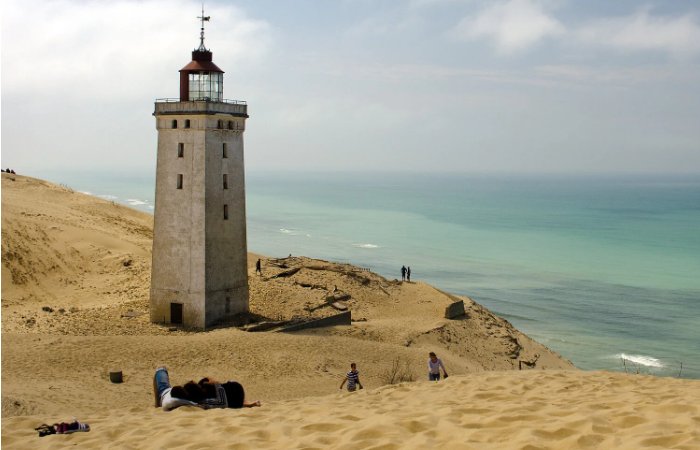
The Rubjerg Knude lighthouse in Denmark, near Løkken, was moved inland at great expense in 2019. This measure was taken by the North Jutland region as part of a planned retreat strategy. In a new study, CAU researcher Dr. Claudia Wolff investigated this and other cases together with Dutch colleagues. The image (from 2014) shows the growing threat to the landmark posed by coastal erosion. Credit: Kiel University
The researchers identified 44 managed retreat projects across eleven European countries, including cases in France, the Netherlands, Denmark, and the United Kingdom. In total, more than 8,700 households are or have been involved. The cases range from the relocation of individual buildings to the relocation of entire communities. However, the analysis also shows that, relative to growing flood risks, the overall scale remains limited and that managed retreat is rarely embedded in long-term adaptation strategies.
Increasing pressure on technical flood protection
Managed retreat refers to the planned and government-supported relocation of homes, communities or infrastructure away from areas exposed to hazards such as sea-level rise, coastal erosion, flooding or extreme rainfall. In Europe, flood risk management has traditionally relied heavily on technical protection measures such as dikes or other engineering structures. However, these systems are coming under increasing pressure as climate risks intensify.
To identify managed retreat initiatives across Europe, the researchers conducted a multilingual review of scientific literature, policy reports and media sources. This approach revealed a much broader set of cases than previously documented in academic research.
The study reveals a clear pattern: most managed retreat initiatives were implemented after major flood events. Disasters often create the political and societal momentum needed to initiate relocation measures, whereas anticipatory planning frameworks that consider managed retreat as a strategic adaptation option remain comparatively rare.
“Managed retreat is not a one-size-fits-all solution,” says lead author Dr. Claudia Wolff from Kiel University. “However, it should be part of the climate adaptation portfolio. Preparing governance frameworks and participation processes in advance, rather than improvising after disasters, can lead to better outcomes for communities.”
The geographer is currently developing future visions for future coastal adaptation strategies together with affected communities in the Baltic Sea Region as part of the RECOAST-VISION project, funded by the Volkswagen Foundation.
Managed retreat is also a social and cultural process
The study also shows that managed retreat is far more than a technical or planning measure. Retreat processes affect social relationships, local identities and future land use.
In several European cases, relocations were accompanied by the preservation or relocation of historic buildings. In other places, memorial sites were created to commemorate abandoned settlements. Former residential areas have also been restored as natural floodplains or transformed into public spaces such as parks and cycling paths.
One example from the Netherlands is the “Room for the River” project in the Noordwaard area near De Biesbosch National Park in North Brabant. A largely embanked area previously used for intensive agriculture was transformed into an active floodplain that can store water during high river levels and reduce flood risk in surrounding regions. Between 2006 and 2016, around 75 houses were relocated. A notable feature of the project was that residents could choose whether to stay or relocate. Some buildings were adapted to the new conditions, while others opted to move elsewhere.
Another example comes from Denmark. In 2019, the Rubjerg Knude Lighthouse was relocated after coastal erosion and shifting dunes brought it dangerously close to the edge of a cliff. In a complex engineering operation, the lighthouse was moved around 80 metres inland on rails, preserving an important cultural landmark and tourist attraction.
Success factors: participation, transparency and trust
Public debates about retreat often focus on losses, such as the loss of home, property or community ties. However, the study shows that the process of planning, communicating and implementation plays a decisive role in how such projects are perceived.
By comparing the 44 case studies, the researchers identified five key factors that influence the process and outcomes of managed retreat projects: the compensation offered, early and continuous participation of those affected, strategic timing of the project, clear responsibilities and leadership by government authorities, and post-retreat land use. Projects tended to be more successful when compensation was transparent and adequate, when communities were involved from an early stage, and when trusted leadership facilitated dialogue. Conversely, unclear responsibilities, insufficient compensation or top-down decision-making often led to conflicts and delays.
A call for forward-looking and strategic climate adaptation
Despite increasing climate risks, managed retreat in Europe remains largely reactive and relatively small in scale compared to the growing number of people exposed to flooding. The authors emphasize that managed retreat should not be seen as a universal solution, but as one option within a broader portfolio of climate adaptation measures.
“Managed retreat can be a very effective form of climate adaptation,” says Dr Caroline Kraan from the Deltares research institute in Delft and co-author of the new study.
“Usually it’s not the first measure to be considered. However, in some cases it’s the only option left, such as the relocation of a lighthouse on eroding cliffs in Denmark. In other cases we’ve seen that relocating a few can result in a significant flood risk reduction for many, for example when a river floodplain could be restored in the Netherlands that helped protect an upstream city.”
Given the increasing impacts of climate change in Europe, the researchers therefore call for managed retreat to be more systematically considered in national and regional climate adaptation and spatial planning strategies.
Written by Eddie Gonzales Jr. – MessageToEagle.com Staff Writer
Related Posts
-
 The Mediterranean Sea Is Rapidly Changing Under Ongoing Climate Change
-
 Why Tree Lines Don’t Simply Rise With Global Warming
-
 How Climate Change Contributed To The Fall Of The Tang Dynasty
-
 Surprising Findings: How Did Earth’s Most Powerful Ocean Current Form?
-
 Forest Damage In Europe To Rise By Around 20% By 2100 Even If Warming Is Limited To 2°C
-
 Most People Believe Climate Change Primarily Affects Others
-
 Grasslands Vanish At Rapid Rate – New Study Finds
-
 HKUST Researchers Unlock Why Arctic Ice Melt Paused
-
 Does Planting Trees Help Cool The Planet?
-
 Mountain Plants Make Their Own Steady Living Conditions

